



Updated data from both the FHFA and the S&P CoreLogic Case-Shiller indices this week confirm what many analysts have been expecting: home prices are still rising year-over-year, but the pace of growth is slowing to levels not seen in over a decade. While the housing market is far from declining broadly, the deceleration is becoming increasingly evident across most regions.
FHFA House Price Index (Seasonally Adjusted)
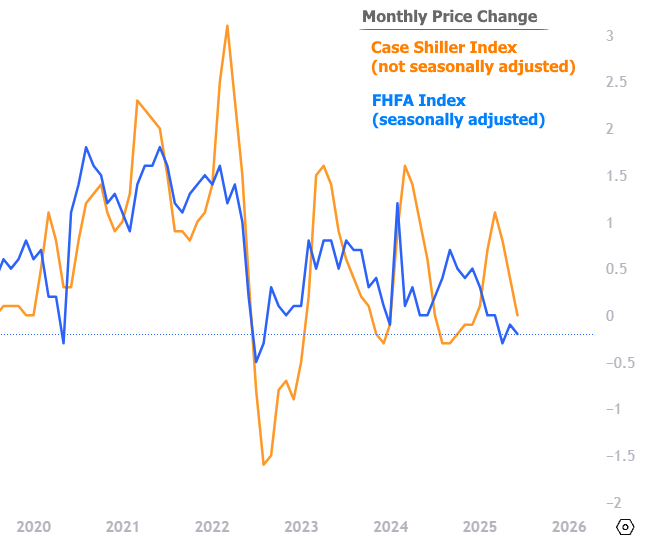
- June MoM: −0.2% (May revised to −0.1% from unchanged)
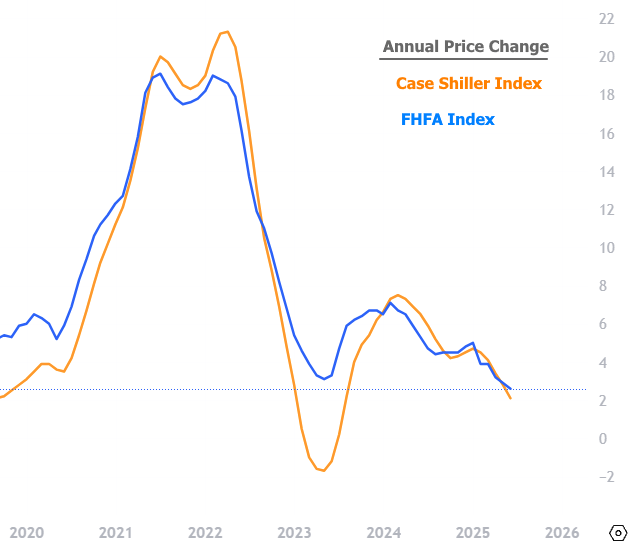
- YoY: +2.9% from June 2024 to June 2025
- All nine census divisions showed positive annual growth, ranging from +0.7% in the Mountain division to +6.7% in the Middle Atlantic.
The FHFA data indicates that price gains continue, but the slowdown is significant. Two consecutive months of slight declines in seasonally adjusted values suggest that the red-hot pace of growth seen in prior years is firmly behind us.
Case-Shiller National Index (Unadjusted)
- YoY: +1.9% in June, down from +2.3% in May
- MoM (Non-Seasonally Adjusted): +0.4%
- MoM (Seasonally Adjusted): −0.3%
- 20-City Composite (SA): −0.3% MoM; +2.1% YoY
- 10-City Composite (SA): −0.1% MoM; +2.6% YoY
The Case-Shiller index, which tends to be more sensitive to short-term swings, shows a typical spring and summer uptick in unadjusted readings, but when seasonality is factored in, the underlying trend points down. The 20-city and 10-city composites reflect this moderation in growth, highlighting a clear deceleration even in some of the traditionally hottest markets.
Longer-Term Trends
- FHFA’s +2.9% YoY growth is the slowest annual increase since 2012.
- Case-Shiller’s +1.9% YoY gain is the lowest in more than two years.
Looking at the year-over-year figures removes much of the seasonal noise, offering a clearer picture of the overall trajectory. Both indices now tell the same story: home price appreciation is slowing, and markets are adjusting to a combination of higher borrowing costs, elevated inventory in some regions, and muted buyer demand.

Key Takeaways
- Prices are still higher than they were a year ago, but the rate of growth is easing.
- The deceleration is most pronounced in areas that saw the strongest prior gains, signaling a potential plateau rather than a sudden drop.
- For buyers, this could mean a more stable market with fewer rapid price jumps. For sellers, it suggests that listing prices may need to be carefully calibrated to match current demand.

Bottom line: home prices continue to rise, but the momentum that propelled markets in recent years has slowed considerably. The coming months will be critical in determining whether this trend stabilizes near current levels or signals the start of a more pronounced cooling phase. For direct financing consultations or mortgage options for you visit 👉 Nadlan Capital Group.
