


Key Points
- Sluggish job growth and a shaky economy are ramping up expectations for the Federal Reserve to reduce interest rates.
- Market sentiment has shifted sharply as employment indicators show growing weakness.
- Uncertainty in the labor market may influence businesses’ investment and hiring decisions in the coming months.
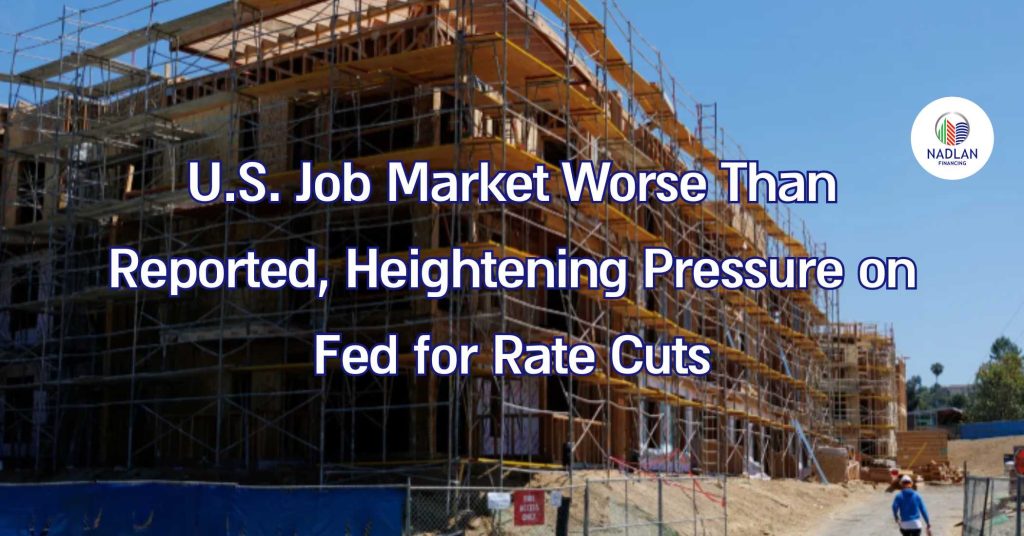
A construction worker climbs scaffolding at a multi-unit residential housing site in Encinitas, California, U.S., July 28, 2025. REUTERS/Mike Blake
With the labor market showing more strain than initially believed, pressure is mounting on the Federal Reserve to begin cutting interest rates, and traders are now pricing in a reduction at all three of the Fed’s remaining meetings this year.
The Bureau of Labor Statistics (BLS) reported on Tuesday that the U.S. economy added 911,000 fewer jobs than previously reported over the year leading up to March 2025. Further downward adjustments suggest the cumulative decline in payroll growth over the past 16 months is closer to 1.2 million, painting a far weaker picture of employment than official tallies had indicated.
Economists say the magnitude of the revisions will draw immediate attention from the Federal Open Market Committee (FOMC) when it meets next week. The data also lends support to President Donald Trump’s long-standing criticism that the central bank has been “too slow” in responding to economic shifts.
“Had Fed officials seen this data in real time, policy rates would already be lower,” said Citigroup economist Andrew Hollenhorst, referencing the BLS benchmark payroll revisions. Hollenhorst added that the updated figures could warrant a substantial half-point cut at the FOMC’s Sept. 17 decision. Still, he believes Fed Chair Jerome Powell is more likely to secure consensus for a more measured quarter-point reduction, signaling that rate cuts could continue at subsequent meetings, potentially including October.
Market expectations have quickly adjusted. Traders now fully anticipate a 25-basis-point cut next week, while also weighing a slim possibility of a larger half-point reduction. According to the CME Group’s FedWatch tool, the market now sees cuts at each of the remaining FOMC sessions for 2025 a sharp pivot from just a week ago, when the chance of multiple reductions seemed modest.
Analyzing the Numbers
While the Fed is not obligated to follow market sentiment, it monitors expectations as part of its broader economic assessment.
“The U.S. economy is significantly weaker than it appears, and it’s been in this state for some time,” said Heather Long, chief economist at Navy Federal Credit Union and a former Fed correspondent for the Washington Post. “The Federal Reserve needs to act aggressively with rate cuts this fall. Simultaneously, the White House must finalize a trade agreement with China to restore confidence. Without clarity, businesses are unlikely to expand or hire, leaving millions of Americans in continued uncertainty.”
Fed officials may still move cautiously, given that some economic indicators remain mixed and the market continues to absorb the ongoing impact of tariffs and geopolitical risks.
Moreover, some analysts suggest the revised data could slightly exaggerate labor market weaknesses. Goldman Sachs, for example, argued that the actual payroll shortfall may be closer to 550,000, based on its proprietary modeling and high-frequency economic indicators. While the bank acknowledged a significant softening in employment conditions, it noted that the benchmark revisions alone provide limited insight into the labor market’s current health.
Still, the recent data compound earlier signs of weakness: nonfarm payrolls rose by just 22,000 in August, and a New York Fed survey revealed historically low confidence among workers about their ability to secure new employment if needed. Other surveys have similarly indicated heightened worker anxiety and declining sentiment.
Political Reactions and Implications
From Washington, the White House seized on the news to renew calls for aggressive rate cuts. “Much like the BLS has failed to provide accurate data in a timely manner, Jerome ‘Too Late’ Powell has exhausted his excuses,” White House press secretary Karoline Leavitt said in a statement. “The Fed must act immediately to cut rates and support American workers.”
Economists warn that the implications of a weak labor market are broad. Slower job growth may reduce consumer spending, constrain household incomes, and ultimately weigh on GDP growth in the coming quarters. Investors, meanwhile, are increasingly looking to the Fed for guidance on interest rates, with expectations of rate cuts acting as a key driver for equity markets.
As policymakers digest the full scope of the labor revisions, all eyes will be on the FOMC next week. Whether the Fed opts for a moderate or aggressive approach, the decisions made in the coming weeks could set the tone for U.S. economic stability heading into 2026. For direct financing consultations or mortgage options for you visit 👉 Nadlan Capital Group.