



Realtor.com’s latest report, “What Is Luxury?”, illustrates that the threshold for luxury homes in the U.S. has climbed dramatically over the past decade. In 2016, a home valued at $796,922 was considered luxury. Today, that bar has surged to approximately $1.3 million, with homes priced closer to $1.6 million now needed to achieve a similar level of status.
“While a million-dollar home still represents an important milestone, it no longer qualifies as true luxury nationwide,” explained Danielle Hale, Chief Economist at Realtor.com. “Luxury today is often about exclusivity and relative standing in a local market. In some areas, a high-end home can command multiple times the price of a typical property, reflecting its location, design, and lifestyle amenities. Over the past decade, rising home prices have shifted the perception of luxury dramatically.”
Defining Luxury in 2025
Realtor.com has established tiered benchmarks for luxury homes based on the distribution of home prices nationwide:
- Entry-level luxury: Top 10% of homes; starts at $1.3 million
- High-end luxury: Top 5% of homes; starts at $2.0 million
- Ultra-luxury: Top 1% of homes; starts at $5.4 million, where uniqueness, prime location, and lifestyle-focused amenities often outweigh traditional valuation metrics
By comparison, the median U.S. home price in July 2025 was $439,450. Entry-level luxury now costs nearly three times the median, high-end luxury roughly five times, and ultra-luxury more than twelve times the typical home price.

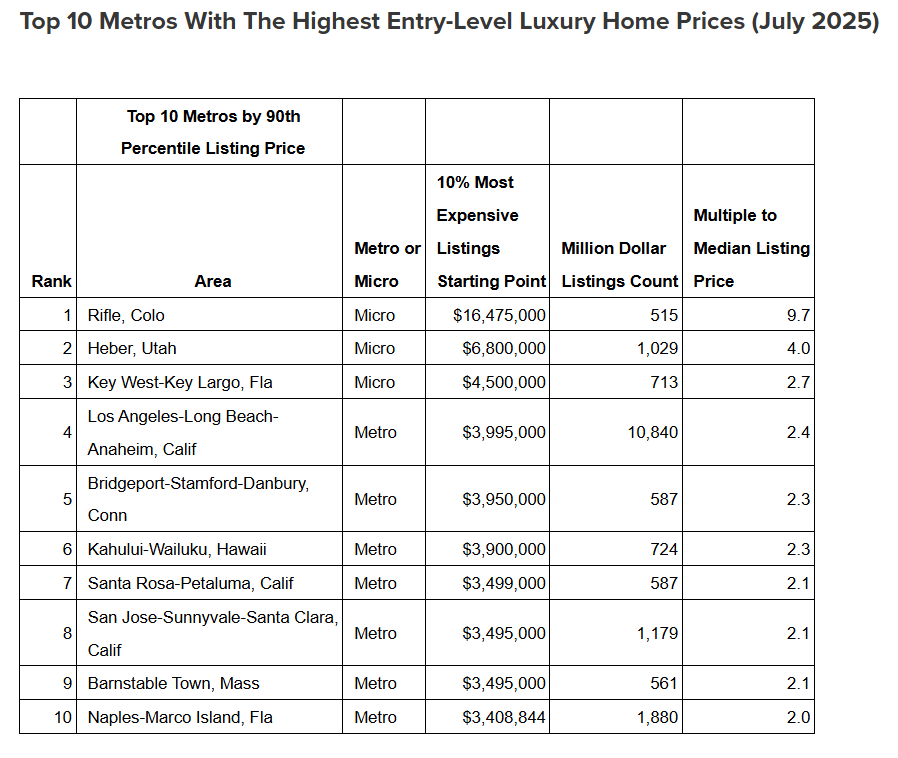
Markets With the Highest Entry-Level Luxury Prices
Realtor.com examined metros and micro-markets with at least 500 active million-dollar listings in July 2025 to identify areas where entry-level luxury prices are highest. Leading the list:
- Rifle, Colorado
- Heber, Utah
- Key West–Key Largo, Florida
- Los Angeles–Long Beach–Anaheim, California
- Bridgeport–Stamford–Danbury, Connecticut
These markets are often coastal, vacation-focused, or high-income hubs, where the gap between median and luxury property values is pronounced. High desirability, limited developable land, and proximity to lifestyle amenities drive the steep entry point for luxury.
Million-Dollar Homes: A Psychological and Market Benchmark
Although $1 million is no longer the national marker for luxury, it remains an influential benchmark. Nationwide, homes at or above $1 million account for 13% of all listings, and they dominate in markets synonymous with upscale living. In these areas, million-dollar properties are less an exception and more a standard.

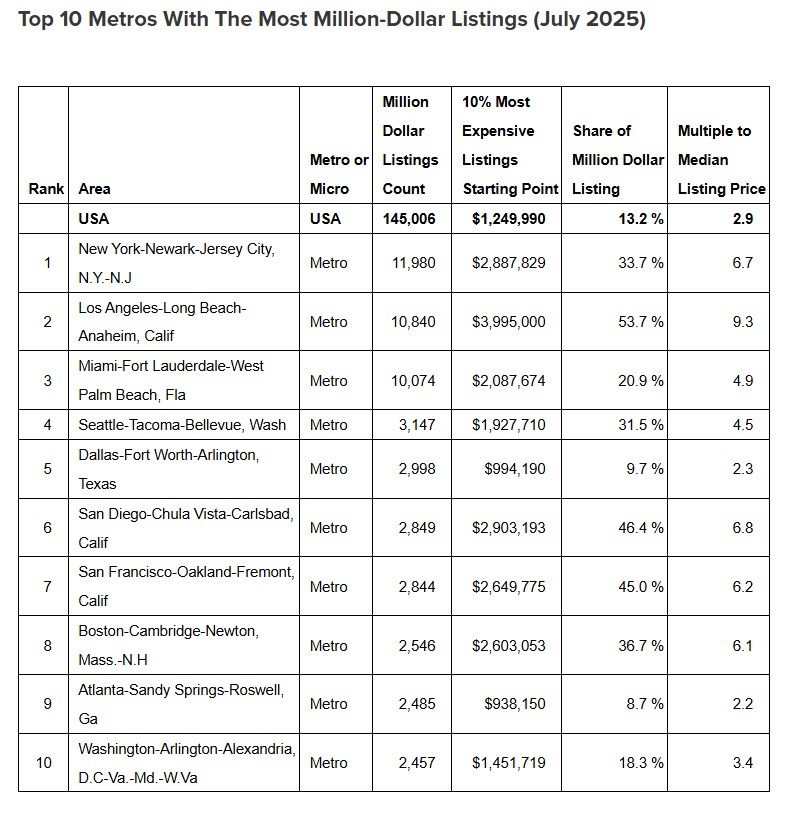
Metros with the largest inventory of million-dollar listings include:
- New York–Newark–Jersey City, NY/NJ
- Los Angeles–Long Beach–Anaheim, CA
- Miami–Fort Lauderdale–West Palm Beach, FL
- Seattle–Tacoma–Bellevue, WA
- Dallas–Fort Worth–Arlington, TX
Remarkably, just 10 metros account for 36% of all million-dollar listings nationwide, emphasizing sustained demand for premium real estate. Factors contributing to this dominance include international interest, limited housing supply, and concentrations of high-paying jobs in finance, tech, and other professional sectors.
Rising Luxury Prices and Market Implications
The report highlights a broader trend: luxury housing continues to outpace overall home price growth, reflecting both economic stratification and high-income concentration. For buyers entering these markets, the stakes are high, with properties offering unique architectural designs, cutting-edge technology, and lifestyle amenities such as private beaches, ski-in/ski-out access, or smart-home integration.
Hale noted, “Luxury isn’t just a price tag it’s about the experience, the exclusivity, and the prestige of living in a highly sought-after location. The increasing thresholds are reflective of what buyers value today: privacy, convenience, and lifestyle opportunities that stand out in the market.”
With home prices continuing to rise in many urban and coastal regions, aspiring luxury buyers may need to adjust expectations, while investors in premium properties will find opportunities for long-term appreciation and rental yield. Meanwhile, luxury markets remain resilient even amid broader housing market fluctuations, underscoring that high-end real estate is both a status symbol and an investment vehicle. For direct financing consultations or mortgage options for you visit 👉 Nadlan Capital Group.
