


Out-of-market homebuyers 2026 trends show a clear shift in how Americans shop for homes. According to the latest Cross-Market Demand Report from Realtor.com, nearly 61.9% of listing views in the 100 largest metro areas during Q4 2025 came from buyers searching outside their current metro.
That share is slightly lower than last year’s 64.7%, but still far above the pre-pandemic level of 48.6% in late 2019. The data suggests that cross-market home shopping is no longer temporary. It has become a lasting feature of the housing market.
A Structural Shift in Housing Demand
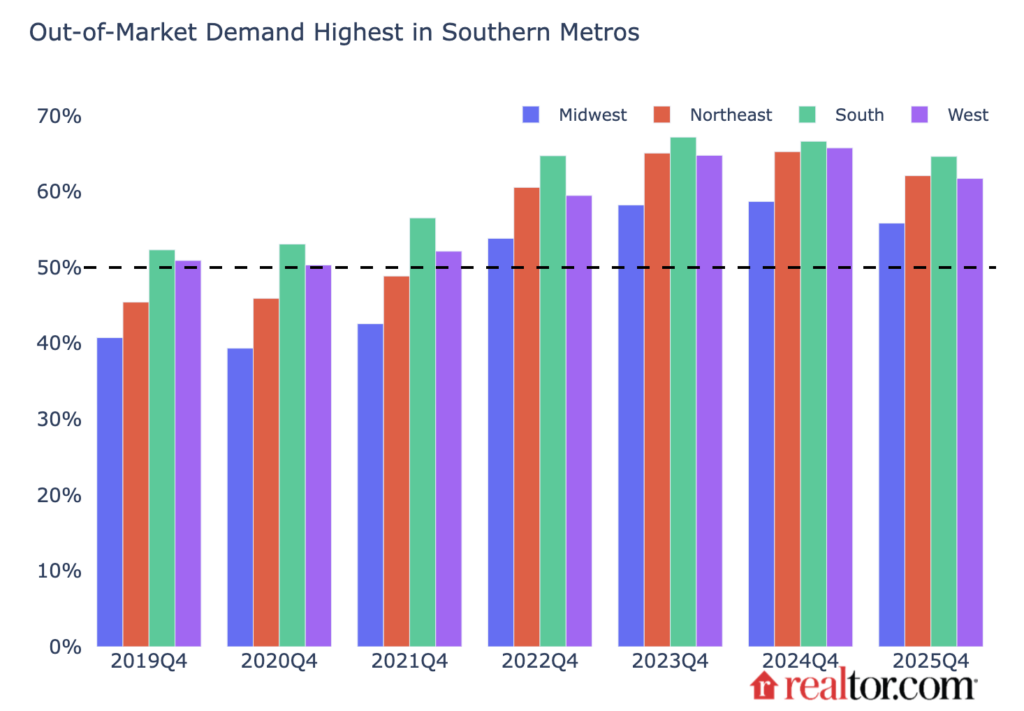
Six years ago, most buyers focused on their local market, especially in the Midwest and Northeast. In Q4 2019, out-of-market demand averaged just 40.8% in Midwest metros and 45.4% in Northeastern metros.
By Q4 2025, that changed. Out-of-market demand rose to 55.8% in the Midwest and 62.1% in the Northeast. In both regions, nonlocal interest now exceeds local demand.
One key reason is the “lock-in effect.” Many existing homeowners secured low mortgage rates in prior years. With today’s higher rates and limited inventory, they are less likely to sell and move within the same metro. As a result, more transactions are driven by people relocating from other markets rather than local move-up buyers.

South and West Continue to Lead
Even before the pandemic, metro areas in the South and West had stronger out-of-market interest. In late 2019, nonlocal views already made up about 50% or more of traffic in those regions.
By Q4 2025:
- Western metros averaged 64.6% out-of-market demand
- Southern metros averaged 61.7%
Southern cities in particular have consistently attracted the largest share of nonlocal buyers over the past six years. Lower taxes, job growth, and lifestyle changes continue to draw people from higher-cost coastal areas.
Where Local Buyers Still Dominate
Only 13 of the 100 largest metro areas were still led primarily by local buyers in late 2025.
Top examples include:
- New York – 73.7% local traffic
- Chicago – 72.3% local traffic
- Dallas – 68.0% local traffic
- Atlanta – 61.4% local traffic
- Washington – 60.6% local traffic
In these cities, strong job markets and high home prices tend to keep demand centered around existing residents. However, even in these metros, the share of out-of-market shoppers has grown compared to six years ago. The gap between local and nonlocal demand is narrowing.
Markets such as Indianapolis, Denver, and St. Louis have shifted toward a more balanced mix of buyers.
Sun Belt Markets Dominate Nonlocal Demand
Out-of-market demand exceeded local demand in 87 of the top 100 metros in Q4 2025.
The strongest examples include:
- Cape Coral – 82.5% out-of-market traffic
- Lakeland – 79.8%
- Durham – 78.2%
- North Port – 77.8%
- Poughkeepsie area – 77.5%
These markets offer lower home prices compared to major coastal cities, along with lifestyle appeal. Many attract retirees, remote workers, investors, and buyers seeking second homes.
The Hudson Valley region near New York City stands out because it offers more affordable options compared to Manhattan and nearby boroughs, pulling in outside interest.
AI and Data Centers Create New Buyer Flows
Some of the biggest changes occurred in cities that are benefiting from growth in artificial intelligence, cloud computing, and data center investment.
Metros seeing major shifts toward out-of-market demand include:
- San Francisco
- Philadelphia
- Pittsburgh
- Omaha
- Detroit
In San Francisco, renewed interest in AI companies is drawing buyers from outside the region. In Pennsylvania and the Midwest, investments in infrastructure and cloud computing facilities are bringing new job growth. That, in turn, is increasing housing demand from relocating workers.
What This Means for 2026
The rise of out-of-market homebuyers 2026 trends reflects a more connected housing market. Buyers are no longer limited by geography in the same way they were before 2020.
Several forces are driving this shift:
- Remote and hybrid work
- Migration toward lower-cost areas
- Investment and second-home demand
- Lock-in effects from low mortgage rates
- Tech and infrastructure job growth
For sellers, this means broader exposure beyond local buyers. For buyers, it means more competition from outside their metro.
Cross-market demand is no longer a short-term trend. It is now a defining feature of the U.S. housing market heading into 2026. For direct financing consultations or mortgage options for you visit 👉 Nadlan Capital Group.
