


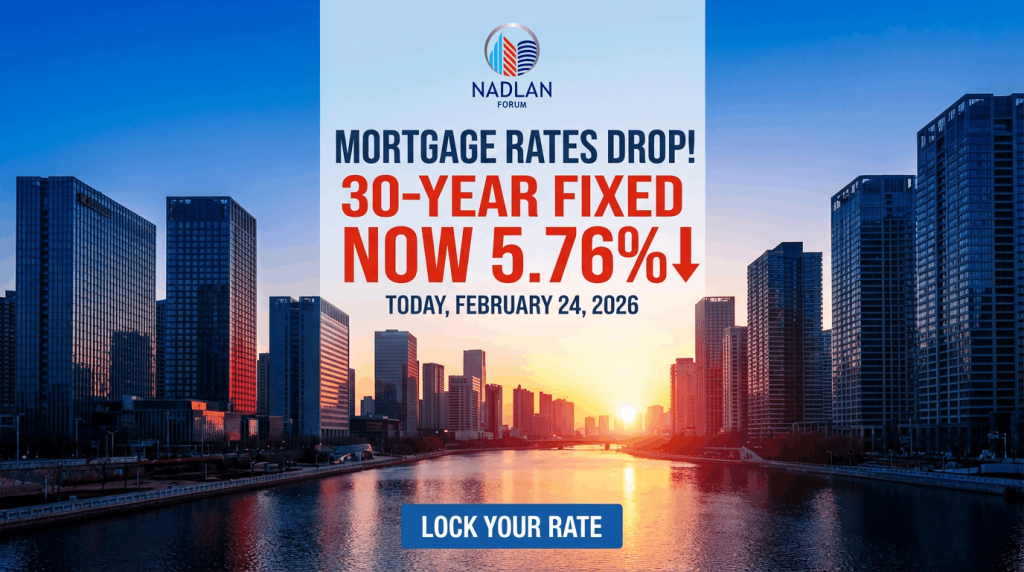
Mortgage rates February 24 2026 moved lower again, giving buyers and refinancers another opportunity to lock in rates below 6%.
According to data from Zillow, the national average 30-year fixed mortgage rate is now 5.76%. The 15-year fixed rate stands at 5.37%. More lenders are offering sub-6% options, and some advertised APRs are even lower depending on borrower qualifications.
Today’s Mortgage Rates
Here are the current national averages for home purchases:
- 30-year fixed: 5.76%
- 20-year fixed: 5.78%
- 15-year fixed: 5.37%
- 5/1 ARM: 5.86%
- 7/1 ARM: 5.69%
- 30-year VA: 5.38%
- 15-year VA: 5.04%
- 5/1 VA: 5.32%
These rates are rounded averages. Your actual rate will depend on credit score, down payment, loan size, and lender pricing.
Current Refinance Rates
For homeowners considering a refinance, today’s averages are:
- 30-year fixed: 5.93%
- 20-year fixed: 5.73%
- 15-year fixed: 5.49%
- 5/1 ARM: 6.08%
- 7/1 ARM: 6.01%
- 30-year VA: 5.57%
- 15-year VA: 5.13%
- 5/1 VA: 4.90%
Refinance rates are often slightly higher than purchase rates, though individual offers vary.
30-Year vs. 15-Year Mortgage Example
Choosing between a 30-year and 15-year loan depends on monthly budget and long-term goals.
If you borrow $400,000 with a 30-year term at 5.76%, your monthly principal and interest payment would be about $2,337. Over the life of the loan, total interest would reach roughly $441,260.
With a 15-year mortgage at 5.36% on the same amount, the monthly payment would rise to about $3,241. However, total interest paid would fall to around $183,345.
The shorter term costs more each month but reduces long-term interest significantly.
Borrowers who choose a 30-year loan can also make extra principal payments to reduce interest and shorten the payoff period.
Fixed vs. Adjustable-Rate Mortgages
A fixed-rate mortgage keeps the same interest rate for the entire term unless you refinance. This offers predictable payments.
An adjustable-rate mortgage (ARM) locks in a rate for a set period — such as five or seven years — before adjusting annually. For example, a 7/1 ARM holds the rate steady for seven years, then adjusts once per year.
In some market cycles, ARMs start with lower rates than fixed loans. Recently, however, many ARM rates have been similar to or even higher than fixed options. Borrowers should compare offers carefully.
Why Rates Are Moving Lower
Mortgage rates are influenced by bond market trends, particularly mortgage-backed securities and Treasury yields. Recent easing in bond yields has helped push mortgage rates down.
Industry forecasts suggest rates may hover near 6% for much of 2026. The Mortgage Bankers Association projects the 30-year fixed rate will average around 6.10% this year, while Fannie Mae expects rates near 6% through the end of 2026.
While dramatic drops are not widely expected, gradual improvements like the recent move to 5.76% can make a meaningful difference in monthly payments.
How to Secure the Best Rate
To qualify for lower mortgage rates:
- Maintain a strong credit score
- Keep your debt-to-income ratio low
- Compare multiple lenders
- Consider whether paying discount points makes sense
Even small differences in interest rate can translate into thousands of dollars saved over time.
Bottom Line
Mortgage rates February 24 2026 show continued improvement, with the 30-year fixed rate at 5.76% and more lenders offering options below 6%.
For buyers waiting on better conditions, this latest dip may present a timely opportunity to move forward.