


Real asset investment has emerged as a cornerstone strategy for investors seeking tangible wealth preservation and portfolio diversification in an increasingly volatile market environment. Unlike paper assets such as stocks and bonds, real assets provide physical value that often appreciates with inflation and economic expansion. For investors navigating the complexities of modern financial markets, understanding how to strategically allocate capital into real assets can provide both stability and growth potential throughout various economic cycles.
Understanding the Foundations of Real Asset Investment
Real assets are tangible or physical assets that derive their value from their physical properties and utility. This asset class encompasses real estate, infrastructure, natural resources, commodities, and precious metals. Each category offers distinct characteristics that contribute to portfolio resilience and long-term wealth creation.
The fundamental appeal of real asset investment lies in its intrinsic value proposition. Physical assets maintain purchasing power during inflationary periods because they typically increase in price alongside general price levels. This inflation-hedging characteristic makes real assets particularly attractive when traditional fixed-income securities struggle to preserve capital value.
Key Categories Within Real Asset Investment
Real estate represents the most accessible entry point for many investors. Commercial properties, residential complexes, and specialized facilities such as data centers or medical buildings generate income through rental payments while appreciating in value over time. Location, tenant quality, and property management expertise significantly influence returns in this sector.
Infrastructure assets include transportation systems, utilities, energy facilities, and communication networks. These investments often feature stable cash flows supported by long-term contracts or regulated revenue models. Governments worldwide continue expanding infrastructure needs, creating sustained demand for private capital participation.
Natural resources encompass timberland, farmland, and mineral rights. According to Gresham House’s Real Assets division, these investments provide sustainable yield opportunities while contributing to environmental objectives. Timber appreciation, agricultural commodity production, and resource extraction generate multiple revenue streams.
Commodities and precious metals round out the real asset investment landscape. Gold, silver, oil, and agricultural products offer portfolio diversification benefits through their low correlation with traditional financial assets. These holdings provide insurance against currency devaluation and geopolitical uncertainty.


Strategic Advantages for Portfolio Construction
Incorporating real asset investment into a diversified portfolio delivers multiple strategic benefits that extend beyond simple return generation. Understanding these advantages helps investors optimize allocation decisions based on their financial objectives and risk tolerance.
Inflation Protection Mechanisms
Real assets provide natural inflation hedging through several mechanisms:
- Direct pricing power: Property owners and commodity producers can raise prices in response to inflation
- Replacement cost increases: Physical assets become more expensive to replicate as construction and production costs rise
- Revenue escalation clauses: Many real estate leases and infrastructure contracts include automatic inflation adjustments
- Scarcity value: Limited supply of prime locations and finite natural resources supports price appreciation
Historical data demonstrates that real asset investment has consistently outperformed financial assets during high-inflation environments. During the 1970s inflation surge and recent post-pandemic price increases, tangible assets preserved purchasing power more effectively than bonds or cash equivalents.
Diversification and Correlation Benefits
Real assets exhibit low correlation with stocks and bonds, reducing overall portfolio volatility. When equity markets decline due to economic concerns, real assets often maintain stability or appreciate based on supply-demand fundamentals independent of market sentiment.
| Asset Class | Correlation with Stocks | Correlation with Bonds | Inflation Sensitivity |
|---|---|---|---|
| Real Estate | 0.45 – 0.60 | 0.20 – 0.35 | High |
| Infrastructure | 0.30 – 0.50 | 0.15 – 0.25 | Moderate to High |
| Commodities | 0.10 – 0.30 | -0.05 – 0.15 | Very High |
| Timberland | 0.25 – 0.40 | 0.10 – 0.20 | Moderate |
This correlation structure allows investors to reduce portfolio drawdowns during market stress while maintaining return potential. The diversification benefit becomes particularly valuable for retirees and institutions requiring stable income streams.
Implementation Strategies for Real Asset Investment
Successfully executing a real asset investment strategy requires understanding various implementation vehicles and selecting approaches aligned with investment goals, capital availability, and expertise levels.
Direct Ownership Approaches
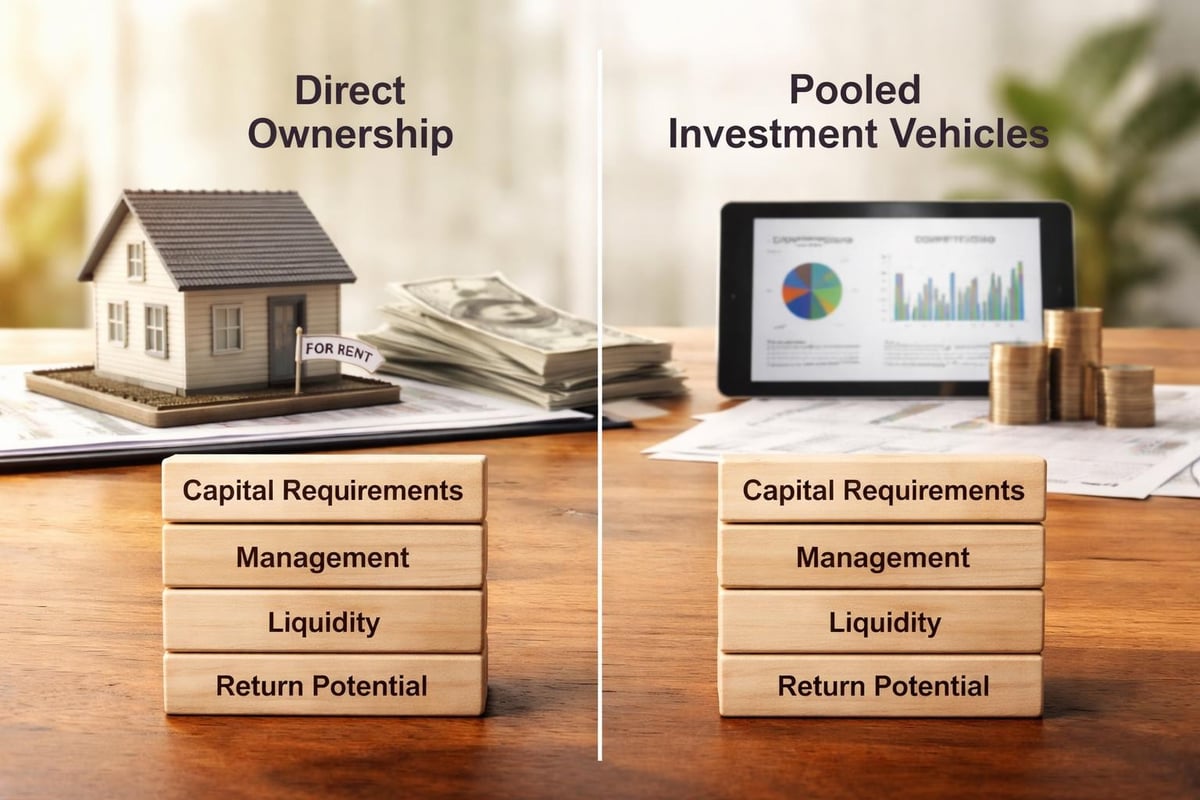
Direct property ownership offers maximum control and potential returns but demands substantial capital and active management. Investors purchasing commercial buildings, apartment complexes, or land parcels assume responsibility for:
- Property selection and due diligence
- Financing arrangement and capital structure optimization
- Tenant acquisition and lease negotiation
- Ongoing maintenance and capital improvements
- Tax planning and regulatory compliance
- Exit strategy execution and sale negotiations
Direct ownership works best for investors with real estate expertise, local market knowledge, and sufficient capital to diversify across multiple properties. The hands-on nature requires time commitment and professional support from attorneys, accountants, and property managers.
Pooled Investment Vehicles
Real estate investment trusts (REITs) and private funds provide access to diversified real asset portfolios without direct management responsibilities. These vehicles offer several advantages:
- Professional management expertise from specialized teams
- Portfolio diversification across property types and geographies
- Lower minimum investment thresholds compared to direct ownership
- Liquidity options through publicly traded REITs
- Economies of scale in acquisition and operations
Private real estate funds typically target institutional investors and high-net-worth individuals with longer investment horizons. These closed-end vehicles pursue value-add or opportunistic strategies, acquiring underperforming assets for renovation and repositioning.
Market Analysis and Opportunity Identification
Successful real asset investment requires disciplined market analysis to identify opportunities offering attractive risk-adjusted returns. Real Asset Insight’s approach emphasizes thought leadership and market intelligence as foundations for investment decisions.
Economic Cycle Considerations
Different real asset categories perform optimally during specific economic phases:
Early expansion: Infrastructure and industrial real estate benefit from increasing business activity and capital investment. Transportation networks and logistics facilities experience rising utilization rates.
Mid-cycle growth: Multifamily housing and retail properties capture consumer spending growth. Commodity prices strengthen as production capacity tightens relative to demand.
Late cycle: Precious metals and defensive real estate sectors such as self-storage and senior housing provide protection against economic uncertainty. Investors rotate toward quality assets with stable income profiles.
Recession: Core real estate in prime locations with creditworthy tenants maintains value. Essential infrastructure assets continue generating predictable cash flows regardless of economic conditions.
Geographic and Sector Selection
Location analysis drives real asset investment success, particularly in real estate. Population growth, employment trends, regulatory environments, and infrastructure development determine long-term appreciation potential.
Growth markets in the Sun Belt and Mountain West regions continue attracting businesses and residents from high-cost coastal areas. Cities investing in transportation infrastructure, technology ecosystems, and quality-of-life amenities demonstrate superior real estate performance.
Sector selection requires understanding structural trends reshaping space utilization:
- Industrial and logistics facilities benefit from e-commerce expansion
- Data centers capture cloud computing and artificial intelligence demand
- Life sciences real estate serves biotechnology and pharmaceutical research
- Renewable energy infrastructure addresses climate transition requirements
Risk Management in Real Asset Investment
While real asset investment offers numerous benefits, investors must recognize and mitigate specific risks inherent to tangible asset ownership. Comprehensive risk management enhances long-term portfolio performance and capital preservation.
Market and Valuation Risks
Real estate and infrastructure valuations fluctuate based on capitalization rate movements, interest rate changes, and economic conditions. Rising interest rates increase discount rates applied to future cash flows, potentially reducing asset values even when operating performance remains strong.
Illiquidity represents another consideration. Unlike publicly traded securities, real assets require extended marketing periods to achieve optimal sale prices. Forced sales during market downturns can result in substantial discounts to intrinsic value.
Operational and Management Risks
Physical assets require ongoing maintenance, renovation, and technological upgrades. Deferred maintenance reduces property values and tenant appeal. Natural disasters, environmental contamination, and obsolescence create financial exposure requiring insurance coverage and reserve funds.
Property management quality directly impacts returns. Ineffective leasing, poor tenant relations, and inadequate cost control erode cash flows. Investors should establish clear performance metrics and accountability systems for management teams.
| Risk Category | Mitigation Strategy | Implementation Tools |
|---|---|---|
| Market Volatility | Geographic diversification | Multi-market portfolio |
| Interest Rate | Fixed-rate financing | Long-term debt locks |
| Tenant Default | Credit screening | Lease guarantees |
| Property Damage | Insurance coverage | Comprehensive policies |
| Obsolescence | Capital improvement | Regular upgrades |
Regulatory and Tax Considerations
Real asset investment involves complex tax treatment varying by asset type, ownership structure, and investor status. Depreciation deductions, capital gains treatment, and passive activity rules affect after-tax returns significantly.
Zoning regulations, environmental laws, and building codes constrain property development and usage. Changes in regulatory frameworks can enhance or diminish property values. Investors should monitor legislative developments and maintain compliance with applicable requirements.
Performance Measurement and Benchmarking
Evaluating real asset investment performance requires appropriate metrics and comparison benchmarks. RCA® Industry Insights provides expert analysis helping investors assess performance relative to market standards.
Return Calculation Methodologies
Cash-on-cash return measures annual cash flow relative to equity investment, providing insight into income generation efficiency. This metric helps evaluate whether properties meet income objectives and support distribution requirements.
Internal rate of return (IRR) accounts for investment timing, interim cash flows, and terminal value realization. IRR facilitates comparison across investments with different holding periods and capital structures.
Total return combines income and appreciation components, reflecting comprehensive investment performance. Comparing total return against inflation rates determines real wealth creation effectiveness.
Benchmarking Against Market Indices
Several indices track real asset investment performance across categories:
- NCREIF Property Index: Measures unleveraged commercial real estate returns
- FTSE NAREIT All Equity REITs Index: Tracks publicly traded REIT performance
- Bloomberg Commodity Index: Monitors commodity price movements
- S&P Global Infrastructure Index: Follows listed infrastructure company performance
Regular performance comparison identifies outperformance or underperformance requiring portfolio adjustments. Significant deviations from benchmarks warrant investigation into underlying causes and potential corrective actions.

Emerging Trends Reshaping Real Asset Investment
The real asset investment landscape continues evolving in response to technological innovation, demographic shifts, and environmental priorities. Forward-thinking investors position portfolios to capture opportunities from these transformative trends.
Technology Integration and PropTech
Digital technologies are revolutionizing property management, tenant experience, and building operations. Smart building systems optimize energy consumption, reducing operating costs while enhancing environmental performance. Automated leasing platforms streamline tenant acquisition and rent collection.
Data analytics enable sophisticated underwriting and portfolio management. Predictive maintenance algorithms identify equipment failures before they occur, minimizing downtime and repair costs. Market intelligence platforms provide real-time pricing data and transaction comparables supporting investment decisions.
Sustainability and ESG Considerations
Environmental, social, and governance (ESG) factors increasingly influence real asset investment decisions. Energy-efficient buildings command premium rents and higher valuations as tenants prioritize sustainability. Green building certifications such as LEED and ENERGY STAR demonstrate environmental commitment and operational excellence.
Climate risk assessment has become essential for long-term value preservation. Properties in flood zones, wildfire-prone areas, or regions facing water scarcity require enhanced due diligence and risk mitigation strategies. Investors incorporate climate projections into holding period analyses and exit planning.
Social considerations include affordable housing development, community impact, and labor practices. Governance encompasses transparent reporting, stakeholder engagement, and ethical business conduct. Institutional investors increasingly mandate ESG integration across real asset portfolios.
Demographic-Driven Opportunities
Population aging creates demand for senior housing, healthcare facilities, and age-restricted communities. The 65-and-older demographic segment continues expanding, requiring specialized real estate solutions addressing accessibility, healthcare access, and social engagement.
Remote work adoption has transformed office and residential real estate dynamics. Suburban markets gain attractiveness as workers prioritize space and affordability over downtown proximity. Home offices and flexible workspaces become standard amenities in multifamily developments.
Migration patterns toward Sun Belt states drive housing demand in growing markets. Technology sector expansion beyond traditional hubs creates new real estate opportunities in emerging cities investing in innovation ecosystems.
Building a Comprehensive Real Asset Investment Portfolio
Constructing an optimal real asset investment portfolio requires balancing diversification, return objectives, and risk tolerance. Strategic allocation frameworks help investors achieve financial goals while managing volatility and preserving capital.
Core-Satellite Approach
The core-satellite strategy combines stable, income-producing assets with opportunistic investments targeting higher returns:
Core holdings (60-70% of allocation): Stabilized properties in prime locations with creditworthy tenants, long-term leases, and predictable cash flows. These assets provide portfolio stability and consistent income distribution.
Value-add investments (20-30%): Properties requiring repositioning, renovation, or lease-up to achieve market potential. Moderate risk-return profile appeals to investors seeking appreciation beyond core returns.
Opportunistic positions (10-20%): Development projects, distressed assets, or emerging markets offering substantial upside potential. Higher risk justifies concentrated positions and active monitoring.
This framework balances stability and growth while maintaining overall portfolio risk within acceptable parameters. Allocation percentages adjust based on market conditions, investment opportunities, and individual circumstances.
Geographic and Sector Diversification
Spreading investments across multiple markets reduces concentration risk associated with local economic downturns or regulatory changes. National portfolios capture growth in various regions while limiting exposure to any single market’s challenges.
Sector diversification addresses shifting demand patterns across property types:
- Multifamily housing: Provides steady income across economic cycles
- Industrial/logistics: Captures e-commerce and supply chain trends
- Office properties: Focuses on life sciences and technology tenants
- Retail: Emphasizes experiential and necessity-based formats
- Specialty sectors: Includes data centers, self-storage, and healthcare
Balanced sector exposure creates resilience against industry-specific disruptions while maintaining participation in growth opportunities.
Rebalancing and Portfolio Maintenance
Regular portfolio reviews ensure alignment with investment objectives and risk parameters. Market appreciation can create overconcentration in specific assets or sectors requiring rebalancing through strategic sales and reinvestment.
Disposition timing considers tax implications, market conditions, and replacement investment availability. 1031 exchanges allow tax deferral when reinvesting proceeds into qualifying like-kind properties, preserving capital for continued compounding.
Portfolio maintenance includes:
- Quarterly performance reviews against benchmarks
- Annual strategic planning and allocation adjustments
- Ongoing property inspections and condition assessments
- Lease renewal negotiations and tenant retention programs
- Capital improvement budgeting and execution
Accessing Institutional-Quality Real Asset Investment
Individual investors increasingly seek access to institutional-quality real asset opportunities traditionally reserved for pension funds and endowments. Several pathways provide entry into professionally managed portfolios with lower capital requirements.
Real Estate Investment Trusts
Publicly traded REITs offer daily liquidity and portfolio transparency through stock exchange listings. These companies own and operate income-producing properties across various sectors, distributing at least 90% of taxable income to shareholders as dividends.
Non-traded REITs provide access to private market pricing without daily volatility, though they sacrifice liquidity during hold periods. These vehicles typically target longer-term investors willing to accept limited redemption options in exchange for potentially higher returns.
Private Real Estate Funds
Accredited investors can access private funds pursuing value creation strategies across the risk spectrum. Fund structures vary from open-end vehicles accepting periodic subscriptions to closed-end funds with defined investment periods and lifecycle timelines.
Interval funds blend attributes of open-end and closed-end structures, offering periodic redemption opportunities at net asset value. These vehicles provide middle ground between daily liquidity and complete lockup periods.
Direct Partnership Opportunities
Syndications and joint ventures allow investors to participate directly in specific property acquisitions alongside experienced sponsors. These structures provide transparency into individual asset performance and direct ownership benefits, though they require larger minimum investments and longer hold commitments.
Delaware statutory trusts (DSTs) enable fractional ownership interests in institutional-quality properties while qualifying for 1031 exchange treatment. Professional management handles all operational responsibilities while investors receive passive income distributions.
Real asset investment provides essential portfolio diversification and inflation protection through tangible assets generating income and appreciating over time. By understanding implementation strategies, risk management techniques, and emerging opportunities, investors can build resilient portfolios positioned for long-term success. Whether you’re exploring direct property ownership, REITs, or alternative investment vehicles, Nadlan Forum offers the resources, consultation, and community engagement you need to make informed real estate investment decisions and develop smart strategies aligned with your financial objectives.