


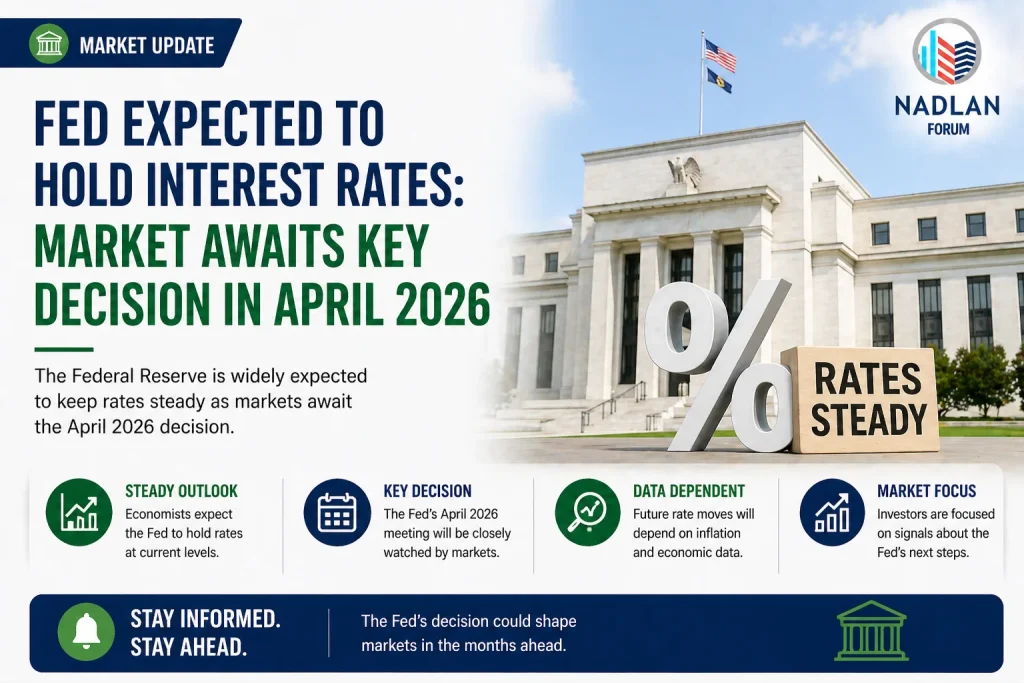
The Federal Reserve is widely expected to leave interest rates unchanged at its upcoming policy meeting. If confirmed, this would mark the third time this year that rates have remained steady as policymakers continue to evaluate economic conditions.
The decision comes at a time when the central bank is facing several challenges, including rising inflation, a slower job market, and ongoing global uncertainty.
Why the Fed Is Holding Rates Steady
Officials are taking a cautious approach as they monitor how different economic factors are developing. Key concerns include:
- Inflation pressures that remain above target
- Slower hiring and signs of weakness in the labor market
- Global events, including geopolitical tensions, affecting energy prices
Analysts believe the Fed will continue its “wait-and-see” strategy, choosing not to make sudden changes until there is clearer direction in the economy.
Ongoing Economic Uncertainty
Recent global developments have added complexity to the Fed’s decision-making process. Economic uncertainty linked to international conflicts and trade policies is making it harder to predict how inflation and growth will evolve.
Higher energy costs and supply disruptions are also contributing to inflation, which limits the central bank’s ability to lower rates in the short term.
As a result, keeping rates unchanged allows policymakers to balance the risks of slowing growth with the need to control rising prices.
Jerome Powell’s Final Meeting as Chair
This meeting is expected to be the last for Jerome Powell as head of the Federal Reserve. His term as chair is set to end in mid-May, concluding several years of leadership during both stable periods and times of economic stress.
Under his leadership, the Fed navigated major events such as the pandemic, inflation spikes, and changes in global economic conditions.
Although Powell could remain on the board as a governor, he has not yet confirmed his future plans.
Transition to New Leadership
President Donald Trump has nominated Kevin Warsh to take over as the next Fed chair.
Warsh recently appeared before the Senate Banking Committee as part of the confirmation process. His potential leadership could bring changes in how the central bank approaches interest rate policy in the future.
Investigation Ends, Clearing Path Forward
Warsh’s nomination faced uncertainty due to an investigation related to renovations at the Fed’s Washington, D.C. headquarters. However, that investigation has now been closed, removing a major obstacle.
Following this development, lawmakers who had previously raised concerns are now more open to moving forward with the confirmation process.
This change increases the likelihood that Warsh could take over leadership soon after Powell’s term ends.
Political Pressure on Interest Rates
The Fed has also faced political pressure to reduce rates more quickly. President Trump has publicly called for lower interest rates, arguing that high borrowing costs can slow economic growth and make it harder for businesses and consumers.
Despite this, the Federal Reserve is expected to maintain its independence and focus on long-term economic stability rather than short-term political demands.
What This Means for Consumers and Markets
If the Fed keeps rates unchanged, the immediate impact on consumers will be limited:
- Borrowing costs for loans and credit cards will remain high
- Mortgage rates are likely to stay near current levels
- Savings rates may continue offering relatively better returns
For financial markets, stability in interest rates can reduce uncertainty, but investors will continue to watch for future signals from the Fed.
Key Takeaways
- The Fed is expected to hold interest rates steady for the third time this year
- Inflation, job market concerns, and global events are influencing the decision
- This may be Jerome Powell’s final meeting as Fed chair
- Kevin Warsh is likely to take over leadership soon
- Interest rate changes may depend on future economic data
Final Outlook
The Federal Reserve is taking a cautious approach as it navigates a complex economic environment. By holding rates steady, policymakers are giving themselves time to better understand how inflation, employment, and global risks will evolve.
For now, both consumers and markets should expect stability rather than major changes, with future decisions depending on how economic conditions develop in the months ahead. For direct financing consultations or mortgage options for you visit 👉 Nadlan Capital Group.
