


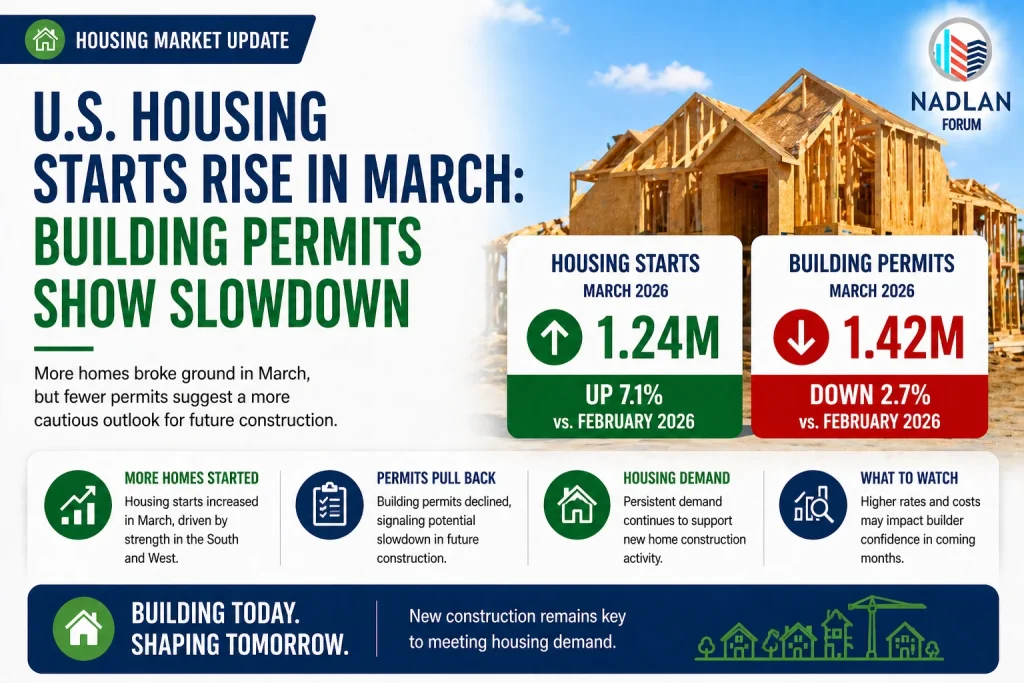
New data from the U.S. Census Bureau and the Department of Housing and Urban Development shows mixed trends in the housing market for March 2026. While construction activity increased, indicators for future building suggest a possible slowdown.
Housing Starts Show Strong Monthly Growth
Single-family housing starts rose to an annual rate of 1.03 million in March. This represents a 9.7% increase compared to the revised February figure.
Overall housing starts, including both single-family and multifamily properties, reached a seasonally adjusted annual rate of 1.5 million. This is:
- Up 10.8% from February
- Up 10.8% compared to March 2025
These figures suggest that builders increased construction activity as the spring season began, which is typically a busy time for housing development.
Building Permits Decline Sharply
While construction activity improved, building permits—which signal future construction—moved in the opposite direction.
- Single-family permits fell to 895,000, down 3.8% from February
- Total housing permits dropped to 1.37 million
- Permits declined 10.8% from February and 7.4% year-over-year
This decline indicates that builders may be preparing for slower demand in the months ahead.
Housing Completions Also Move Lower
Housing completions showed a slight decline in March:
- Single-family completions fell to 896,000, down 4.8% from February
- Total completions reached 1.36 million, nearly unchanged from February but down 12.8% compared to last year
This suggests that while new construction is increasing, the number of finished homes entering the market is not growing at the same pace.
What the Data Means for the Market
The combination of rising starts and falling permits presents a mixed picture.
Positive signs:
- Builders are actively starting new projects
- Seasonal demand is supporting construction activity
Areas of concern:
- Fewer permits signal reduced future supply
- Completions are declining compared to last year
This pattern may indicate that builders are cautious about future market conditions despite current activity.
Economic Factors Behind the Trends
Several broader factors are influencing housing activity:
- Ongoing economic uncertainty
- Higher construction and financing costs
- Global events affecting energy prices and inflation
These challenges are making builders more careful when planning new projects, which is reflected in the decline in permits.
Market Conditions Shift Toward Buyers
Recent trends suggest that the housing market is becoming more balanced.
In many areas:
- Buyers have more negotiating power
- Sellers are offering price cuts or incentives
- Builders are adjusting strategies to attract buyers
This shift comes after years of strong seller-driven markets.
Mortgage Rates Remain a Key Factor
Mortgage rates continue to play a major role in housing demand. Rates are currently in the low-to-mid 6% range, which is lower than last year but still high compared to earlier periods.
Lower rates would likely encourage more buyers to enter the market, but significant growth may require rates to fall closer to the 5% range.
Some borrowers with strong credit profiles can already secure rates slightly below current averages by comparing lenders.
Policy and Housing Supply Outlook
Lawmakers are also working on potential housing policies aimed at increasing supply.
Discussions in Congress include:
- Reducing regulations that slow construction
- Addressing the role of large investors in the housing market
- Encouraging more homebuilding to improve affordability
While there is still debate on how to move forward, increasing housing supply remains a key goal for improving market conditions.
Key Takeaways
- Housing starts increased significantly in March 2026
- Building permits declined, signaling possible future slowdown
- Housing completions are lower compared to last year
- Market conditions are shifting in favor of buyers
- Mortgage rates and economic uncertainty continue to influence demand
Final Outlook
The housing market is showing mixed signals as it moves into the spring season. While construction activity is picking up, the decline in permits suggests that builders are cautious about future demand.
For buyers, the current environment may offer more opportunities and flexibility. For builders and policymakers, the focus remains on balancing supply and affordability.
The coming months will be important in determining whether housing activity continues to grow or slows further as economic conditions evolve. For direct financing consultations or mortgage options for you visit 👉 Nadlan Capital Group.
