


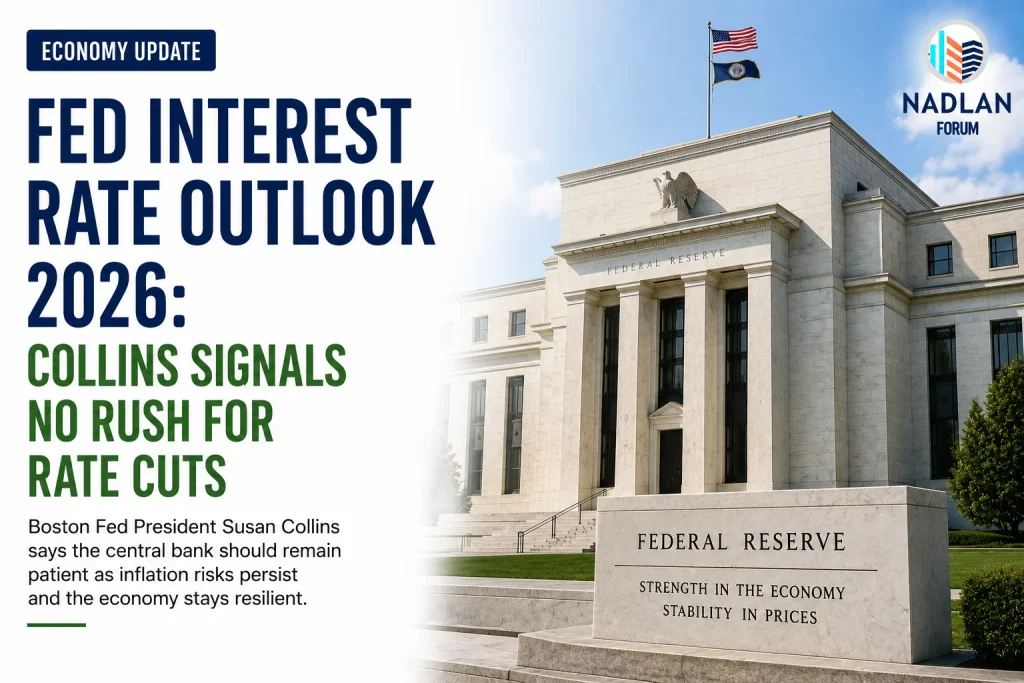
Fed Signals a More Neutral Policy Approach
The outlook for U.S. interest rates may be shifting toward a more balanced stance. Susan Collins, President of the Federal Reserve Bank of Boston, has indicated that the central bank should avoid signaling that rate cuts are the next likely move.
Instead, she supports updating policy guidance so it reflects more flexibility. This would mean that future decisions could go in either direction higher or lower depending on how the economy evolves.
Rates Likely to Stay Steady for Now
Collins said she expects interest rates to remain unchanged for a longer period. While she does see rate cuts happening at some point in the future, she does not believe there is a need to act soon.
Her comments suggest that the Federal Open Market Committee should take a careful approach and avoid making assumptions about the next step.
This view is shared by a growing number of policymakers who want to move away from language that points clearly toward easing.
Why the Fed Wants to Adjust Its Messaging
In recent years, markets have often reacted strongly to signals from the Fed about future rate moves. When guidance suggests that rate cuts are coming, investors may adjust expectations quickly.
Collins and others believe this can create confusion if economic conditions change. By removing a “rate-cut bias” from official statements, the Fed can keep its options open and respond more effectively to new data.
This approach reflects uncertainty around inflation and economic growth.
Inflation Remains a Key Concern
One reason for caution is that inflation has not fully returned to the Fed’s target. Collins has repeatedly said that she needs clear evidence that inflation is moving steadily toward 2% before supporting rate cuts.
Until that happens, keeping rates steady is seen as the safer option.
She also noted that factors such as tariffs and global developments could still affect prices in the coming months, adding to the uncertainty.
A “Higher-for-Longer” Strategy
Collins has been part of the group of policymakers often described as supporting a “higher-for-longer” rate strategy. This means keeping interest rates at current levels until inflation is clearly under control.
She has warned that cutting rates too early could slow progress on inflation or even reverse it. In her view, patience is important to avoid repeating past mistakes.
Policy Seen as Well Positioned
According to Collins, current monetary policy is already close to a neutral level. After multiple rate adjustments over the past year and a half, the Fed is in a position where it can wait and observe how the economy develops.
This allows policymakers to respond carefully rather than making quick changes.
She has described the current economic outlook as relatively stable, with moderate inflation and steady wage growth, though risks still remain.
What This Means for Markets and Borrowers
For financial markets, a more neutral policy stance means fewer clear signals about future rate cuts. This could lead to more cautious behavior among investors.
For borrowers, including those looking at mortgages or business loans, interest rates may stay elevated for longer than previously expected.
At the same time, the possibility of future cuts is still there, but it will depend on how inflation and economic data evolve.
Final Thoughts
The Fed interest rate outlook for 2026 is becoming more flexible. Instead of pointing clearly toward rate cuts, policymakers like Susan Collins are pushing for a balanced approach.
This shift highlights the importance of data-driven decisions and reflects ongoing uncertainty in the economy. For now, the message is clear: interest rates are likely to stay steady until stronger signals appear. For direct financing consultations or mortgage options for you visit 👉 Nadlan Capital Group.
