


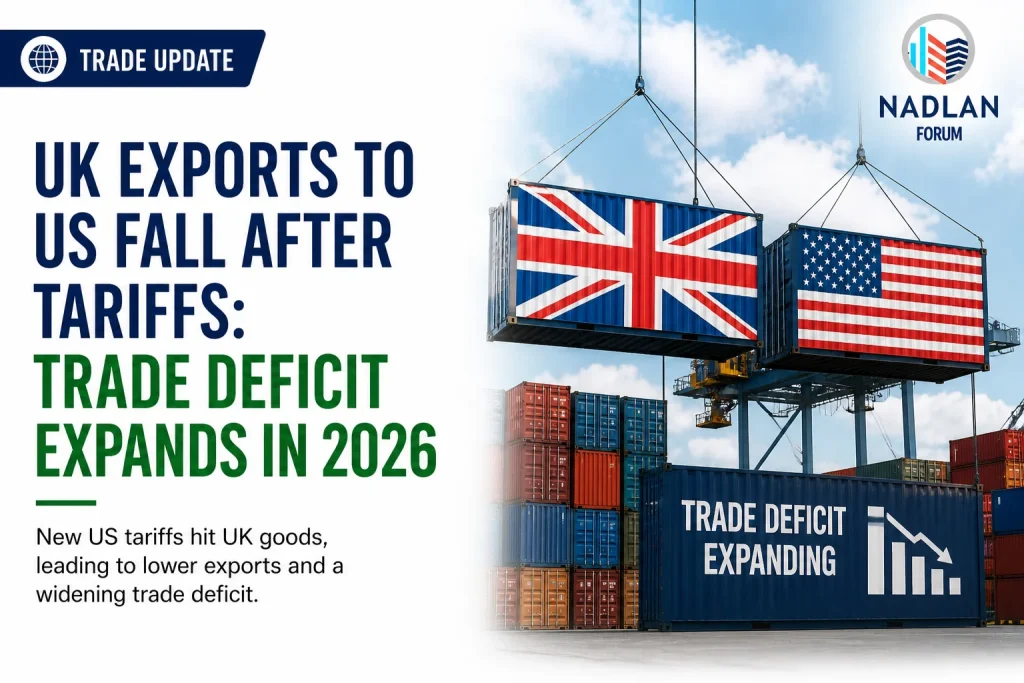
Trade between the United Kingdom and the United States has weakened following new tariff policies, with exports seeing a sharp drop over the past year. Recent data shows that shipments from the UK to the US declined significantly after trade measures introduced by Donald Trump.
According to the Office for National Statistics, UK goods exports to the US fell by around 25% after the tariffs were implemented, highlighting the immediate impact of higher trade costs.
Sharp Drop in Exports After Tariff Changes
The data shows that UK exports to the US, excluding precious metals, declined by approximately £1.5 billion, representing a 24.7% fall.
This drop came after the introduction of a 10% tariff on many goods entering the US market. The new policy marked a major shift away from the previous zero-tariff environment that had supported trade between the two countries.
Industries that rely heavily on exports, such as automotive manufacturing, have been particularly affected. Car exports from the UK to the US have remained below pre-tariff levels throughout the past year.
Trade Deficit Begins to Widen
While exports have declined, imports from the US into the UK have increased in early 2026. This imbalance has led to a trade deficit between the two countries for three consecutive months.
The US remains the UK’s largest export market, so any decline in trade has a noticeable effect on overall economic performance. A sustained drop in exports could slow growth and reduce business activity in key sectors.
Tariffs Reshape Trade Conditions
The tariff policy introduced in 2025 significantly changed how goods move between the UK and the US.
Key changes included:
- A 10% tariff on many UK goods entering the US
- New duties applied to products such as Scotch whisky
- Higher costs for exporters and reduced competitiveness
These changes have forced many UK businesses to adjust pricing, absorb costs, or explore alternative markets.
Partial Relief for Scotch Whisky Industry
In a recent development, Donald Trump announced that tariffs on Scotch whisky would be removed following a state visit involving King Charles III.
The Scotch whisky industry is a major contributor to the UK economy:
- Supports around 40,000 jobs in Scotland
- Accounts for roughly 23% of Scottish goods exports
While the removal of tariffs on whisky may provide relief for that sector, it is unlikely to offset the broader decline in exports across other industries.
Pressure on UK Exporters
UK exporters are currently facing several challenges at the same time:
- Higher costs due to tariffs
- Increased wages and taxes
- Rising input costs linked to inflation
These factors are reducing profit margins and making it harder for businesses to compete in international markets.
Many companies are now operating in a more difficult environment where maintaining sales volumes requires either lowering prices or accepting lower profits.
Broader Economic Impact
The slowdown in exports could have wider implications for the UK economy.
Lower export activity may lead to:
- Reduced industrial output
- Slower economic growth
- Pressure on employment in export-driven sectors
As trade with the US plays a key role in the UK economy, prolonged weakness could affect overall economic stability.
What This Means Going Forward
The current situation reflects a shift in global trade conditions.
Businesses may need to:
- Diversify export markets
- Adjust supply chains
- Improve efficiency to manage higher costs
At the same time, policymakers may look for ways to stabilize trade relationships and support exporters.
Key Takeaways
- UK exports to the US fell by about 25% after new tariffs
- A trade deficit has emerged due to rising imports
- Car exports and other goods remain below previous levels
- Tariff removal on whisky offers limited relief
- Exporters face higher costs and lower margins
Final Outlook
Trade between the UK and the US is going through a period of adjustment. While some sectors may recover with policy changes, the overall export environment remains challenging.
Future growth will depend on how businesses adapt to higher costs and whether trade conditions improve. For now, the data shows that tariffs have had a clear and lasting impact on UK exports and economic performance. For direct financing consultations or mortgage options for you visit 👉 Nadlan Capital Group.