



Real estate investors stepped back from the housing market during the first quarter of 2026 as higher ownership costs, slower home-price growth, and ongoing economic uncertainty made investment properties less attractive.
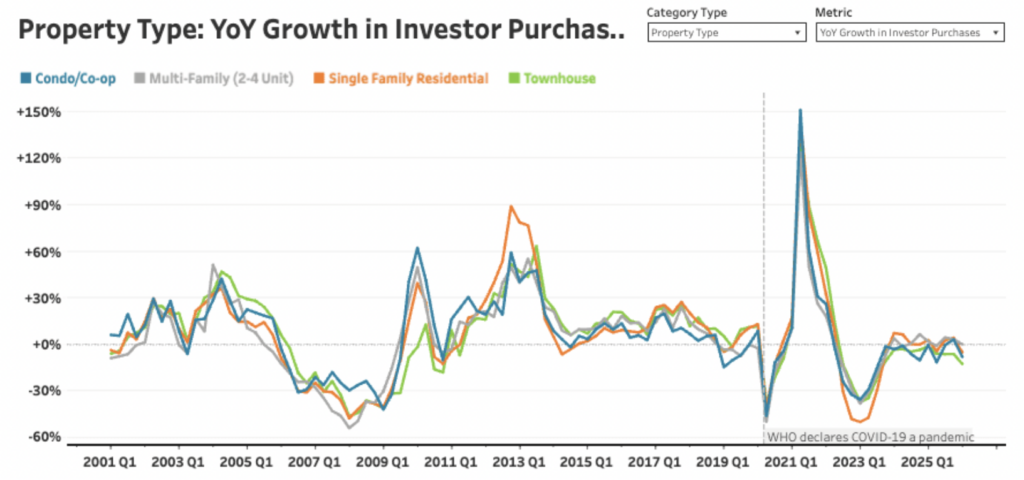
According to a recent housing market analysis, investor home purchases declined 6% compared with the same period one year earlier, reaching their lowest first-quarter level since 2020. Outside of the pandemic slowdown, investor activity is now at its weakest level in nearly a decade.
The decline signals a major shift from the aggressive buying activity seen during the housing boom of 2021 and 2022, when low mortgage rates and rapidly rising home values created strong investment opportunities.
Investors Face a Different Market Environment
The housing market that attracted large numbers of investors during the pandemic has changed significantly.
Mortgage rates remain much higher than the historic lows seen during 2020 and 2021. Although borrowing costs improved slightly earlier this year, financing remains considerably more expensive than it was during the peak investment years.
At the same time, home prices remain elevated in many markets, making acquisitions more costly while reducing potential returns.
For investors focused on rental income or property flipping, the math has become much less favorable.
Higher purchase prices mean larger upfront investments, while borrowing costs continue to pressure cash flow and profitability.

Slower Home Price Growth Reduces Investor Confidence
One of the biggest factors influencing investor behavior is the slowdown in home appreciation.
During the pandemic housing boom, investors benefited from rapid price growth that often generated substantial gains within a short period.
Today, many markets are experiencing much slower appreciation, while some regions have even seen modest price declines.
Without expectations of strong future price growth, investors are becoming more selective about where and when they deploy capital.
Many are choosing to wait for clearer market conditions before expanding their portfolios.
Rising Ownership Costs Create New Challenges
Investors are also facing a sharp increase in operating expenses.
Several costs associated with property ownership have risen significantly in recent years, including:
Insurance Premiums
Property insurance costs have climbed substantially across many parts of the country, particularly in states exposed to weather-related risks.
Property Taxes
As home values increased over the past several years, many investors saw corresponding increases in property tax obligations.
Maintenance and Repairs
Labor shortages, higher material costs, and inflation have pushed maintenance expenses higher, reducing profit margins.
These growing costs are making it more difficult for investors to generate attractive returns, especially on smaller properties.
Economic Uncertainty Encourages Caution
Broader economic concerns are also influencing investor decisions.
Uncertainty surrounding inflation, interest rates, global events, and economic growth has caused many investors to become more conservative.
Rather than aggressively acquiring new properties, some investors are focusing on preserving cash and strengthening existing portfolios.
Volatility in financial markets and concerns about future economic conditions have added another layer of risk to real estate investment decisions.
As a result, many investors are taking a wait-and-see approach.
Investor Activity Returns to More Normal Levels
While the decline in investor purchases may appear significant, it also reflects a return toward historical norms.
Investor activity reached unusually high levels during 2021 and 2022 when low financing costs and rapidly appreciating home values created exceptionally favorable conditions.
Those years represented an extraordinary period in the housing market rather than a long-term trend.
The current slowdown suggests the market is gradually moving back toward more traditional investment patterns.
Investor Market Share Declines
Investors accounted for approximately 19% of all home purchases during the first quarter, down slightly from 20% one year earlier.
At the same time, investor-owned listings represented just 7.8% of homes for sale nationwide, the lowest share in five years.
Because investors are purchasing fewer homes, they also have fewer properties available to sell, contributing to the decline in inventory held by investment groups.
The reduction in investor activity mirrors broader housing market trends, as overall home sales have also remained below normal levels.
Condos Experience the Largest Decline
Not all property types performed equally.
Condominiums
Investor purchases of condominiums fell 8% year over year, reaching their lowest first-quarter level since 2015.
Rising homeowners association fees, growing insurance costs, and slower demand have reduced the appeal of condos for many investors.
Townhouses
Townhouse purchases declined 13%, representing the largest percentage drop among major property categories.
Single-Family Homes
Single-family homes remained the most popular choice for investors despite a 6% annual decline in purchases.
These properties accounted for roughly 70% of all investor acquisitions during the quarter.
Lower-Priced Homes See the Biggest Pullback
The most significant decline occurred in lower-priced housing.
Investor purchases of affordable homes dropped 10% compared with one year earlier, reaching the lowest first-quarter level in a decade.
Mid-priced homes also experienced weaker demand, while purchases of higher-priced properties showed only modest declines.
The trend suggests investors are becoming increasingly cautious about properties that offer thinner profit margins.
Regional Markets Show Major Differences
Investor activity varied significantly across the country.
Markets With the Largest Declines
Several metros experienced sharp reductions in investor purchases:
- Detroit: Down 35%
- Orlando: Down 25%
- Cleveland: Down 21%
Florida markets continue to face challenges from rising insurance costs, growing inventory levels, higher HOA fees, and softer home-price growth.
These factors have caused many investors to reduce their exposure to the state.
Markets With Growing Investor Activity
Not every market experienced a decline.
Investor purchases increased in several locations, including:
- San Francisco: Up 19%
- Virginia Beach: Up 15%
- San Jose: Up 12%
In parts of California’s Bay Area, strong demand related to technology and artificial intelligence industries has attracted renewed investor interest.
Investors appear to be targeting markets where economic growth and housing demand remain strong.
New Housing Policy Could Influence Investors
Housing policy remains another factor investors are monitoring closely.
Recent federal housing legislation has proposed restrictions on large institutional investors purchasing existing single-family homes while allowing them to continue building new housing.
Supporters argue that such measures could improve affordability for traditional buyers.
However, some economists caution that limiting investor participation alone may not solve the housing affordability challenge if overall housing supply remains constrained.
Many housing experts continue to emphasize that increasing new construction is likely to have a larger impact on affordability than restricting investor activity.
Outlook for the Rest of 2026
Investor home purchases are expected to remain relatively subdued throughout much of 2026 unless market conditions improve significantly.
Several factors will likely determine future investor activity:
- Mortgage rate trends
- Home-price appreciation
- Insurance and tax costs
- Rental market performance
- Economic growth
- Housing policy developments
If borrowing costs decline and economic uncertainty eases, investors could become more active later in the year.
For now, however, most investors appear focused on caution, profitability, and careful market selection rather than rapid portfolio expansion.
The shift marks a clear departure from the aggressive buying environment that defined the pandemic housing boom and signals a more disciplined investment landscape moving forward. For direct financing consultations or mortgage options for you visit 👉 Nadlan Capital Group.
