


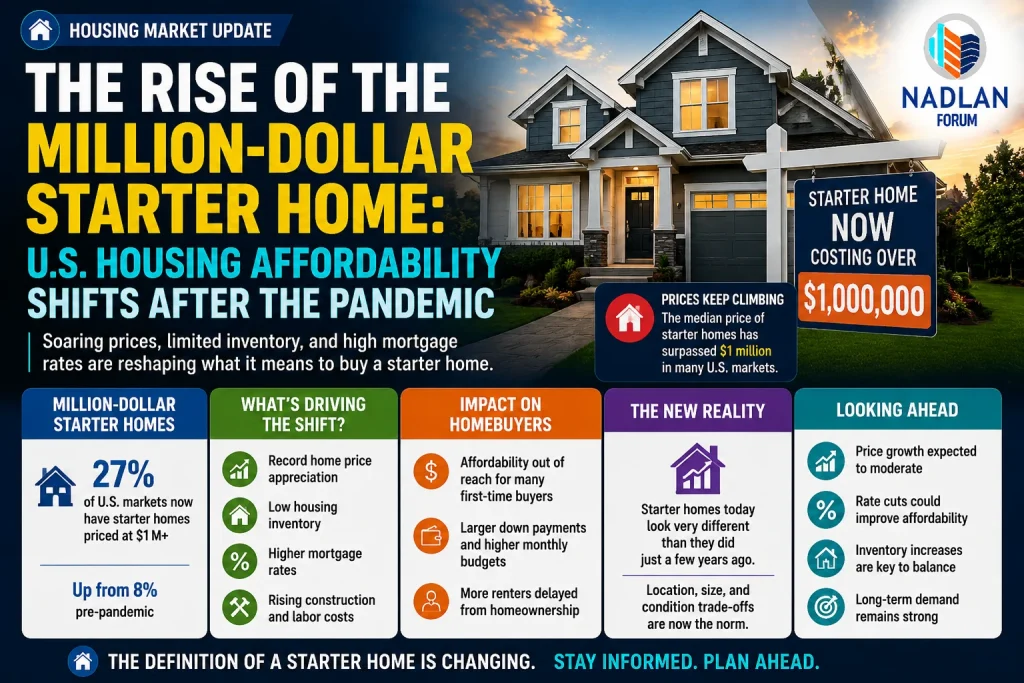
A growing number of American cities are seeing a dramatic change in what it costs to enter the housing market. Homes once considered “starter properties” are now priced at levels that were previously associated with luxury housing.
A recent Zillow analysis shows that 242 cities across 26 states now have starter homes valued at $1 million or more, highlighting a major shift in affordability since the pandemic-era housing boom.
What Is a “Starter Home”?
A starter home is typically defined as a property within the lowest third of home values in a given area. These are usually the entry-level homes that first-time buyers purchase before moving into larger properties.
However, in many high-demand markets today, even these lower-tier homes have reached seven-figure price levels.
Despite this trend, the national average starter home value remains significantly lower at around $198,649, showing that million-dollar starter homes are still concentrated in specific regions rather than widespread nationwide.
Rapid Growth Since 2020
The number of cities with million-dollar starter homes has increased sharply over the past several years:
- 2020: 80 cities
- 2025: 226 cities
- 2026: 242 cities
This represents nearly a tripling of cities where entry-level housing costs reach $1 million.
The surge is largely tied to pandemic-era housing dynamics, including:
- Record-low mortgage rates during 2020–2021
- Limited housing supply from a long-term construction shortage
- Increased demand driven by remote work flexibility
- Rapid home price appreciation in major metro areas
These factors combined to push home values higher across many regions, especially in urban and coastal markets.
States With the Most Million-Dollar Starter Home Cities
Some states account for the majority of these high-cost entry markets.
Leading states (April 2026)
| State | Cities with $1M+ Starter Homes |
|---|---|
| California | 105 |
| New York | 41 |
| New Jersey | 26 |
| Florida | 11 |
| Massachusetts | 10 |
| Washington | 8 |
| Texas | 7 |
| Connecticut | 4 |
| Hawaii | 4 |
| Maryland | 4 |
California continues to dominate the list, but the fastest growth has shifted toward the Northeast.
Where Growth Is Happening the Fastest
New York and New Jersey have seen the most rapid expansion in the number of cities with million-dollar starter homes.
Together, the two states added 15 new cities in just one year, reflecting ongoing affordability pressure in the region.
This trend aligns with broader housing conditions in the Northeast, where:
- Inventory remains tight
- New construction has lagged demand
- Competition among buyers remains strong
Metro Areas Leading the Trend
At the metro level, several major regions dominate the list of areas with expensive entry-level housing.
- New York City metro area: 63 cities
- San Francisco metro: 37 cities
- Los Angeles metro: 33 cities
- San Jose metro: 13 cities
- Miami metro: 8 cities
- Seattle metro: 8 cities
These metros continue to reflect high demand and limited supply, both of which contribute to elevated home prices even at the lower end of the market.
Housing Affordability Is Still Uneven
Although million-dollar starter homes are increasing, they remain concentrated in specific high-cost regions.
Most U.S. markets still have starter homes far below the million-dollar mark. However, affordability challenges are becoming more visible in major metropolitan areas, especially for first-time buyers.
At the same time, financial conditions for buyers have slightly improved compared to recent years. With slower home price growth and more available inventory in some markets, buyers are sometimes able to break even faster when compared to renting.
What This Means for First-Time Buyers
The rise in starter home prices creates new challenges for entry-level buyers:
- Higher down payments are required
- Monthly mortgage costs increase significantly
- Saving for a home takes longer in expensive metros
- Buyers may need to consider smaller or farther-out properties
In many high-cost areas, first-time buyers are increasingly looking outside city centers or exploring alternative housing options to enter the market.
Outlook for the Housing Market
Experts note that while affordability has worsened in select regions, homeownership is still possible in many parts of the country.
Markets with stronger inventory growth or slower price appreciation may offer better entry points for buyers in the coming years.
However, in coastal and high-demand metro areas, elevated starter home prices are likely to remain a long-term feature of the housing landscape unless significant new housing supply is added. For direct financing consultations or mortgage options for you visit 👉 Nadlan Capital Group.
