


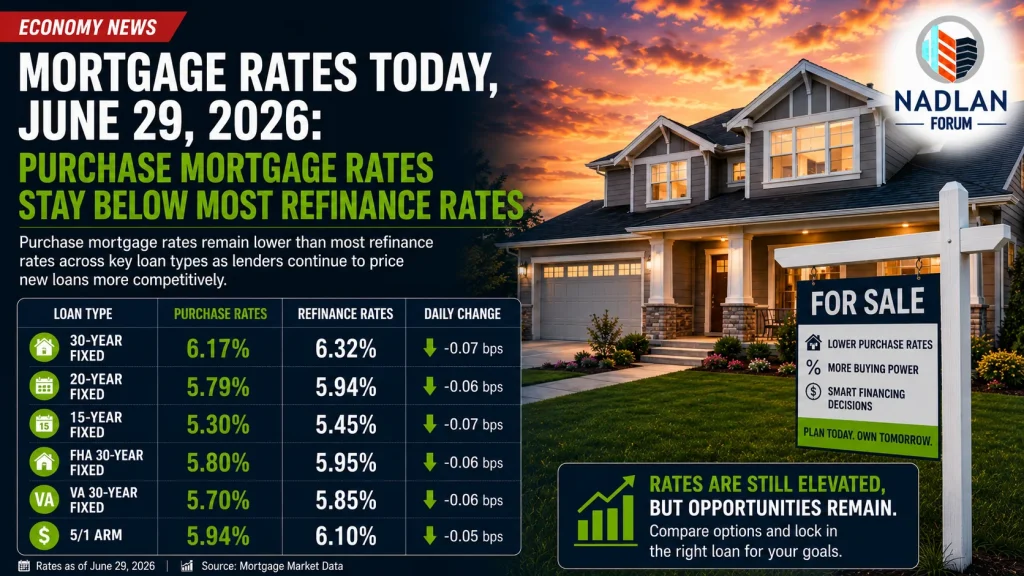
Mortgage rates began the new week with little change, giving homebuyers another opportunity to lock in financing near the lowest levels seen in more than a month. The latest market data shows that purchase mortgage rates continue to hold below most refinance rates, making new home financing slightly more attractive than refinancing for many borrowers.
Although mortgage rates remain well above the record lows experienced during the pandemic, recent improvements have created a more favorable lending environment as buyers continue navigating a competitive housing market.
For homeowners considering refinancing, the decision remains more complex, especially for those holding mortgage rates between 3% and 4% that were secured during 2020 through 2022.
Current Mortgage Rates Today
According to the latest national averages, today’s mortgage rates for home purchases are:
- 30-year fixed: 6.17%
- 20-year fixed: 6.00%
- 15-year fixed: 5.75%
- 5/1 Adjustable-Rate Mortgage (ARM): 6.09%
- 7/1 ARM: 6.14%
- 30-year VA: 5.69%
- 15-year VA: 5.41%
- 5/1 VA: 5.58%
Compared with recent market levels, purchase rates have continued moving modestly lower, helping improve affordability for buyers entering the housing market.
The average 30-year fixed mortgage remained at 6.17%, while shorter-term loans and adjustable-rate products also held near recent lows.
Current Refinance Rates
Homeowners exploring refinancing options saw the following national average refinance rates:
- 30-year fixed: 6.26%
- 20-year fixed: 5.96%
- 15-year fixed: 5.73%
- 5/1 ARM: 6.18%
- 7/1 ARM: 6.18%
- 30-year VA: 5.61%
- 15-year VA: 5.34%
- 5/1 VA: 5.56%
For most loan products, refinance rates remain slightly higher than purchase mortgage rates.
For example:
- The 30-year purchase mortgage is approximately 0.09 percentage points lower than the average 30-year refinance loan.
- The 5/1 ARM purchase rate also remains below its refinance equivalent.
This pricing difference reflects current lending conditions and borrower risk profiles rather than a permanent market trend.
Why Purchase Rates Are Lower Than Refinance Rates
Although refinance rates have often been similar to purchase rates, current market conditions have created modest pricing differences.
Several factors influence refinance pricing, including:
- Existing loan characteristics
- Borrower equity levels
- Loan-to-value ratios
- Market demand
- Overall lending risk
For homeowners with exceptionally low mortgage rates from previous years, refinancing into today’s higher-rate environment frequently provides limited financial benefit unless they need to access home equity or change loan terms.
As a result, purchase lending remains more active than traditional rate-and-term refinancing in today’s market.
30-Year Fixed Mortgage Remains the Most Popular Choice
The 30-year fixed mortgage continues to dominate home financing because it offers predictable monthly payments over the life of the loan.
Its primary advantages include:
- Fixed interest rate
- Stable monthly payment
- Lower monthly costs compared with shorter loan terms
- Easier household budgeting
Although borrowers pay more interest over 30 years, many buyers prefer the lower monthly payment and increased financial flexibility.
For example, financing a $300,000 mortgage over 30 years generally produces significantly lower monthly payments than the same loan repaid over 15 years.
Is a 15-Year Mortgage Right for You?
The average 15-year fixed mortgage rate currently stands at 5.75%, offering a lower interest rate than the standard 30-year loan.
Benefits of a 15-year mortgage include:
- Faster loan payoff
- Lower total interest costs
- Faster home equity growth
- Lower overall borrowing expense
The trade-off is a considerably higher monthly payment because the loan balance must be repaid in half the time.
Borrowers with stable income and room in their monthly budget often choose 15-year loans to reduce lifetime interest costs.
Adjustable-Rate Mortgages Continue to Be an Option
Adjustable-rate mortgages (ARMs) remain available for borrowers planning shorter ownership periods.
With products such as a 5/1 ARM, the interest rate remains fixed for the first five years before adjusting annually according to market conditions.
Potential advantages include:
- Lower introductory rates in some markets
- Reduced monthly payments during the initial period
- Suitable for shorter-term ownership plans
However, today’s market presents a different environment than previous years.
In some cases, fixed-rate mortgages now offer rates similar to—or even lower than—certain adjustable-rate loans, reducing one of the traditional advantages of ARMs.
Borrowers should carefully compare both options before making a financing decision.
How Buyers Can Qualify for Better Mortgage Rates
Individual financial qualifications remain one of the biggest factors influencing mortgage pricing.
Borrowers may improve their chances of receiving lower interest rates by:
- Increasing their down payment
- Improving their credit score
- Lowering their debt-to-income ratio
- Reducing outstanding debt
- Comparing multiple lenders
- Shopping for different loan programs
Some buyers may also choose to purchase discount points, which reduce the mortgage interest rate in exchange for higher upfront closing costs.
Temporary interest rate buydowns have also become more common as sellers and builders offer financing incentives to attract buyers.
Should You Consider a Rate Buydown?
A mortgage rate buydown allows borrowers to lower their interest rate either temporarily or permanently.
One common example is a 2-1 buydown, where:
- The interest rate is reduced by 2 percentage points during the first year.
- It increases by 1 percentage point during the second year.
- The loan then returns to its permanent interest rate for the remainder of the mortgage.
Rate buydowns can reduce monthly payments during the early years of homeownership, particularly when sellers or builders help cover the upfront cost.
However, buyers should calculate whether the long-term savings justify the additional closing expenses.
What Could Influence Mortgage Rates Next?
Although mortgage rates have improved recently, future movements will continue depending on several economic factors.
Markets remain focused on:
- Inflation reports
- Employment data
- Treasury bond yields
- Federal Reserve policy
- Consumer spending
- Economic growth
- Global financial developments
Upcoming economic reports, especially labor market data and inflation readings, could determine whether mortgage rates continue moving lower or stabilize near current levels.
Final Thoughts
Mortgage rates remained steady on June 29, 2026, with the average 30-year fixed purchase mortgage holding at 6.17%. Purchase loans continue to offer slightly lower rates than most refinance products, creating a more favorable environment for buyers entering the housing market.
While refinancing remains beneficial for some homeowners, many borrowers continue holding historically low mortgage rates secured during previous years. As a result, purchase activity has become the stronger segment of today’s mortgage market.
For anyone planning to buy a home or refinance, comparing multiple lenders, reviewing loan costs, and evaluating both fixed-rate and adjustable-rate options remain essential steps toward securing the most competitive financing available. For direct financing consultations or mortgage options for you visit 👉 Nadlan Capital Group.
