


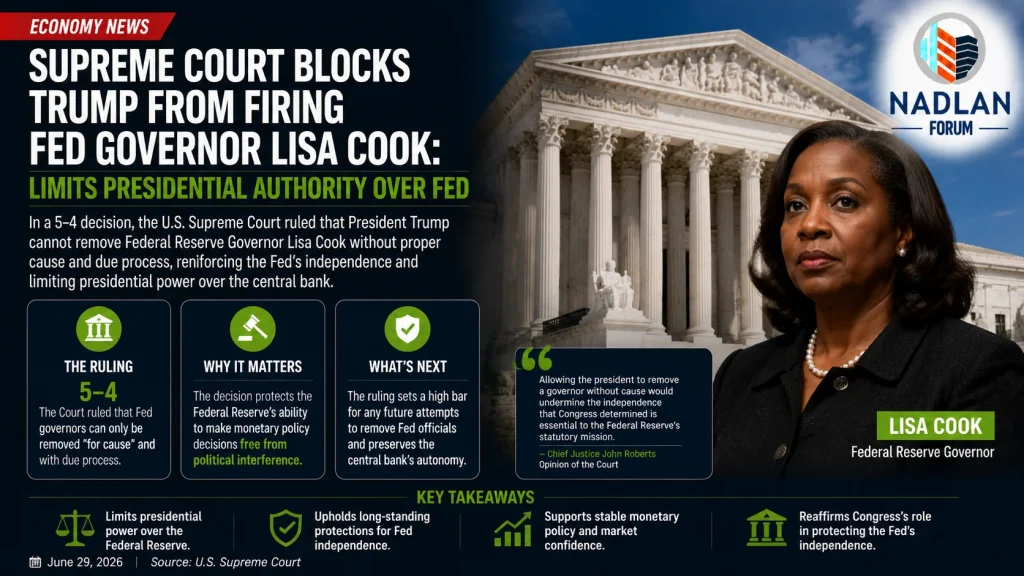
The U.S. Supreme Court has ruled that President Donald Trump cannot immediately remove Federal Reserve Governor Lisa Cook from office, marking a significant decision regarding the independence of the central bank.
At the same time, the Court issued a separate ruling that expanded presidential authority over certain federal agencies, creating a complex and split outcome that reshapes how executive power applies across government institutions.
The decisions, both authored by Chief Justice John Roberts, highlight the Court’s attempt to balance presidential authority with long-standing protections designed to shield the Federal Reserve from political interference.
Court Upholds Federal Reserve Independence
In the case involving Federal Reserve Governor Lisa Cook, the Supreme Court ruled 5–4 that she cannot be removed from office without proper legal process.
The Court rejected arguments from the administration that the president could immediately dismiss Cook over allegations of mortgage fraud, which she denies.
Chief Justice Roberts wrote that allowing such removal without due process would effectively eliminate statutory protections that ensure Federal Reserve independence.
The ruling reinforces the principle that the Federal Reserve must operate free from direct political pressure when setting monetary policy, including decisions on interest rates.
Due Process Requirements for Removal
While the Court blocked the immediate removal, it did not entirely prevent future action.
The ruling stated that any attempt to remove a Federal Reserve governor must follow proper legal procedures, including:
- Clear explanation of the allegations
- Opportunity for the official to respond
- A defined timeline for review
- Judicial oversight of the process
The Court emphasized that only after these steps are completed can courts evaluate whether removal is legally justified.
This ensures that Federal Reserve officials cannot be dismissed without formal review and procedural fairness.
Separate Ruling Expands Executive Authority
In a separate but related decision, the Supreme Court allowed President Trump to remove a member of the Federal Trade Commission, signaling a broader shift in how the Court views presidential power over federal agencies.
That ruling overturned long-standing precedent established in a 1935 case that had limited presidential authority to remove independent agency officials.
The contrasting outcomes highlight a key distinction made by the Court between the Federal Reserve and other regulatory agencies.
While some agencies may now face stronger executive control, the Federal Reserve appears to retain a higher level of institutional independence.
Split Decision Reflects Divided Court Reasoning
The Court’s rulings were divided differently across the two cases.
- The Lisa Cook case was decided 5–4, with some conservative justices joining liberals to uphold Fed protections.
- The FTC-related case was decided 6–3, reflecting a more traditional ideological split.
Chief Justice Roberts and Justice Brett Kavanaugh were among the few justices who joined the majority in both cases, reflecting a nuanced approach to executive authority rather than a uniform ideological position.
Why Federal Reserve Independence Matters
The Federal Reserve plays a central role in the U.S. economy by setting interest rates and controlling monetary policy.
Its independence is widely considered important because it allows policymakers to make decisions based on economic data rather than political pressure.
If the Fed were subject to direct presidential control, critics argue it could lead to:
- Short-term political influence over interest rates
- Reduced credibility in financial markets
- Increased inflation risk
- Less predictable monetary policy
By limiting the president’s ability to remove Fed governors without cause and due process, the Court reinforced the institutional separation between monetary policy and political leadership.
Political Response and Ongoing Legal Debate
Following the ruling, President Trump indicated on social media that he would continue pursuing action against Cook, suggesting the dispute is not fully resolved.
The Court’s decision leaves open the possibility of future proceedings if proper legal steps are followed.
Supporters of the ruling view it as a defense of central bank independence, while critics argue it restricts presidential oversight of appointed officials.
The broader legal debate centers on how much control a president should have over independent agencies versus the need to preserve institutional checks and balances.
Implications for Financial Markets
The ruling has potential implications for financial markets and interest rate expectations.
By reinforcing Federal Reserve independence, the decision may:
- Increase confidence in monetary policy stability
- Reduce concerns about political interference in rate decisions
- Strengthen investor trust in long-term policy consistency
- Support bond market stability
Markets generally value predictable and independent central banking, especially during periods of inflation uncertainty.
Connection to Broader Fed Policy Environment
The ruling comes at a time when the Federal Reserve is already navigating complex economic conditions, including:
- Elevated inflation pressures
- Strong investment in artificial intelligence infrastructure
- Labor market uncertainty
- Ongoing debates about future interest rate policy
Recent statements from Fed officials have highlighted the challenge of balancing economic growth with inflation control, particularly as new sources of demand emerge in sectors like technology and infrastructure.
Final Thoughts
The Supreme Court’s decision to block President Trump from immediately firing Federal Reserve Governor Lisa Cook reinforces the long-standing principle of central bank independence in the United States.
At the same time, the Court’s separate ruling expanding executive authority over other agencies reflects a more flexible approach to presidential power in different institutional contexts.
Together, the decisions highlight the ongoing tension between political authority and independent economic governance—an issue that continues to shape U.S. monetary policy, financial markets, and institutional stability in 2026. For direct financing consultations or mortgage options for you visit 👉 Nadlan Capital Group.
