


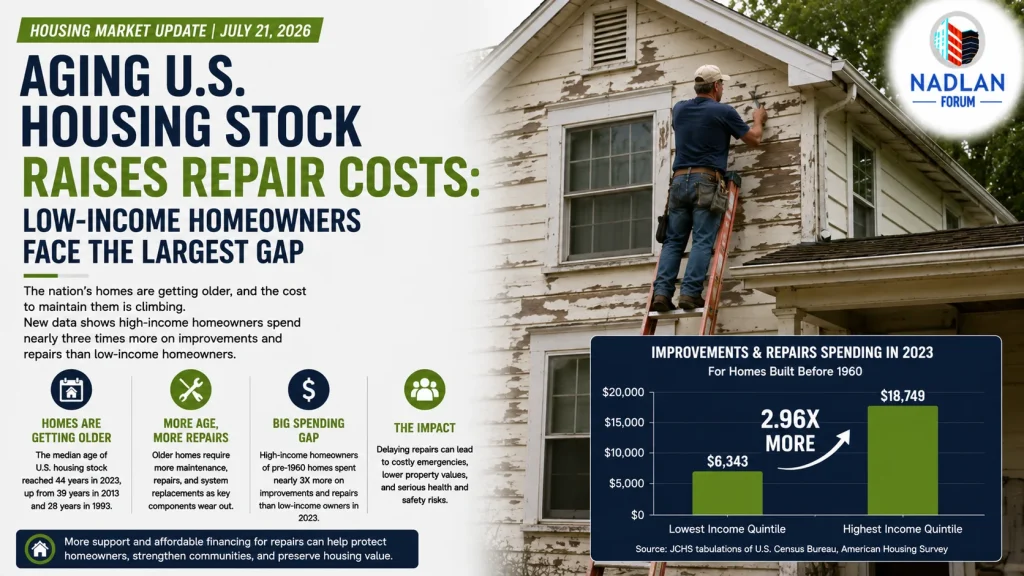
America’s housing stock is older than at any previous point on record, creating a growing need for repairs, maintenance, and replacement of major home systems.
Homeowners generally spend more as properties age because roofs, siding, windows, plumbing, electrical systems, heating equipment, and other parts of a home eventually wear out. However, the households living in the oldest properties are not always financially prepared to complete that work.
Among owners of homes built before 1960, households in the highest income group spent nearly three times as much on improvements and repairs in 2023 as those in the lowest income group.
This spending gap creates a serious challenge. Older properties typically require more work, but many are occupied by households with limited savings, lower incomes, or little access to affordable financing.
As repairs are delayed, minor problems can become expensive emergencies. Deferred maintenance can also reduce property values and expose residents to health and safety risks.
The Typical U.S. Home Is Now 44 Years Old
The median age of the nation’s housing stock reached 44 years in 2023, up from 39 years in 2013 and 28 years in 1993. This means half of U.S. homes were built before approximately 1979.
Several long-term trends have contributed to the increase.
Homebuilding fell sharply during and after the Great Recession, leaving the country with fewer newly constructed homes than in earlier decades. At the same time, stronger building standards, improved construction materials, and better renovation practices have allowed older properties to remain usable for longer periods.
Instead of older homes being replaced, many continue to make up an important part of the nation’s housing supply.
In 2023, approximately 22 million homeowners, or close to one in four owner households, lived in homes constructed before 1960.
These properties provide important housing options, particularly in older cities, rural communities, and established neighborhoods where new construction may be limited or expensive.
Older Homes Require Different Types of Spending
Owners of new and old homes do not spend money on the same kinds of projects.
People living in newer properties may focus more on landscaping, outdoor improvements, additions, patios, fences, pools, or design changes.
Owners of older properties are more likely to spend money on necessary maintenance and the replacement of worn components.
In 2023, maintenance accounted for approximately 22% of total improvement and repair spending on homes built before 1960. It represented only about 16% of spending on properties constructed in 2010 or later.
Replacement projects also took a much larger share of spending in older homes.
Work involving roofs, siding, windows, insulation, plumbing, heating and cooling equipment, and other major systems represented about 39% of spending on pre-1960 homes, compared with 24% for homes built after 2010.
These projects are often difficult to postpone. A worn roof, broken heating system, unsafe wiring, or major plumbing leak can quickly affect whether a home remains safe and livable.
Newer Homes Receive More Optional Improvements
Owners of newer homes generally spend a greater share of their remodeling budgets on optional or lifestyle-related projects.
Outdoor improvements, including landscaping, fences, sheds, pools, and recreational areas, represented about one-third of spending on homes built in 2010 or later.
The same category accounted for only around 10% of spending on properties built before 1960.
Room additions, porches, and other exterior attachments were also more common among newer homes. These projects represented approximately 15% of spending on recently built properties, compared with about 8% for older homes.
This difference does not necessarily mean owners of older homes do not want these improvements. Many must first direct their available money toward basic repairs and essential replacements.
Repair Costs Rise After Homes Reach 20 Years
Home improvement and maintenance spending generally increases once a property becomes more than 20 years old.
By that point, original appliances, roofing materials, heating and cooling systems, windows, and other components may begin reaching the end of their expected life.
In 2023, homeowners in properties built before 1960 spent an average of approximately $6,000 on improvements and maintenance.
Owners of homes built in 2010 or later spent about $4,500, making average spending on the oldest homes roughly 35% higher.
The same general pattern appears across income groups. Higher- and lower-income households both tend to spend more when they live in older homes.
The difference is that wealthier households usually have more ability to complete the full range of needed projects.
Income Determines Which Repairs Get Completed
Among homeowners living in properties built before 1960, those in the highest income quintile spent an average of approximately $12,700 on improvements and repairs in 2023.
Owners in the lowest income quintile spent about $3,400.
That difference does not mean lower-income homes need less work. In many cases, these properties may have greater repair needs because important projects have already been delayed.
Higher-income owners of newer homes also spent more than lower-income households living in much older properties.
Affluent owners of homes built after 2010 spent an average of around $7,400, more than twice the amount spent by lower-income owners of homes built before 1960.
This suggests that renovation spending reflects financial capacity as much as physical need.
Separate national research found that homeowners in the bottom fifth of the income distribution spent an average of about $3,100 on improvements and repairs in 2023, compared with $10,900 among households in the top fifth.
Deferred Maintenance Can Become More Expensive
Postponing repairs may provide temporary relief to a household budget, but it can increase costs over time.
A small roof leak may eventually damage insulation, ceilings, walls, floors, and electrical systems. A plumbing problem can lead to mold, structural damage, and higher water bills.
An inefficient heating system may increase monthly energy expenses before it eventually fails completely.
Routine maintenance is usually less expensive than an emergency replacement, but many lower-income owners do not have enough savings to address problems early.
Some also face difficulty obtaining home-equity loans, personal loans, or affordable contractor financing.
Older homeowners with fixed incomes may be especially vulnerable. They may own their homes without a mortgage but still lack the cash needed for a roof, furnace, electrical update, or accessibility improvement.
Millions of Homes Have Serious Physical Problems
In 2023, approximately 2.9 million homeowner households, representing about 3.3% of owners, lived in homes classified by HUD as moderately or severely inadequate.
These homes may have problems such as major water leaks, open cracks, holes in floors, unsafe electrical systems, plumbing failures, or inadequate heating.
The rate was significantly higher among older properties.
Approximately 5.4% of owner-occupied homes built before 1960 were considered inadequate, compared with about 1.3% of homes built in 2010 or later.
The difference shows how physical conditions tend to decline when aging components are not repaired or replaced.
Even homes that meet basic federal adequacy standards may still need substantial work. A home can technically remain habitable while having an aging roof, inefficient windows, outdated plumbing, damaged siding, or an unreliable heating system.
National Repair Needs Reach Nearly $200 Billion
A Federal Reserve Bank of Philadelphia analysis estimated that repairing identified problems in occupied U.S. homes would cost approximately $198.4 billion in 2024 dollars.
Households earning below 200% of the federal poverty level occupied about 29% of housing units but represented roughly 37.6% of the total estimated repair costs, or $74.6 billion.
Nearly three-quarters of households with repair needs required less than $5,000 worth of work.
Although these amounts may appear moderate compared with major renovations, even a $2,000 or $4,000 repair can be unaffordable for a household with limited savings.
Around 5.4 million households had estimated repair needs of at least $10,000, according to the same analysis.
The findings show that the national repair problem is not limited to a small number of severely damaged homes. It includes millions of properties with smaller but still important maintenance needs.
The Oldest Homes Need Repairs More Often
Older properties are substantially more likely to require at least one repair than recently built homes.
Research cited in the housing analysis found that nearly half of owner-occupied homes built before 1940 required some form of repair, compared with roughly one-quarter of those constructed in 2000 or later.
Older properties also carried higher average repair costs because they were more likely to need structural work or replacement of major systems.
Homes built before 1940 had an estimated average repair cost of approximately $5,200 per affected unit, compared with about $3,600 for homes built in 2000 or later.
The combined repair need for owner-occupied homes built before 1940 was estimated at roughly $23.9 billion.
These properties frequently contain materials and systems that require specialized work. They may also have outdated layouts, old wiring, lead paint, inefficient heating, or construction features that do not meet current standards.
Older Homes Support Affordable Homeownership
Despite their repair needs, older properties remain an essential source of lower-cost housing.
Homes built many decades ago often sell for less than newly constructed properties because they may be smaller, have fewer modern features, or require renovation.
In 2023, approximately 29% of homeowners in the lowest income quintile lived in properties constructed before 1960.
For many households, these homes provide one of the few paths to ownership in communities where new construction is too expensive.
However, a lower purchase price does not always mean the home will remain affordable.
An older house may require a new roof, heating system, plumbing work, foundation repair, or electrical upgrade soon after purchase. These expenses can create significant pressure for buyers who already used most of their savings for the down payment and closing costs.
Buyers should therefore consider the expected condition of major systems—not only the listing price—when comparing older and newer homes.
Poor Maintenance Can Reduce Household Wealth
A home is the largest financial asset for many American households.
When owners cannot maintain it, the property may lose value or appreciate more slowly than comparable homes in better condition.
This limits the owner’s ability to build equity, borrow against the property, or receive a strong sale price later.
Deferred maintenance can also make refinancing or obtaining a home-equity loan more difficult if the property does not meet appraisal or lending standards.
For lower-income owners, this creates a cycle.
They may lack money to complete repairs, but the unrepaired condition may prevent them from using the home’s value to finance the work.
Over time, this can widen the wealth gap between homeowners who can regularly invest in their properties and those who cannot.
Aging Homes Can Create Health and Safety Risks
Unrepaired homes may expose residents to more than financial problems.
Water intrusion and poor ventilation can lead to mold and unhealthy indoor air. Old paint may create lead exposure risks, particularly for young children.
Outdated wiring can increase the risk of electrical fires. Damaged stairs, railings, floors, and porches can cause falls and injuries.
Broken heating or cooling equipment may expose older adults and other vulnerable residents to unsafe indoor temperatures.
Many repairs also affect energy efficiency.
Poor insulation, old windows, leaking ducts, and outdated equipment can lead to high utility bills, placing additional pressure on households that already have limited income.
Repair assistance can therefore support public health, housing stability, energy savings, and neighborhood conditions at the same time.
Pennsylvania Created a Statewide Repair Program
Pennsylvania established the Whole-Home Repairs Program to support repairs and improvements for eligible homeowners and small rental property owners.
The program provides money through county-level agencies to address habitability and safety problems, improve energy or water efficiency, and make homes more accessible for people with disabilities. It also supports workforce development in construction-related fields.
Eligible work may include roof repairs, plumbing, electrical improvements, heating systems, accessibility modifications, and other projects needed to keep homes usable.
The program is important because many traditional housing policies focus on building new homes rather than preserving existing ones.
Repairing an occupied home can sometimes be faster and less expensive than replacing a property after it becomes uninhabitable.
Federal Policy Also Recognizes Repair Needs
Federal housing policy has begun giving more attention to the condition of existing owner-occupied homes.
New repair initiatives aim to help income-qualified homeowners address problems involving safety, habitability, accessibility, weatherization, and essential systems.
These programs can help prevent displacement, protect affordable housing, and allow older adults to remain in their homes.
However, current public funding remains small compared with the scale of the need.
The estimated national repair gap reaches tens of billions of dollars for the oldest owner-occupied properties and nearly $200 billion across all occupied housing with identified problems.
A meaningful response would likely require stable funding over many years rather than short-term pilot programs.
More Repair Support Could Protect Housing Supply
The national housing debate often focuses on building new homes, but maintaining existing properties is also important.
When an older home becomes unsafe or uninhabitable, the country effectively loses part of its housing supply.
That loss is especially damaging in communities where affordable homes are already limited.
Repair grants, low-cost loans, tax credits, weatherization programs, and emergency assistance can help keep existing homes occupied.
Programs may be most effective when they target:
- Low-income homeowners
- Older adults living on fixed incomes
- Homes with serious health or safety problems
- Properties in areas with limited affordable housing
- Repairs that prevent further structural damage
- Accessibility work that allows residents to age in place
- Energy improvements that reduce monthly costs
Careful oversight is still necessary to ensure funding reaches qualified owners and that contractors complete safe, reliable work.
Aging Homes Will Require Long-Term Investment
The growing age of the housing stock means repair needs are unlikely to decline soon.
Many homes built during the large construction periods of the 1970s, 1980s, and 1990s are now reaching ages when original roofs, windows, plumbing, and mechanical equipment may need replacement.
At the same time, national remodeling growth is expected to slow during 2026, even as spending continues to rise modestly. Harvard’s remodeling indicator projected annual improvement and maintenance growth of about 2.1% around midyear before easing to approximately 1.6% by the end of 2026.
Slower spending does not necessarily mean homes need less work. It may reflect homeowners delaying projects because of high labor costs, material prices, borrowing rates, and general economic pressure.
Bottom Line
The typical American home is now older than ever, and millions of properties require ongoing maintenance or major repairs.
Owners of older homes spend more on essential systems and replacement projects, but household income strongly determines which repairs are actually completed.
Higher-income households can invest thousands more each year, while lower-income owners may delay important work even when their homes have greater physical needs.
Without adequate repairs, properties can lose value, create safety hazards, raise utility costs, and eventually disappear from the usable housing supply.
Building new homes remains important, but preserving existing housing is also necessary. Expanding well-managed repair assistance could protect affordable homeownership, strengthen neighborhoods, and help families remain safely in homes they already own. For direct financing consultations or mortgage options for you visit 👉 Nadlan Capital Group.
