


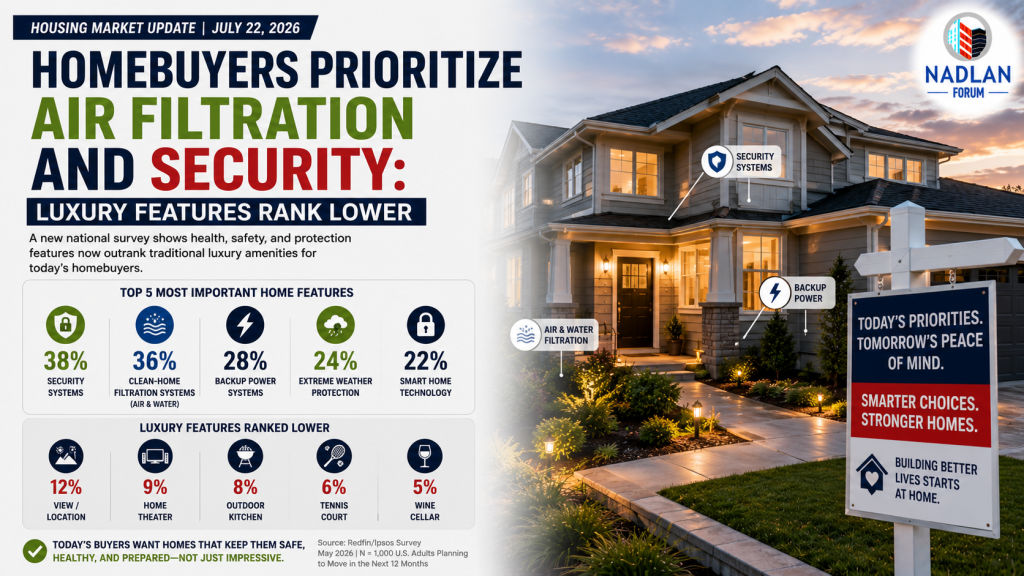
Homebuyers are becoming more focused on health, safety, and protection when choosing their next property.
A new national survey found that 36% of people planning to move within the next year consider a clean home with advanced air or water filtration systems one of their three most important features.
Security systems ranked slightly higher at 38%, although the difference between the two results was not statistically significant. Together, clean-home systems and security features ranked above every other option included in the survey.
The findings suggest that many buyers are giving practical features greater importance than traditional luxury additions.
Views, home theaters, outdoor kitchens, and tennis courts may still attract interest, but more buyers appear to be thinking about air quality, personal safety, power outages, and the ability of a home to remain comfortable during extreme weather.
Survey Focused on People Planning to Move
The survey was conducted in May 2026 and included approximately 4,000 U.S. residents.
The housing-preference results focused on roughly 1,000 respondents who said they planned to move within the following 12 months. Participants were asked to choose their three most important features from a list of 22 options.
The most common priorities were:
- Security systems: 38%
- Clean-home filtration systems: 36%
- Views: 25%
- Smart-home technology: 20%
- Backup power generation: 19%
- Climate-resilient features: 14%
Luxury amenities ranked considerably lower.
Only 10% selected outdoor kitchens as a top-three priority, while home theaters received 7% and tennis courts received 4%.
These results show that buyers are increasingly interested in how a home performs during everyday life and emergencies, not only how impressive it looks.
Clean Homes Now Mean More Than Appearance
In this survey, a clean home did not simply mean freshly painted rooms, polished floors, or a well-maintained kitchen.
The term included homes equipped with higher-quality systems that improve indoor air and water.
Examples may include:
- Whole-home air filtration
- High-efficiency HVAC filters
- Air purification systems
- Whole-house water filtration
- Reverse-osmosis drinking-water systems
- Humidity-control systems
- Improved ventilation
These systems can help reduce smoke particles, dust, allergens, odors, and some other indoor pollutants.
For households with children, older adults, asthma, allergies, or other sensitivities, indoor environmental quality may be a major part of the homebuying decision.
A filtration system can also offer reassurance during periods when outdoor air quality becomes unhealthy.
Wildfire Smoke Has Increased Awareness
The survey was completed before a major period of Canadian wildfire smoke affected large parts of the United States.
In mid-July, smoke spread across sections of the Midwest and Northeast, placing more than 100 million people in 18 states and Washington, D.C., under air-quality alerts.
Minnesota, Ohio, Illinois, Indiana, and Michigan were among the areas reporting some of the poorest conditions, while unhealthy air also reached New York and parts of New England.
The event showed how wildfire smoke can affect homes located hundreds or even thousands of miles from an active fire.
A property does not need to be located near a forest or wildfire zone to experience poor indoor air.
Smoke particles can enter through doors, windows, ventilation openings, older ductwork, and small gaps in the building.
As these events become more familiar, buyers may place greater value on homes that can maintain safer indoor conditions.
Air Filtration Is Becoming a Practical Feature
Whole-home air filtration was once treated mainly as a premium upgrade.
It is increasingly being viewed as a practical system, similar to efficient heating, cooling, or insulation.
A high-quality system may help during:
- Wildfire smoke events
- High-pollen seasons
- Dust storms
- Construction activity
- Traffic pollution
- Indoor renovation work
- periods of poor outdoor air quality
However, buyers should understand that not every filtration system offers the same level of protection.
The performance depends on the filter rating, HVAC design, airflow, installation quality, building tightness, and how regularly the filter is replaced.
A poorly maintained system may offer limited benefit, even if the property description advertises advanced filtration.
Buyers interested in this feature should ask when the system was installed, how it is maintained, and whether replacement filters are widely available.
Water Quality Is Also Part of Buyer Interest
Whole-home water filtration is another feature receiving more attention.
Concerns about aging pipes, mineral content, taste, odor, and local water quality may encourage buyers to look for filtration or purification systems.
A whole-house system generally filters water before it reaches faucets, showers, and appliances.
A smaller reverse-osmosis system may treat only drinking water at one sink.
These systems may improve taste and reduce certain substances, but their performance depends on the filter type and the specific water-quality issue.
Buyers should not assume that every system removes every contaminant.
It is important to review the equipment specifications, maintenance records, and local water test results.
Filters, membranes, and other parts also require regular replacement, creating an ongoing ownership cost.
Security Systems Ranked First
Security systems were selected by 38% of prospective movers, making them the most frequently chosen feature in the survey.
Modern home-security systems may include:
- Door and window sensors
- Video doorbells
- Outdoor cameras
- Motion detection
- Smart locks
- Smoke and carbon-monoxide monitoring
- Water-leak sensors
- Professional emergency monitoring
Buyers may value these systems because they provide both physical security and remote access.
A homeowner can check cameras, lock doors, adjust alarms, or receive alerts while away from the property.
Security technology may be especially attractive to households that travel frequently, receive deliveries, live alone, or own a second home.
However, buyers should review monthly monitoring fees and determine whether equipment belongs to the seller or is leased from a service provider.
Views Remain Important
Views ranked third, with 25% of respondents selecting them as one of their most important home features.
This indicates that location and visual surroundings still matter, even as practical systems gain attention.
Buyers may pay more for views of:
- Water
- Mountains
- City skylines
- Parks
- Open land
- Natural landscapes
Views can improve enjoyment and sometimes support resale value.
However, they can also come with higher purchase prices, insurance costs, or environmental exposure.
Waterfront homes may face flood and storm risks. Mountain or hillside properties can have wildfire, erosion, or access concerns.
Buyers should balance the value of the view with the long-term cost and risk of the location.
Smart-Home Technology Ranked Fourth
Smart-home technology was a top-three priority for 20% of buyers.
This category may include connected thermostats, lighting, appliances, security equipment, blinds, irrigation systems, and energy monitors.
Smart technology can improve convenience and may help reduce utility use.
For example, a connected thermostat can adjust heating and cooling based on household schedules. Smart leak sensors can warn owners about plumbing failures before major damage occurs.
However, technology can become outdated quickly.
Buyers should check whether systems are compatible with commonly used platforms, whether they require paid subscriptions, and whether the seller will transfer ownership of the accounts and equipment.
Privacy and data security are also important considerations.
Backup Power Enters the Top Five
Backup power generation was selected by 19% of prospective buyers, placing it among the five most desired features.
This category includes generators, battery systems, and solar panels paired with energy storage.
Interest in backup power may be influenced by:
- Grid outages
- Severe storms
- Wildfires
- Extreme heat
- Winter freezes
- Public-safety power shutoffs
- Remote work
A power interruption can affect heating, cooling, refrigeration, internet access, medical equipment, well pumps, and home-security systems.
For households working from home, even a short outage can disrupt income and communication.
A backup system may therefore be viewed as more than a convenience.
Buyers Should Review Backup-System Details
Not every backup-power system can operate an entire home.
Some systems support only essential circuits, such as refrigerators, lights, internet equipment, and medical devices.
Others can power heating, air conditioning, and larger appliances.
Buyers should ask:
- Which parts of the home are connected?
- How long can the system operate?
- What fuel or battery capacity does it use?
- Is the equipment owned, financed, or leased?
- When was it last serviced?
- Are permits and warranties available?
Solar panels can also involve contracts that may need to be transferred during a sale.
A buyer should review any remaining loan balance, lease payment, maintenance responsibility, or electricity-purchase agreement before closing.
Climate-Resilient Features Gain Attention
Approximately 14% of respondents ranked climate-resilient upgrades among their most important considerations.
These features may vary by location.
In wildfire areas, they can include fire-resistant roofing, protected vents, cleared vegetation, and noncombustible exterior materials.
In hurricane markets, buyers may look for impact-resistant windows, storm shutters, reinforced roofs, and elevated utilities.
Flood-prone properties may benefit from drainage improvements, raised mechanical systems, flood barriers, and water-resistant building materials.
In regions exposed to extreme heat, buyers may prioritize insulation, efficient cooling, reflective roofing, shade, and backup power.
The growing interest suggests that more households are thinking about how a property will perform during future weather events, not just its present condition.
Luxury Features Rank Lower
Traditional luxury additions were less important to most buyers in the survey.
Only:
- 10% prioritized outdoor kitchens
- 7% selected home theaters
- 4% chose tennis courts
These features may appeal to certain high-end buyers, but they serve a narrower purpose than security, filtration, or backup power.
An outdoor kitchen may be difficult to use during extreme heat, smoke, heavy rain, or winter weather.
A home theater can provide entertainment, but it does not lower risk or improve basic household operations.
A tennis court requires land and maintenance and may not add value for every future buyer.
The results do not mean luxury features have no value. They show that most buyers are placing more importance on systems that improve daily comfort, safety, or reliability.
Millennial Buyers Focus on Clean Homes
Among millennials planning to move, 37% ranked clean-home systems as a top-three priority.
That placed filtration systems in a tie with security.
Backup power was selected by 20% of millennials, while 15% prioritized climate-resilient improvements.
Millennials are now in a major homebuying stage, with many purchasing homes for growing families, remote work, or long-term ownership.
This group has experienced wildfire smoke, severe storms, power interruptions, rising insurance costs, and increasing energy prices.
Those experiences may be influencing the types of features they value.
Instead of focusing only on design, many millennial buyers appear to be asking whether a home can protect their family and remain functional during disruptions.
Gen Z Shows the Strongest Interest
Gen Z respondents showed even greater interest in clean and secure homes.
Approximately 40% ranked filtration systems as a top priority, while 42% selected security systems.
These were the two leading features for the youngest group included in the survey.
Many Gen Z buyers are only beginning to enter the housing market.
They may be purchasing smaller homes, condominiums, or properties shared with family members or roommates.
Because affordability remains difficult, this group may be especially selective about features that directly affect health, safety, or utility costs.
They may also be more comfortable using connected systems and monitoring indoor conditions through apps and sensors.
Gen X Also Values Security and Filtration
Among Gen X respondents, 32% ranked security systems as a top priority.
Clean homes followed at 25%.
Gen X households may be balancing several needs, including children, aging parents, work-from-home space, and long-term retirement planning.
Security and air quality can be important for multigenerational homes.
This group may also own older properties that require HVAC, plumbing, electrical, or energy upgrades.
When moving, they may prefer a home where those systems have already been improved.
Baby Boomers Place Views First
Baby boomers showed a somewhat different pattern.
Views were the most popular feature, selected by 47% of respondents in this age group.
Security systems ranked second at 40%, followed by clean-home features at 35%.
The strong interest in views may reflect lifestyle choices connected to retirement, downsizing, or moving to a preferred destination.
However, boomers also placed substantial importance on security and filtration.
Older adults may be particularly sensitive to smoke, heat, allergens, and other environmental conditions.
They may also value systems that allow remote monitoring or reduce maintenance.
Health Features May Affect Resale Value
As buyer preferences change, filtration, security, and resilience upgrades could become more important in property marketing.
Features that once received little attention in listing descriptions may now help a home stand out.
Sellers may benefit from documenting:
- Filter type and efficiency
- HVAC upgrade dates
- Water-treatment equipment
- Security system ownership
- Generator capacity
- Solar battery storage
- Storm-resistant improvements
- Energy-efficiency certifications
Clear documentation can help buyers understand the value of the equipment.
However, sellers should avoid making broad health or safety claims that cannot be supported.
A system should be described accurately, including its age, condition, maintenance requirements, and coverage.
Buyers Should Include Systems in Inspections
A standard home inspection may not fully evaluate advanced filtration, security, solar, or backup-power systems.
Buyers may need specialized inspections or service records.
Important questions include:
- Is the system operating correctly?
- Are replacement parts available?
- Does it meet current codes?
- Is a warranty transferable?
- Is professional maintenance required?
- Are there subscription fees?
- Will the seller remove any equipment?
- Is the system included in the sale contract?
A feature that sounds valuable could become an expense if it is outdated, damaged, leased, or difficult to maintain.
Buyers should include these details in their review before making a final decision.
Practical Features Can Affect Monthly Costs
Health and safety systems may add value, but they also carry ongoing expenses.
Air filters must be replaced. Water systems require cartridges or membranes. Security services may charge monthly fees. Generators require inspections and fuel. Battery systems may eventually need replacement.
Buyers should estimate these costs as part of the household budget.
They should also check whether upgrades create insurance discounts or energy savings.
Some insurers may provide reduced premiums for monitored alarms, leak sensors, impact-resistant roofs, storm protection, or other risk-reduction improvements.
Local governments or utilities may also offer incentives for certain energy or resilience projects.
Builders May Respond to Changing Demand
New-home builders often adjust designs based on buyer interest.
If demand for healthier and more resilient homes continues, builders may begin offering more filtration, security, backup power, and climate protection as standard features or upgrade packages.
Possible changes include:
- Higher-rated HVAC filtration
- Better ventilation
- Whole-house water systems
- Prewired security cameras
- Generator connections
- Solar-ready roofs
- Battery-storage space
- Leak-detection devices
- Fire- or storm-resistant materials
However, every added system increases construction cost.
Builders will need to balance buyer interest with affordability, especially while mortgage rates and home prices remain high.
Home Design May Change During Smoke Events
Longer and more frequent smoke events may also influence floor plans.
Households forced to remain indoors may place greater value on flexible interior space.
A bonus room, finished basement, indoor fitness area, playroom, or larger common area may become more useful when outdoor activities are limited.
Condo buyers may focus on shared indoor amenities such as gyms, lounges, coworking spaces, or event rooms.
This does not mean buyers will stop valuing yards, patios, or balconies.
Instead, they may look for homes that offer both outdoor access and comfortable indoor alternatives.
Location Is Still Important
Filtration systems and climate upgrades cannot remove every environmental risk.
Buyers should still research the property’s location.
Important factors may include:
- Wildfire risk
- Flood zones
- Storm history
- Local air quality
- Industrial activity
- Traffic pollution
- Water quality
- Power reliability
- Insurance availability
A well-equipped home in a high-risk area may still carry high insurance premiums or face repeated disruptions.
Buyers should compare the cost of the property with the cost of maintaining, protecting, and insuring it over time.
Bottom Line
Homebuyer priorities are changing as health, security, and environmental risks become a larger part of housing decisions.
Security systems ranked as a top-three priority for 38% of prospective movers, while 36% selected clean homes with advanced air or water filtration.
Views ranked third at 25%, followed by smart-home technology at 20% and backup power at 19%. Climate-resilient features were selected by 14% of buyers.
Luxury features received much less interest, with outdoor kitchens at 10%, home theaters at 7%, and tennis courts at 4%.
The results suggest that buyers are no longer looking only at size, finishes, and appearance.
They are also asking whether a home can provide clean air, safe water, reliable power, physical security, and protection during extreme weather.
For sellers and builders, these practical systems may become increasingly important as buyers place greater value on homes that support both everyday comfort and long-term safety. For direct financing consultations or mortgage options for you visit 👉 Nadlan Capital Group.
