


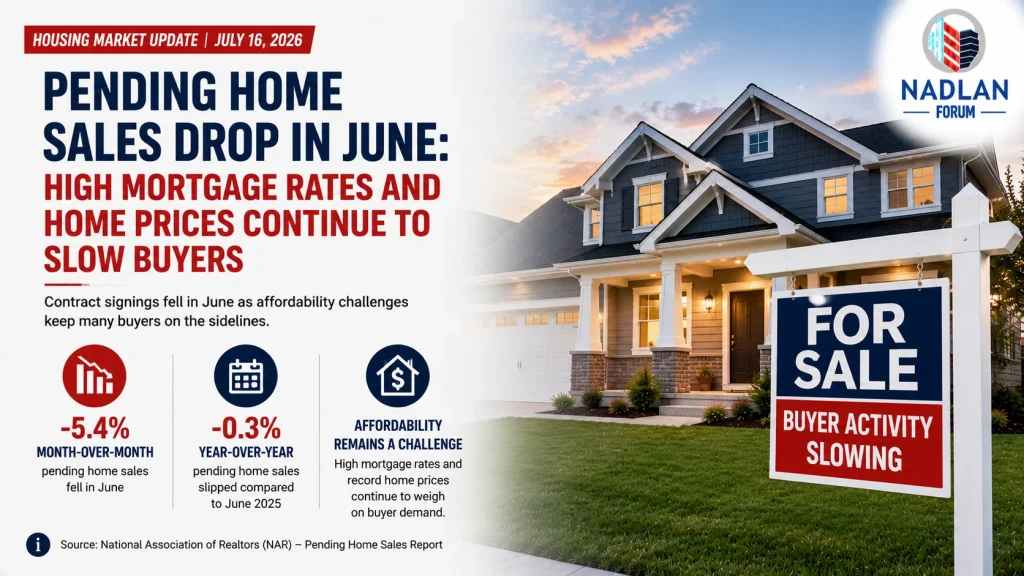
The U.S. housing market lost some momentum in June as pending home sales declined nationwide, highlighting the continued impact of elevated mortgage rates and record home prices on buyer activity. While employment remains relatively strong and some local markets continue to attract buyers, affordability challenges are keeping many households on the sidelines.
According to the latest Pending Home Sales Report from the National Association of Realtors (NAR), contract signings for existing homes fell 5.4% compared with May and were 0.3% lower than June 2025. The report suggests that many buyers are delaying purchasing decisions as borrowing costs remain high and home prices continue to hover near record levels.
Mortgage Rates and Home Prices Continue to Limit Demand
Housing affordability remains one of the biggest obstacles for prospective buyers in 2026. Mortgage rates have stayed near their highest levels in almost a year, while the national median existing-home price recently reached another record high.
This combination has made it increasingly difficult for first-time buyers to qualify for financing or comfortably manage monthly mortgage payments. Even buyers with stable incomes are taking more time to evaluate their options before signing a purchase contract.
Despite these challenges, continued job growth has helped prevent a much sharper slowdown in housing demand. A healthy labor market continues to provide many households with the confidence to remain active in their home search, even if purchases are taking longer to complete.
Every Region Reported Monthly Declines
Pending home sales declined on a month-over-month basis in all four major U.S. regions, showing that affordability concerns are widespread rather than limited to one part of the country.
Compared with the same period last year, however, regional performance was mixed.
The Northeast and Midwest posted modest annual increases in pending contracts, while the South and West experienced slight year-over-year declines. These differences reflect how local inventory levels, employment conditions, migration patterns, and home prices continue to shape individual housing markets.
What Pending Home Sales Tell Us
Pending home sales measure signed purchase contracts for existing homes before transactions officially close. Because most home sales are completed within one or two months after a contract is signed, the report is widely viewed as one of the best leading indicators of future existing-home sales.
However, pending contracts do not always become completed sales. Financing issues, appraisal problems, inspections, or buyer withdrawals can prevent some transactions from reaching the closing table. As a result, economists often view pending sales as an indication of future activity rather than a precise forecast.
Several Metro Areas Are Defying the National Trend
Although the national numbers point to slower activity, many local markets continue to perform well.
Among the nation’s 50 largest metropolitan areas, these cities recorded the strongest year-over-year increases in pending home sales during June:
- Virginia Beach–Chesapeake–Norfolk, VA-NC (+15.4%)
- Sacramento–Roseville–Folsom, CA (+15.2%)
- Kansas City, MO-KS (+14.4%)
- Richmond, VA (+14.0%)
- Buffalo–Cheektowaga, NY (+12.1%)
- Austin–Round Rock–San Marcos, TX (+11.1%)
- San Francisco–Oakland–Fremont, CA (+10.7%)
- Los Angeles–Long Beach–Anaheim, CA (+9.6%)
- Miami–Fort Lauderdale–West Palm Beach, FL (+9.5%)
- St. Louis, MO-IL (+9.1%)
These gains demonstrate that local housing conditions often differ significantly from national averages. Markets with improving employment, attractive pricing, or changing inventory levels continue to generate healthy buyer demand despite higher financing costs.
National Numbers Don’t Tell the Whole Story
Housing professionals caution against relying solely on national statistics when evaluating the market.
Different metro areas are experiencing very different conditions. Some cities continue to face limited inventory, which keeps competition high even as mortgage rates remain elevated. Other markets have seen inventory increase enough to provide buyers with more negotiating power and additional choices.
For example, inventory shortages continue to support pricing in parts of the Midwest, while several coastal markets have recently experienced renewed buyer activity after periods of slower demand. At the same time, a few cities are still adjusting to weaker price growth and softer sales conditions.
These regional differences explain why many real estate professionals describe today’s housing market as a collection of local markets rather than one national trend.
Buyers Are Becoming More Selective
Another trend emerging in 2026 is that buyers are taking longer to make purchasing decisions. Higher borrowing costs have increased monthly payments, making affordability a larger concern than it was just a few years ago.
Many buyers are comparing more properties, negotiating harder on price, requesting seller concessions, and waiting for homes that better fit their budgets. Sellers are also adapting by offering price reductions, mortgage rate buydowns, or assistance with closing costs in order to attract qualified buyers.
This more balanced environment is giving buyers additional negotiating opportunities in many areas, even though affordability remains challenging.
What Could Happen Next?
Looking ahead, future housing activity will largely depend on mortgage rates, inflation, employment growth, and available housing inventory.
If borrowing costs begin to ease later this year, pending home sales could gradually recover as more buyers return to the market. Likewise, continued inventory growth may improve affordability by giving buyers more options and reducing competitive bidding.
For now, however, the housing market remains in a transition period. National sales activity has slowed, but many local markets continue to perform well, showing that buyer demand has not disappeared—it has simply become more selective and more sensitive to affordability. For direct financing consultations or mortgage options for you visit 👉 Nadlan Capital Group.
