


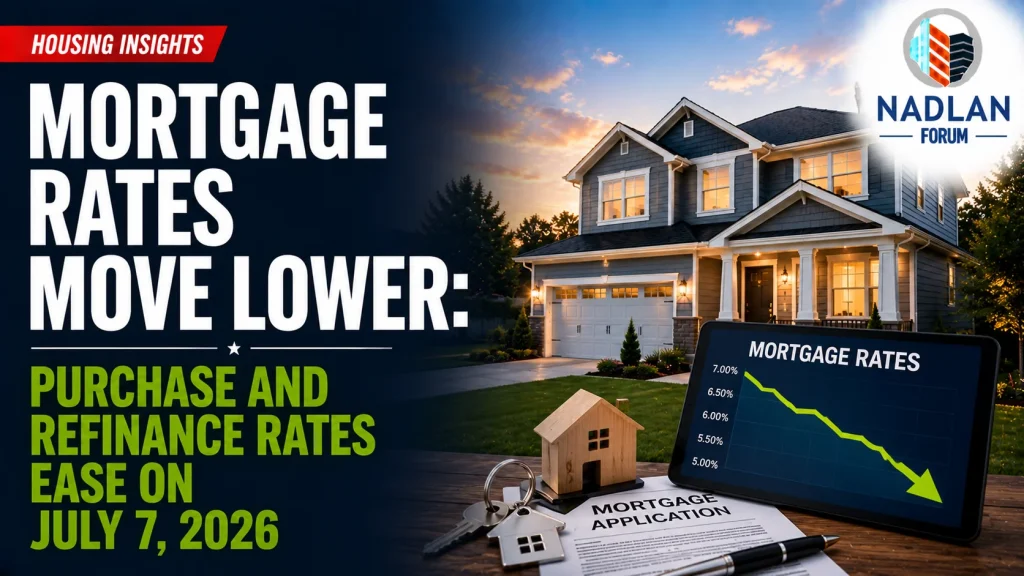
Mortgage rates moved modestly lower on Tuesday, giving homebuyers and homeowners a welcome break after several weeks of elevated borrowing costs. While interest rates remain well above the historic lows seen during the pandemic, the latest decline may improve affordability for buyers entering the market during the summer homebuying season.
Lower rates also provide refinancing opportunities for some homeowners, particularly those who purchased recently at higher interest rates. Although the changes are relatively small, every basis point can make a difference in monthly mortgage payments over the life of a loan.
Mortgage Rates Decline Across Most Loan Types
According to the latest national lending data, most popular mortgage products posted lower rates compared with the previous day.
Current average purchase mortgage rates include:
- 30-year fixed: 6.36%
- 20-year fixed: 6.24%
- 15-year fixed: 5.83%
- 5/1 Adjustable-Rate Mortgage (ARM): 6.31%
- 7/1 ARM: 6.24%
- 30-year VA: 5.76%
- 15-year VA: 5.49%
- 5/1 VA: 5.82%
Compared with Monday’s figures:
- The 30-year fixed mortgage declined by 4 basis points.
- The 15-year fixed mortgage fell by 3 basis points.
- The 5/1 ARM recorded one of the largest daily moves, declining by 21 basis points.
Although daily changes may appear small, lower interest rates can reduce monthly housing costs for new borrowers.
Current Refinance Rates
Refinance rates also remained relatively stable, with modest improvements across several loan products.
Current average refinance rates include:
- 30-year fixed: 6.38%
- 20-year fixed: 6.07%
- 15-year fixed: 5.84%
- 5/1 ARM: 6.36%
- 7/1 ARM: 6.00%
- 30-year VA: 5.84%
- 15-year VA: 5.48%
- 5/1 VA: 5.74%
Although refinance rates are often slightly higher than purchase mortgage rates, market conditions occasionally narrow or even reverse that difference.
Borrowers considering refinancing should compare loan offers from multiple lenders, as pricing can vary significantly based on credit profile, loan amount, and property type.
Lower Rates Can Improve Affordability
Even small declines in mortgage rates can have a meaningful impact on borrowing costs.
For example, a reduction of only a few basis points may lower monthly principal and interest payments, particularly on larger loan balances.
Lower rates can also:
- Improve purchasing power
- Reduce lifetime interest costs
- Increase refinancing opportunities
- Lower monthly housing expenses
- Improve mortgage qualification for some borrowers
While the latest decline is modest, continued stability could encourage more buyers to enter the housing market.
30-Year vs. 15-Year Mortgage
Many borrowers continue choosing between 30-year and 15-year fixed-rate mortgages.
Each option offers different advantages depending on financial goals.
30-Year Fixed Mortgage
A 30-year mortgage remains the most popular loan option because it provides:
- Lower monthly payments
- Greater financial flexibility
- Easier budgeting
- Improved affordability
The trade-off is paying substantially more interest over the life of the loan because payments are spread across three decades.
15-Year Fixed Mortgage
A 15-year mortgage offers several long-term financial benefits:
- Lower interest rate
- Faster loan payoff
- Less total interest paid
- Faster equity growth
However, monthly payments are significantly higher because the loan must be repaid in half the time.
Borrowers with stable income and sufficient cash flow often choose shorter loan terms to reduce overall borrowing costs.
Example of Long-Term Interest Savings
The difference between loan terms can be substantial.
For example, a $400,000 mortgage financed over 30 years at approximately 6.19% would generate a monthly principal and interest payment of about $2,447, while total interest paid over the life of the loan would exceed $480,000.
By comparison, financing the same amount over 15 years at approximately 5.65% increases the monthly payment to roughly $3,300, but reduces total interest costs to approximately $194,000.
Although monthly payments rise considerably, the long-term savings can be significant.
Fixed-Rate vs. Adjustable-Rate Mortgages
Another important decision involves choosing between a fixed-rate mortgage and an adjustable-rate mortgage (ARM).
Fixed-Rate Mortgages
Fixed-rate loans provide:
- Stable monthly payments
- Predictable budgeting
- Protection from future rate increases
- Long-term certainty
Many borrowers prefer fixed rates when interest rates remain relatively attractive or when planning to own a home for many years.
Adjustable-Rate Mortgages
Adjustable-rate mortgages maintain an introductory rate for a specific period before adjusting periodically based on market conditions.
Examples include:
- 5/1 ARM
- 7/1 ARM
These products may benefit buyers planning to move or refinance before the adjustment period begins.
However, borrowers assume the risk that interest rates could increase after the initial fixed period expires.
Interestingly, adjustable-rate mortgages have recently offered little or no pricing advantage compared with fixed-rate loans, making fixed mortgages more attractive for many buyers.
What Is Driving Mortgage Rates?
Mortgage rates continue responding to several economic factors.
Key influences include:
- Inflation expectations
- Federal Reserve policy
- Treasury bond yields
- Labor market conditions
- Economic growth
- Investor confidence
Recent employment data showing slower job growth has reduced expectations for additional interest rate increases, helping mortgage rates move modestly lower.
Financial markets continue closely monitoring inflation reports and Federal Reserve communications for additional clues regarding future rate movements.
What This Means for Homebuyers
Although mortgage rates remain above historical averages, today’s market offers several advantages that were unavailable during the intense housing competition of recent years.
Buyers now benefit from:
- More available inventory
- Greater negotiating power
- Slower home price appreciation
- Increased seller flexibility
- More financing options
Combining these market improvements with slightly lower mortgage rates could create favorable opportunities for qualified buyers during the second half of 2026.
Tips for Getting the Best Mortgage Rate
Borrowers can improve their chances of receiving a competitive mortgage rate by strengthening their financial profile before applying.
Helpful strategies include:
- Maintaining an excellent credit score
- Saving for a larger down payment
- Reducing outstanding debt
- Improving debt-to-income ratio
- Comparing multiple lenders
- Reviewing loan fees in addition to interest rates
- Considering discount points when appropriate
Even small improvements in borrower qualifications can result in lower financing costs.
Mortgage Rate Outlook
Current industry forecasts suggest mortgage rates may remain relatively stable throughout the remainder of 2026.
Many economists expect the average 30-year fixed mortgage rate to stay close to the mid-6% range, with moderate day-to-day fluctuations driven by economic reports, inflation data, and Federal Reserve policy expectations.
While significant declines appear unlikely in the near term, continued stability would provide greater certainty for buyers and homeowners planning major financial decisions.
Looking Ahead
Mortgage rates moved modestly lower on July 7, offering a small but meaningful improvement for both homebuyers and homeowners considering refinancing. The decline reflects changing expectations surrounding the economy and interest rate policy, while continuing to support a housing market that is gradually becoming more balanced.
As buyers gain access to more inventory and sellers adjust pricing strategies, even modest improvements in borrowing costs can help improve affordability. Future inflation reports, labor market data, and Federal Reserve decisions will continue shaping mortgage rate trends during the remainder of 2026. For direct financing consultations or mortgage options for you visit 👉 Nadlan Capital Group.
