


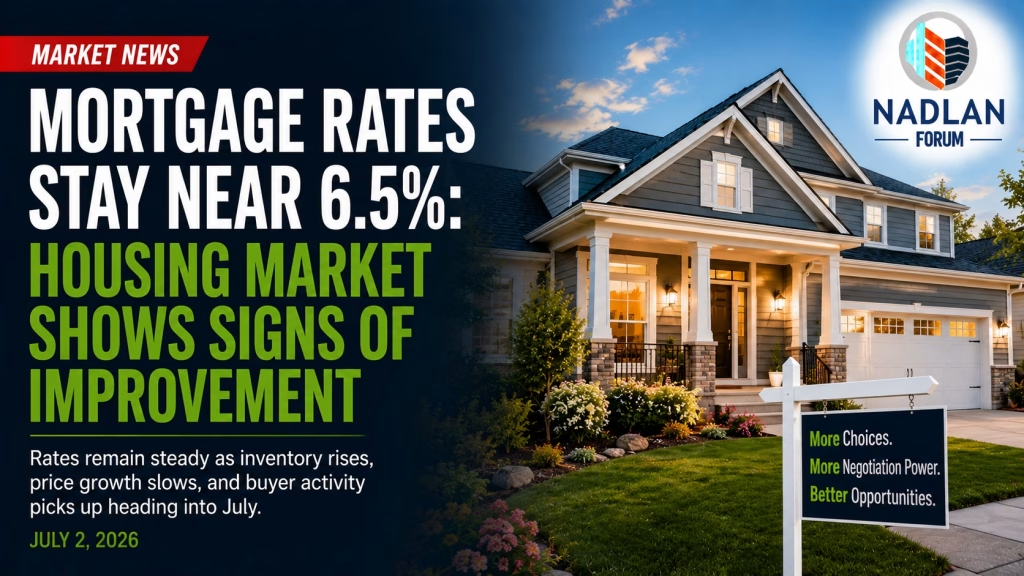
Mortgage rates remained relatively stable heading into early July, giving homebuyers a welcome period of consistency after months of market uncertainty. While borrowing costs are still much higher than the historic lows seen a few years ago, several housing indicators suggest that market conditions are gradually becoming more favorable for buyers.
The average 30-year fixed mortgage continues to hover around the mid-6% range, while housing inventory is improving, home price growth has slowed, and pending home sales are showing signs of recovery. Together, these developments indicate that the housing market is becoming more balanced as the second half of 2026 begins.
Mortgage Rates Continue to Hold Steady
According to the latest weekly data from Freddie Mac, the average 30-year fixed-rate mortgage declined slightly by six basis points to 6.43% for the week ending July 2, 2026.
Although the weekly change was modest, mortgage rates have remained close to the 6.5% level for nearly two months. This period of stability has helped many prospective buyers better plan their home purchases without worrying about large swings in financing costs.
While today’s rates remain elevated compared to the record-low levels experienced during 2020 and 2021, they have become more predictable, which is often just as important for buyers making long-term financial decisions.
Housing Market Shows Gradual Improvement
Several housing indicators released over recent weeks suggest that market conditions continue to improve, even as affordability remains a challenge.
Purchase mortgage applications have stayed ahead of last year’s pace for nearly three consecutive months. Buyers appear to be taking advantage of growing housing inventory and slower home price appreciation in many markets across the country.
More available listings have given buyers additional choices, reducing some of the competitive pressure that dominated the market over the past few years.
At the same time, many sellers are adjusting their pricing strategies to better match current market conditions. Instead of listing homes above market value and making repeated price cuts later, sellers are increasingly pricing homes more realistically from the beginning. This shift has encouraged more buyers to submit offers and has helped improve overall market activity.
Pending home sales have also posted several consecutive months of gains, while national home prices have continued to soften modestly, signaling that the market is moving toward a healthier balance between buyers and sellers.
Slower Job Growth May Ease Pressure on Interest Rates
Economic data released Thursday provided another factor supporting stable mortgage rates.
The U.S. economy added 57,000 jobs in June, significantly below economists’ expectations of approximately 115,000 new jobs.
A weaker labor market can reduce inflationary pressure, which often leads investors to expect a less aggressive approach from the Federal Reserve regarding future interest rate decisions.
Although mortgage rates are not directly controlled by the Federal Reserve, expectations surrounding monetary policy strongly influence Treasury yields, which in turn affect mortgage pricing.
If future economic reports continue to show slower growth and easing inflation, mortgage rates could remain relatively stable or even decline modestly during the coming months.
Current Mortgage Rates Today (July 2, 2026)
National average purchase mortgage rates currently stand at:
- 30-year fixed: 6.36%
- 20-year fixed: 6.22%
- 15-year fixed: 5.87%
- 5/1 Adjustable-Rate Mortgage (ARM): 6.41%
- 7/1 Adjustable-Rate Mortgage (ARM): 6.29%
- 30-year VA loan: 5.75%
- 15-year VA loan: 5.41%
- 5/1 VA ARM: 5.66%
Actual mortgage rates will vary depending on factors such as credit score, down payment, loan amount, debt-to-income ratio, lender pricing, and property location.
Current Mortgage Refinance Rates
Homeowners considering refinancing will find refinance rates remaining close to purchase mortgage rates.
Today’s average refinance rates include:
- 30-year fixed: 6.33%
- 20-year fixed: 6.31%
- 15-year fixed: 5.85%
- 5/1 ARM: 6.33%
- 7/1 ARM: 6.34%
- 30-year VA refinance: 5.80%
- 15-year VA refinance: 5.49%
- 5/1 VA ARM: 5.69%
While refinance rates are often slightly higher than purchase rates, market conditions can sometimes narrow that difference.
What These Rates Mean for Monthly Payments
Mortgage rates have a significant impact on monthly housing costs.
For example, financing a $340,000 loan (based on a $425,000 home with a 20% down payment) at approximately 6.34% on a 30-year fixed mortgage would produce a monthly principal and interest payment of roughly $2,100 before taxes, homeowners insurance, HOA fees, and other housing expenses.
Even relatively small changes in mortgage rates can noticeably affect monthly payments over the life of a loan, making it worthwhile for borrowers to compare offers from multiple lenders before locking in a rate.
Fixed-Rate vs. Adjustable-Rate Mortgages
Homebuyers generally choose between fixed-rate and adjustable-rate mortgages.
A fixed-rate mortgage keeps the same interest rate throughout the loan term, providing predictable monthly payments and protection against future rate increases.
An adjustable-rate mortgage (ARM) begins with a fixed introductory rate for several years before adjusting periodically based on market conditions. ARMs may offer lower initial payments, but borrowers should understand that rates can increase after the introductory period ends.
The right choice depends on factors such as how long the borrower expects to stay in the home, future income expectations, and overall financial goals.
What Determines Mortgage Rates?
Mortgage rates are influenced by both personal financial factors and broader economic conditions.
Borrowers typically receive better rates when they have:
- Higher credit scores
- Lower debt-to-income ratios
- Larger down payments
- Stable income and employment history
- Strong financial reserves
At the same time, broader economic forces also affect mortgage pricing, including inflation, employment data, Federal Reserve policy expectations, Treasury bond yields, and investor demand for mortgage-backed securities.
Because these economic conditions change regularly, mortgage rates can move even if an individual borrower’s financial profile remains unchanged.
30-Year vs. 15-Year Mortgage
The two most popular mortgage options continue to be the 30-year and 15-year fixed-rate loans.
A 30-year mortgage offers lower monthly payments by spreading repayment over a longer period, making homeownership more affordable for many buyers. However, borrowers pay substantially more interest over the life of the loan.
A 15-year mortgage usually comes with a lower interest rate and allows homeowners to build equity much faster while paying significantly less total interest. The tradeoff is a considerably higher monthly payment.
Choosing between these options depends on monthly budget, long-term financial goals, and how quickly a borrower wants to pay off the home.
Outlook for Mortgage Rates
Mortgage rates are expected to remain sensitive to incoming economic data throughout the summer.
Inflation reports, employment figures, consumer spending, and Federal Reserve communications will all continue to influence market expectations.
If inflation continues to ease and economic growth slows gradually, mortgage rates could drift modestly lower. However, persistent inflation or stronger-than-expected economic data could keep borrowing costs elevated for a longer period.
For buyers actively shopping for a home, today’s combination of stable mortgage rates, growing housing inventory, and slower home price growth offers better opportunities than many experienced over the past two years. For direct financing consultations or mortgage options for you visit 👉 Nadlan Capital Group.
Frequently Asked Questions
What is the average 30-year mortgage rate today?
As of July 2, 2026, the average 30-year fixed mortgage rate is approximately 6.36%, while Freddie Mac’s weekly average stands at 6.43%.
Why are mortgage rates staying around 6.5%?
Mortgage rates remain elevated because investors continue to monitor inflation, Federal Reserve policy expectations, Treasury yields, and overall economic conditions. Recent economic data has helped keep rates relatively stable rather than pushing them significantly higher.
Should I refinance my mortgage now?
Refinancing may be worthwhile if you can meaningfully reduce your interest rate, lower your monthly payment, shorten your loan term, or achieve another financial objective that offsets the closing costs.
Are mortgage rates expected to fall in 2026?
While no outcome is guaranteed, many analysts expect mortgage rates to remain relatively stable, with the possibility of modest declines if inflation continues to ease and economic growth slows during the remainder of 2026.
