


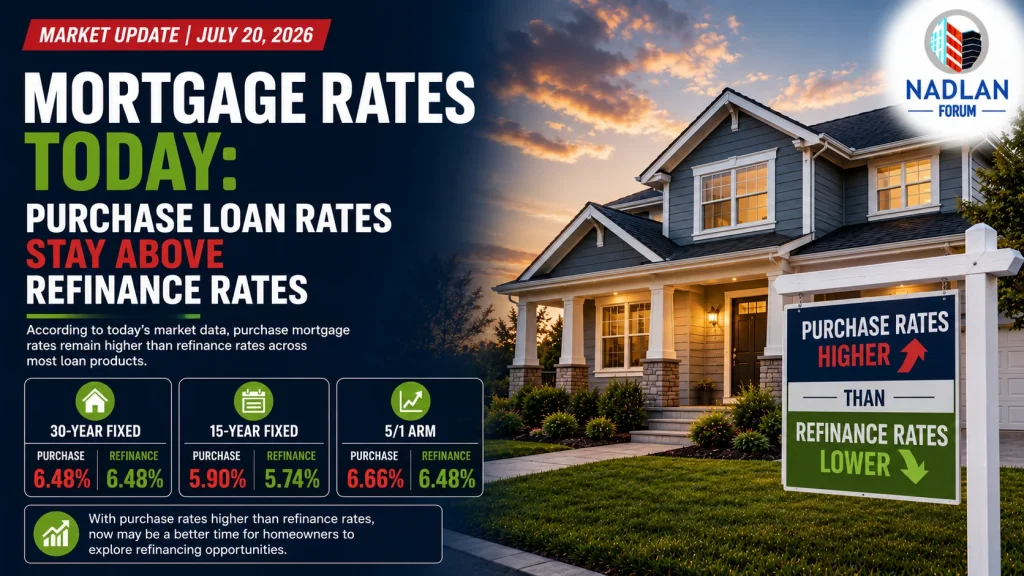
Mortgage rates were little changed to begin the new week, but one trend continues to stand out: many refinance loans are currently offering lower interest rates than comparable purchase mortgages.
Although the difference is not large across every loan product, borrowers looking to refinance may find slightly better pricing than buyers entering the market for a new home. At the same time, mortgage rates remain well below the highs reached earlier in the week after softer inflation reports improved conditions in the bond market.
While affordability remains a challenge for many households, stable mortgage rates and improving housing inventory continue to create opportunities for both buyers and homeowners considering refinancing.
Purchase Mortgage Rates Remain Elevated
According to the latest national averages, purchase mortgage rates were generally unchanged from the previous trading session.
Current average purchase mortgage rates are:
- 30-year fixed: 6.48%
- 20-year fixed: 6.18%
- 15-year fixed: 5.90%
- 5/1 ARM: 6.46%
- 7/1 ARM: 6.35%
- 30-year VA: 5.93%
- 15-year VA: 5.47%
- 5/1 VA: 5.75%
Although these figures represent national averages, individual borrowers may receive different offers depending on their credit profile, loan amount, property type, down payment, debt-to-income ratio, and lender.
Refinance Rates Offer Slightly Better Value
Refinancing continues to provide slightly lower rates for several popular mortgage products.
Current average refinance rates include:
- 30-year fixed: 6.48%
- 20-year fixed: 6.26%
- 15-year fixed: 5.74%
- 5/1 ARM: 6.28%
- 7/1 ARM: 6.36%
- 30-year VA: 5.80%
- 15-year VA: 5.70%
- 5/1 VA: 5.58%
The largest difference appears in the 15-year fixed loan, where refinance borrowers are paying noticeably lower rates than buyers financing a home purchase.
While refinance rates are often higher than purchase rates, today’s market shows that this relationship can reverse depending on lender competition and market conditions.
Why Purchase and Refinance Rates Can Differ
Many borrowers assume purchase loans and refinance loans always carry identical interest rates, but that is not necessarily the case.
Mortgage pricing depends on several factors, including:
- Investor demand for mortgage-backed securities
- Loan purpose
- Borrower credit quality
- Loan-to-value ratio
- Market competition among lenders
- Overall economic conditions
When lenders see stronger demand for refinancing or adjust pricing strategies to attract existing homeowners, refinance rates may temporarily fall below comparable purchase loans.
This is one reason financial experts encourage borrowers to compare multiple lenders instead of relying on national averages alone.
Understanding the 30-Year Fixed Mortgage
The 30-year fixed mortgage remains the most common home loan in the United States.
Its biggest advantage is affordability.
By spreading payments across 30 years, borrowers benefit from lower monthly payments than they would receive with shorter loan terms.
For example, a $300,000 mortgage at approximately 6.34% would produce a monthly principal and interest payment of about $1,865.
The trade-off is that borrowers pay significantly more interest over the life of the loan because repayment is stretched across three decades.
For many households, however, the lower monthly payment provides valuable financial flexibility.
Why Some Borrowers Choose a 15-Year Loan
The 15-year fixed mortgage remains attractive for buyers focused on long-term savings.
Because repayment occurs over half the time, borrowers usually receive lower interest rates while paying substantially less total interest.
Using the same $300,000 loan, a 5.90% interest rate would increase the monthly payment to roughly $2,515, but lifetime interest costs would be dramatically lower than with a 30-year mortgage.
For borrowers with stable income and room in their monthly budgets, the shorter loan can produce significant long-term savings while building home equity more quickly.
Adjustable-Rate Mortgages Still Offer Flexibility
Adjustable-rate mortgages (ARMs) continue to appeal to certain buyers, particularly those who expect to sell or refinance before the introductory fixed-rate period expires.
With a 5/1 ARM, the interest rate remains fixed for the first five years before adjusting annually based on market conditions.
Although ARMs have traditionally started with lower rates than fixed mortgages, recent market conditions have narrowed that advantage.
Because future adjustments depend on broader interest rate movements, borrowers should carefully evaluate the risks before selecting an adjustable-rate product.
For homeowners planning shorter stays, however, an ARM may still provide worthwhile savings.
Mortgage Calculator Shows Full Housing Costs
When estimating affordability, borrowers should consider more than principal and interest.
A complete mortgage payment often includes:
- Property taxes
- Homeowners insurance
- Private mortgage insurance (PMI), when required
- Homeowners association (HOA) dues
- Flood insurance in eligible areas
Including these expenses provides a much more accurate estimate of monthly housing costs than looking only at the mortgage payment.
For many homeowners, taxes and insurance now account for a growing share of total monthly housing expenses.
How to Qualify for a Lower Mortgage Rate
Even when national averages remain relatively stable, individual borrowers can often secure better pricing by strengthening their financial profile.
Several steps may improve mortgage offers:
- Increase your down payment.
- Improve your credit score.
- Reduce existing debt.
- Lower your debt-to-income ratio.
- Compare loan estimates from multiple lenders.
- Consider paying discount points if you plan to remain in the home for many years.
Some buyers also negotiate temporary rate buydowns, allowing lower payments during the first one or two years before the mortgage returns to its permanent interest rate.
Whether that strategy makes financial sense depends on the upfront cost and how long the borrower expects to keep the loan.
Mortgage Rates Continue Following Economic Data
Mortgage rates remain closely tied to broader economic conditions rather than individual Federal Reserve meetings.
Recent improvements in inflation data helped lower Treasury yields and mortgage-backed security yields, allowing mortgage rates to stabilize after reaching their highest levels in nearly a year.
Future movements will likely depend on:
- Inflation reports
- Employment data
- Consumer spending
- Treasury bond yields
- Federal Reserve policy expectations
- Global economic developments
As long as inflation continues easing, mortgage rates could remain relatively stable during the second half of the year.
Is It a Good Time to Buy or Refinance?
For homebuyers, today’s mortgage rates remain significantly higher than those available several years ago. However, the housing market has become more balanced.
Many markets now offer:
- More homes for sale
- Longer listing times
- More seller concessions
- Increased negotiating opportunities
For homeowners, refinancing may become attractive if they can reduce their interest rate, shorten their loan term, or lower monthly payments enough to offset closing costs.
Every situation is different, making it important to compare total loan costs rather than focusing only on the advertised interest rate.
Outlook
Mortgage rates started the week relatively stable, with refinance loans continuing to offer slightly lower pricing than comparable purchase mortgages in several categories.
Although borrowing costs remain elevated by historical standards, recent inflation data has helped calm financial markets and reduce concerns about another near-term interest rate increase.
If inflation continues to moderate and economic conditions remain steady, mortgage rates may stay within a relatively narrow range over the coming months, giving buyers and homeowners more certainty as they make financing decisions. For direct financing consultations or mortgage options for you visit 👉 Nadlan Capital Group.
