


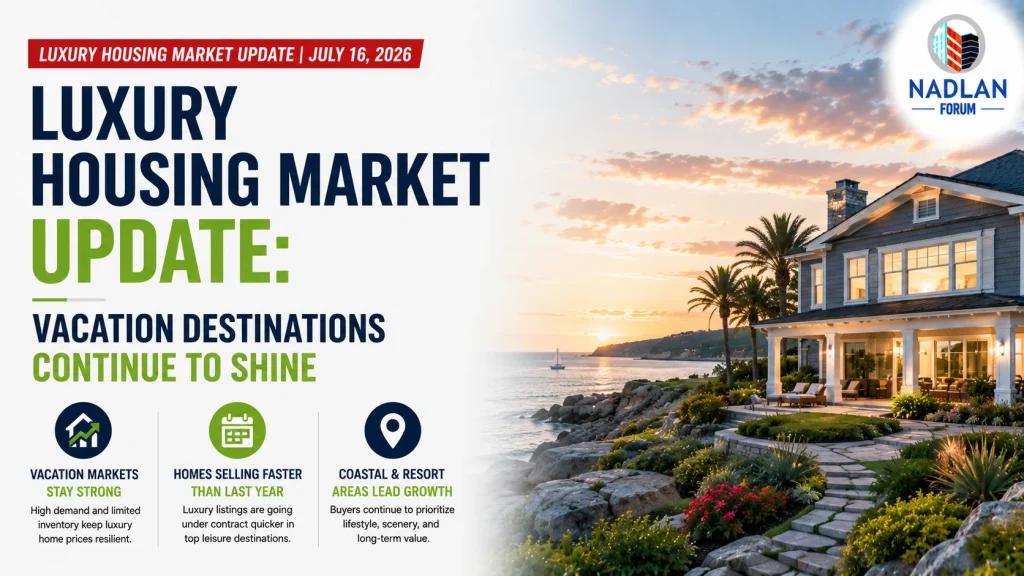
The U.S. luxury housing market continued to shift in June as high-end home prices softened nationwide, while vacation-home destinations remained among the strongest-performing real estate markets. Although luxury price growth has slowed across much of the country, buyers continue to compete for homes in exclusive coastal, mountain, and resort communities where limited supply keeps demand elevated.
The latest luxury housing data shows that premium properties are still selling more quickly than they did a year ago, even as overall prices gradually decline. This contrast suggests that wealthy buyers remain active but are becoming increasingly selective about where they invest.
Luxury Home Prices Continue to Ease
Nationally, the entry price for luxury homes the lowest price needed to qualify for the top 10% of listings fell to approximately $1.28 million in June.
That represents a 1.7% decline compared with one year earlier and marks the 27th consecutive month of annual price declines in the luxury housing market. The pace of the decline also accelerated slightly from May, indicating that price adjustments are continuing across many expensive housing markets.
Even so, demand for luxury homes remains healthy.
Properties in the top 10% of listings sold in a median of 63 days, two days faster than during June 2025. Ultra-luxury homes in the top 1% also sold more quickly than they did a year ago, showing that qualified buyers remain active despite changing market conditions.
Scarcity Continues to Drive Vacation Markets
Unlike many metropolitan luxury markets where prices are cooling, vacation destinations continue to benefit from one major advantage limited supply.
In places such as Nantucket, Massachusetts, and Breckenridge, Colorado, buyers are purchasing something that cannot easily be recreated: prime beachfront property, mountain views, or exclusive resort locations.
Because additional coastline or mountain communities cannot simply be developed, these markets continue attracting buyers willing to pay premium prices even as luxury home values soften elsewhere.
This type of demand is driven less by square footage and more by location, exclusivity, and long-term desirability.
Nantucket Leads the Nation
Nantucket ranked as the country’s leading vacation-home market in June.
Approximately 55% of the area’s housing inventory consists of vacation or seasonal homes, making it the highest concentration in the United States.
Nearby Vineyard Haven, Massachusetts, followed closely with approximately 54%, while Breckenridge, Colorado, ranked third with nearly 46% of its housing stock serving seasonal or vacation purposes.
Nationally, only about 3.3% of housing inventory falls into this category, highlighting just how unique these resort communities are.
Buyers Value Location Over Home Size
One interesting trend emerging from luxury vacation markets is that buyers are often paying more for location than for larger homes.
For example, Nantucket has one of the highest luxury entry prices in the country, with the top 10% of listings beginning above $14 million.
Despite those prices, many homes are relatively modest in size compared with luxury properties in other markets.
This illustrates how scarcity influences pricing.
Rather than paying for expansive square footage, buyers are investing in access to waterfront property, exclusive communities, desirable views, and limited inventory.
Similar trends are visible in several mountain communities where premium pricing reflects location rather than home size alone.
Most Expensive Luxury Markets
Several major metropolitan areas continue to dominate the nation’s most expensive luxury housing markets.
The highest luxury entry prices were recorded in:
- Bridgeport–Stamford–Danbury, Connecticut
- Los Angeles–Long Beach–Anaheim, California
- Kahului–Wailuku, Hawaii
- Naples–Marco Island, Florida
- San Jose–Sunnyvale–Santa Clara, California
- Oxnard–Thousand Oaks–Ventura, California
- New York–Newark–Jersey City
- Crestview–Fort Walton Beach–Destin, Florida
- San Diego–Chula Vista–Carlsbad, California
- San Francisco–Oakland–Fremont, California
Among these markets, Naples–Marco Island stood out as the only top-10 luxury metro to record an annual price increase, with luxury values rising 4.1% compared with last year.
Meanwhile, San Jose experienced the largest annual decline, with luxury prices falling nearly 12%.
San Francisco Returns to the Top 10
The San Francisco metropolitan area re-entered the list of the nation’s most expensive luxury markets during June.
Although luxury prices remain below last year’s levels, analysts believe renewed wealth creation from the technology sector has helped strengthen demand for premium properties.
Unlike vacation destinations, San Francisco’s luxury market is supported primarily by high-income professionals, stock compensation, and business wealth rather than tourism or seasonal demand.
This demonstrates that luxury housing demand can be driven by very different economic forces depending on the market.
Vacation Destinations Continue to Attract Buyers
Several coastal and mountain communities remain among the country’s strongest luxury vacation markets.
Top destinations include:
- Nantucket, Massachusetts
- Vineyard Haven, Massachusetts
- Breckenridge, Colorado
- Barnstable Town, Massachusetts
- Naples–Marco Island, Florida
- Morehead City, North Carolina
- Kill Devil Hills, North Carolina
- Heber, Utah
- Boone, North Carolina
- Edwards, Colorado
These communities continue attracting buyers seeking second homes, vacation properties, retirement residences, or long-term lifestyle investments.
Limited land availability and strong tourism demand continue supporting values even as many traditional luxury markets experience price adjustments.
Luxury Homes Are Still Selling Faster
Despite lower prices, the luxury housing market remains relatively active.
Across the country’s most expensive properties:
- Homes in the top 10% sold two days faster than one year ago.
- Properties in the top 5% sold four days faster.
- Homes in the top 1% sold three days faster.
- The overall median listing time remained stable at 53 days.
These figures indicate that qualified luxury buyers continue entering the market, particularly when desirable properties become available.
What It Means for the Luxury Housing Market
The luxury housing market is becoming increasingly divided between two distinct types of demand.
In major financial centers such as New York, Los Angeles, San Francisco, and Bridgeport, luxury home demand is closely tied to wealth creation, business activity, and financial markets.
By contrast, vacation destinations such as Nantucket, Breckenridge, and other resort communities are supported primarily by location scarcity and lifestyle appeal. Since additional beachfront or mountain property cannot easily be created, these markets often remain resilient even when luxury prices soften nationally.
As inventory gradually increases across many housing markets, this distinction is likely to become even more important. Buyers with significant financial resources continue to pursue unique, limited-supply properties, helping many vacation destinations outperform the broader luxury real estate market despite nationwide price moderation. For direct financing consultations or mortgage options for you visit 👉 Nadlan Capital Group.
