


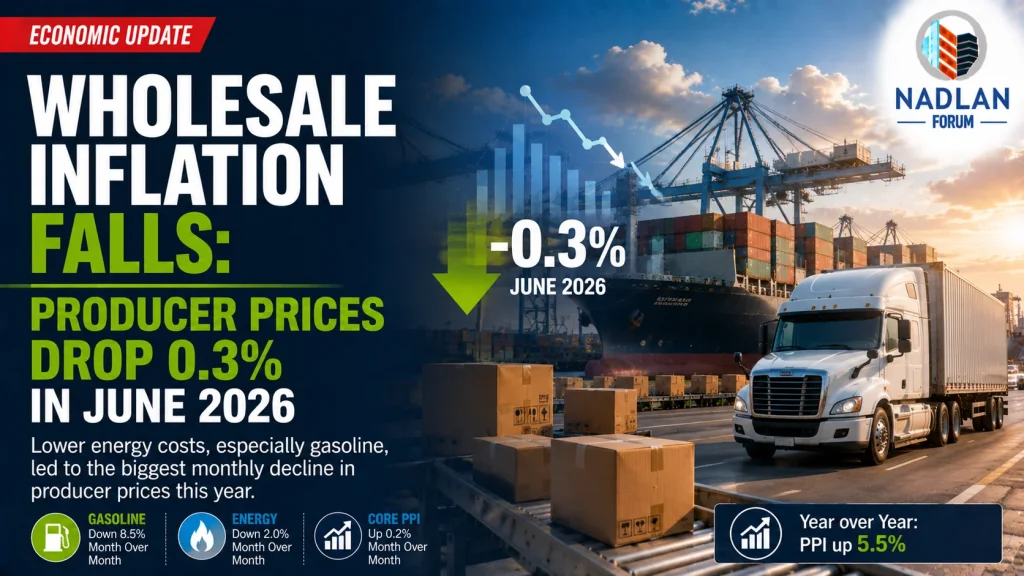
Wholesale inflation delivered a better-than-expected result in June as sharply lower gasoline and energy costs reduced the prices businesses paid for goods.
The Producer Price Index for final demand fell 0.3% in June on a seasonally adjusted basis, while economists had generally expected prices to remain unchanged. The decline followed a revised 0.6% increase in May and a 1.1% rise in April.
The report marks the second encouraging inflation release in two days. Consumer prices also fell in June, strengthening hopes that the recent rise in inflation may be losing momentum.
However, the broader picture remains mixed.
Producer prices were still 5.5% higher than one year earlier, meaning businesses continue to face significantly higher costs than they did in June 2025. Core measures also remained above levels consistent with the Federal Reserve’s long-term inflation goal.
The latest figures offer signs of progress, but they do not show that inflation has been fully controlled.
What Is the Producer Price Index?
The Producer Price Index, commonly known as the PPI, measures how prices change for goods and services sold by domestic producers.
While the Consumer Price Index tracks the prices households pay, the PPI focuses on costs earlier in the production and distribution process.
It can include prices received by:
- Manufacturers
- Wholesalers
- Transportation companies
- Service providers
- Food producers
- Energy companies
The index is closely watched because rising business costs may eventually be passed on to consumers through higher retail prices.
When producer prices decline, businesses may face less pressure to raise prices. That does not guarantee lower prices at stores, but it can help slow future consumer inflation.
Wholesale Prices Fell More Than Expected
The overall PPI declined 0.3% in June, producing a better result than the unchanged reading many economists had expected.
This was the first monthly decline after strong gains during April and May.
May’s increase was also revised lower, from an initially reported 1.1% to 0.6%. The revision suggests that wholesale inflation during the previous month was not as severe as first estimated.
The monthly decline was primarily caused by falling goods prices, particularly gasoline.
Services prices continued to rise, showing that inflation pressure has not disappeared across the entire economy.
Gasoline Prices Drove Much of the Decline
Gasoline prices fell 12% during June, accounting for roughly two-thirds of the decrease in the final-demand goods index.
Overall energy prices fell 6.4%, while food prices declined 0.6%.
These decreases helped push final-demand goods prices down 1.4%, the largest monthly decline since July 2022.
Lower gasoline prices can affect more than the cost of filling a vehicle.
Energy expenses influence:
- Shipping
- Manufacturing
- Agriculture
- Air travel
- Delivery services
- Construction
- Retail distribution
When fuel prices fall, companies may spend less moving products from factories and warehouses to stores.
This can reduce some of the pressure that eventually reaches consumers.
Energy Prices Remain Volatile
The drop in June energy costs followed a period of significant market volatility.
Oil and gasoline prices had previously risen amid global conflict and uncertainty surrounding energy supplies. Prices later declined as tensions temporarily eased.
Energy can make inflation reports appear much stronger or weaker from one month to the next.
A sharp decline in gasoline may pull headline inflation lower even when housing, services, wages, or other costs remain elevated.
For that reason, economists often study both the headline index and measures that remove food and energy.
Core Producer Inflation Still Increased
When food and energy were excluded, core producer prices rose 0.2% in June.
That was slightly below expectations for a 0.3% increase.
Another closely watched measure, which removes food, energy, and trade services, rose only 0.1% during the month. It was still 5.1% higher than a year earlier.
The relatively small monthly gains suggest that underlying wholesale inflation may be cooling.
However, the annual figures remain high, showing that businesses are still paying considerably more than they were one year ago.
Why Trade Services Are Removed From Some Measures
Trade services measure the margins received by wholesalers and retailers rather than the direct price of a physical product.
These margins can move sharply from month to month, making the overall index more volatile.
Removing trade services can provide a clearer look at underlying inflation trends across production and service industries.
The modest 0.1% rise in the index excluding food, energy, and trade services may therefore be viewed as one of the more encouraging parts of the June report.
Services Prices Continued to Rise
While goods prices fell, final-demand services increased 0.2% in June.
Trade services rose 0.4%, helping push the broader services index higher.
Service inflation can be more persistent than goods inflation because it is often connected to:
- Wages
- Rent
- Insurance
- Professional fees
- Health care
- Transportation
- Business operating costs
A factory can sometimes reduce production or find a lower-cost material supplier relatively quickly. Service businesses may have less flexibility when labor, insurance, or property expenses rise.
The continued increase in services means policymakers are unlikely to focus only on the large decline in gasoline.
Annual Wholesale Inflation Remains High
Despite the monthly decline, final-demand producer prices remained 5.5% higher than in June 2025.
This annual rate is still well above what would normally be considered consistent with stable inflation.
The difference between monthly and annual figures is important.
A monthly decline shows that prices fell compared with May. The annual increase shows that wholesale costs remain substantially higher than they were one year earlier.
Businesses and consumers may therefore experience continued financial pressure even when recent monthly reports improve.
Consumer Inflation Also Fell in June
The PPI report followed another positive inflation release.
The Consumer Price Index fell 0.4% in June, the largest seasonally adjusted monthly decline since April 2020. Annual consumer inflation slowed to 3.5%, down from 4.2% in May.
Core consumer prices, excluding food and energy, were unchanged during the month and increased 2.6% from a year earlier.
Like the producer report, the consumer data benefited heavily from falling energy prices.
The two reports together suggest that inflation pressure eased across both household and business costs during June.
PPI and CPI Measure Different Parts of Inflation
The CPI and PPI are related but measure different things.
The Consumer Price Index measures changes in prices paid directly by households.
The Producer Price Index measures prices received by businesses for goods and services.
For example, the PPI may measure the wholesale price of food before it reaches a grocery store. The CPI measures what the shopper ultimately pays.
Producer inflation can sometimes appear in consumer prices later, but the connection is not always direct.
Businesses may:
- Absorb higher costs through lower profits
- Pass the increase to customers
- Reduce employee hours
- Delay expansion
- Find cheaper suppliers
- Change the product or package size
The degree of cost transfer depends on competition, demand, and the company’s financial strength.
What Lower Producer Prices Mean for Consumers
A lower PPI is generally positive for consumers because it suggests that businesses may face less pressure to raise retail prices.
Consumers could eventually see slower price growth in areas influenced by transportation and energy costs.
Potential benefits may include:
- Lower gasoline expenses
- Reduced shipping pressure
- Slower increases in grocery prices
- Lower delivery costs
- More stable retail prices
However, one monthly report does not guarantee that prices will broadly decline.
Many consumer expenses, including rent, insurance, health care, and services, are influenced by factors beyond wholesale energy prices.
Lower Inflation Does Not Mean Low Prices
Inflation measures the rate of price change, not the overall price level.
Even when inflation slows, most goods and services remain more expensive than they were several years ago.
A lower inflation rate means prices are generally rising more slowly. A negative monthly reading means average prices fell compared with the previous month, but it does not reverse years of accumulated increases.
Households may therefore continue feeling financially stretched even as economic reports show progress.
What the Report Means for Businesses
Lower energy and goods prices may provide short-term relief for companies that rely heavily on fuel, transportation, manufacturing, or raw materials.
Businesses could benefit through:
- Lower delivery expenses
- Reduced production costs
- Improved profit margins
- Less need to raise prices
- More predictable inventory expenses
However, service costs continue to rise, and annual producer inflation remains elevated.
Companies must still manage higher expenses involving wages, insurance, commercial rent, financing, and professional services.
The overall benefit will depend on the industry.
A transportation company may experience significant savings from lower fuel prices, while a service-based company may see little improvement.
What the Report Means for the Federal Reserve
The Federal Reserve closely monitors inflation when deciding whether to raise, lower, or hold interest rates.
The June CPI and PPI reports reduce some immediate pressure for another rate increase.
Federal Reserve Chair Kevin Warsh has emphasized that policymakers remain committed to restoring price stability and are reviewing how the central bank measures and responds to inflation.
The Fed will likely want to see several months of improvement before concluding that inflation is moving sustainably lower.
Officials will continue monitoring:
- Core consumer inflation
- Core producer inflation
- Employment
- Wage growth
- Consumer spending
- Energy prices
- Housing costs
- Inflation expectations
A temporary decline caused mainly by gasoline may not be enough to produce a major policy change.
Could the Fed Still Raise Interest Rates?
The improved inflation data may reduce the probability of additional rate increases, but it does not eliminate the possibility.
The Fed could consider another increase if:
- Inflation rises again
- Energy prices rebound
- Consumer demand remains too strong
- Wage growth accelerates
- Financial conditions become too loose
- Inflation expectations increase
The central bank may keep rates unchanged if inflation continues to cool while economic growth remains stable.
A rate cut would generally become more likely if inflation declines steadily and employment or economic activity weakens.
Why the PCE Inflation Report Matters Next
The Consumer Price Index and Producer Price Index both contribute to the calculation of the Personal Consumption Expenditures price index.
The PCE index is the Federal Reserve’s preferred inflation measure.
It covers a broader mix of household spending and adjusts more quickly when consumers change what they purchase.
The May PCE report showed annual headline inflation of 4.1% and core inflation of 3.4%.
The weaker June CPI and PPI readings may lead to lower PCE inflation when the Commerce Department releases the next report.
However, the final result will depend on the detailed components used in the calculation.
What the Report Means for Mortgage Rates
Mortgage rates are not controlled directly by the Federal Reserve.
They are strongly influenced by inflation expectations and long-term Treasury yields.
A cooler-than-expected inflation report can place downward pressure on bond yields and mortgage rates because investors may expect less aggressive monetary policy.
However, mortgage rates also respond to:
- Government borrowing
- Economic growth
- Global risks
- Bond-market demand
- Federal Reserve communication
- Expectations about future inflation
The June PPI result may support slightly lower mortgage rates, but it does not guarantee a lasting decline.
Borrowers should expect continued day-to-day movement.
What It Means for Homebuyers
Lower inflation can benefit homebuyers in several ways.
If inflation continues to improve, mortgage rates could gradually decline or become more stable.
Lower construction and transportation costs could also reduce pressure on builders, although land, labor, permits, and financing remain major expenses.
Buyers should still focus on:
- The complete monthly payment
- Property taxes
- Homeowners insurance
- Mortgage fees
- Local home prices
- Available seller concessions
A small decline in mortgage rates may improve affordability, but it is unlikely to fully offset high home prices in many markets.
What It Means for Homeowners Considering Refinancing
Homeowners waiting to refinance may view the report as a positive development.
If inflation continues cooling and bond yields decline, refinance rates could move lower.
However, refinancing should only be considered when the savings justify the closing costs.
Important factors include:
- Current mortgage rate
- New interest rate
- Remaining loan balance
- Closing expenses
- Break-even period
- Expected time in the home
- New loan term
A single favorable inflation report should not be the only reason to refinance.
What It Means for Real Estate Investors
Real estate investors may benefit if cooler inflation eventually leads to lower financing costs.
Reduced fuel and material expenses could also help renovation and construction projects.
However, investors continue to face elevated costs involving:
- Insurance
- Property taxes
- Labor
- Maintenance
- Commercial financing
- Utilities
Investors should avoid assuming that one month of lower wholesale prices will significantly change project economics.
Deals should still be evaluated using conservative interest-rate and operating-cost assumptions.
Falling Gasoline Prices Help Household Budgets
Gasoline has a direct effect on household finances.
Lower fuel prices can reduce the cost of:
- Commuting
- School transportation
- Shopping trips
- Deliveries
- Summer travel
- Business operations
Consumers may use the savings for other spending, debt repayment, or savings.
However, annual gasoline prices remained significantly higher than one year earlier despite the June monthly decline. Consumer energy prices were still 15.7% higher year over year, while gasoline was up 26.7% over the same period.
This shows why households may not immediately feel as much relief as the monthly inflation figures suggest.
Food Inflation Remains Important
Producer food prices fell 0.6% in June, which could help reduce future pressure on grocery costs.
At the consumer level, however, food prices were still 3% higher than one year earlier.
Restaurant meals and grocery items are affected by more than wholesale food prices.
Other costs include:
- Labor
- Rent
- Transportation
- Packaging
- Insurance
- Utilities
A decline in producer food prices may take time to reach consumers, and businesses may use some of the savings to rebuild profit margins rather than reduce prices.
Is Inflation Finally Under Control?
The June reports show progress but do not provide a final answer.
Positive signs include:
- Producer prices fell 0.3%.
- Consumer prices fell 0.4%.
- Core producer inflation was below expectations.
- Core consumer prices were unchanged.
- Gasoline and energy prices declined sharply.
Reasons for caution include:
- Annual PPI remained at 5.5%.
- Annual CPI remained at 3.5%.
- Services prices continued rising.
- Energy prices remain volatile.
- Both major inflation measures remain above the Fed’s target.
The economy will need several months of consistent improvement before policymakers and households can be confident that inflation is under control.
What to Watch Next
Several upcoming reports will provide more information about the direction of prices and monetary policy.
Key indicators include:
- Personal Consumption Expenditures inflation
- July CPI
- July PPI
- Employment data
- Wage growth
- Retail sales
- Energy prices
- Federal Reserve meetings
Investors will also watch Treasury yields and Federal Reserve statements for clues about future interest-rate decisions.
Final Thoughts
Wholesale inflation delivered an encouraging surprise in June, with the Producer Price Index falling 0.3% as gasoline, food, and energy costs declined.
Final-demand goods prices fell 1.4%, led by a 12% drop in gasoline. Core inflation remained positive but rose less than expected.
The report followed a 0.4% decline in consumer prices, creating two consecutive days of better inflation news.
Still, annual producer inflation remained at 5.5%, and consumer inflation stood at 3.5%, both above levels consistent with long-term price stability.
For consumers, businesses, homebuyers, and investors, the June data may reduce the risk of additional near-term interest-rate increases and could help stabilize borrowing costs.
The strongest conclusion, however, is not that inflation has ended. It is that inflation pressure showed meaningful improvement during June, largely because energy prices moved sharply lower. For direct financing consultations or mortgage options for you visit 👉 Nadlan Capital Group.
