


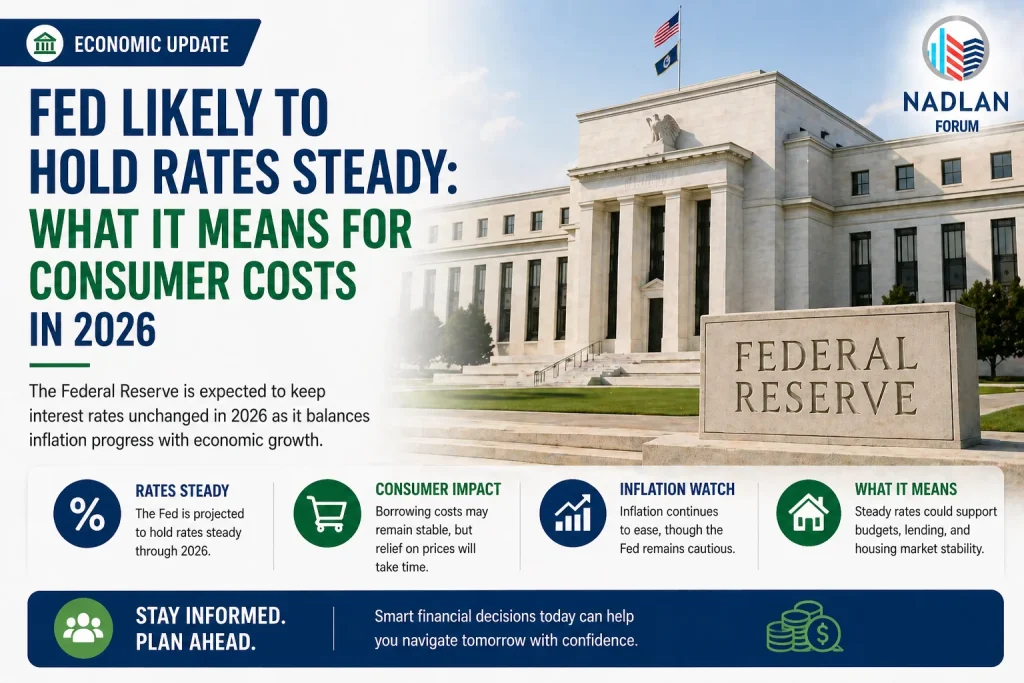
The Federal Reserve is widely expected to keep interest rates unchanged at its upcoming policy meeting. This decision comes at a time when inflation concerns, global tensions, and a mixed job market are all shaping the economic outlook.
If rates remain steady, it may not bring immediate relief to consumers who are already dealing with high borrowing costs. At the same time, it could help maintain stability in savings returns.
Why the Fed Is Holding Rates
The central bank adjusts interest rates to manage inflation and support employment. Right now, several factors are making policymakers cautious:
- Ongoing inflation pressure, partly driven by higher energy prices
- Global uncertainty, including conflict affecting oil supply
- Slower hiring and weaker consumer confidence
Because of these conditions, markets expect little chance of a rate cut in the near term. Keeping rates steady allows the Fed to monitor how the economy evolves before making its next move.
Leadership Changes Add Uncertainty
There is also a possible leadership transition at the Fed. Jerome Powell may be nearing the end of his term, while Kevin Warsh has been nominated as a potential replacement.
At the same time, Donald Trump has openly pushed for lower interest rates, arguing that high borrowing costs slow economic growth.
Even with this pressure, the central bank is expected to stay focused on controlling inflation before considering rate cuts.
How Fed Rates Affect Everyday Finances
The Fed’s benchmark rate directly impacts how much banks charge each other for short-term loans. This influence spreads across many financial products that consumers use daily.
Credit Cards
Credit cards are one of the most directly affected areas. Most cards have variable interest rates, which move in line with the Fed’s decisions.
- If rates stay high, credit card interest remains high
- Carrying a balance becomes more expensive
- Paying off debt takes longer
With rates expected to hold steady, borrowers should not expect relief in credit card costs anytime soon.
Mortgage Rates
Mortgage rates do not directly follow the Fed, but they are influenced by long-term bond yields and inflation expectations.
- Rates for 15-year and 30-year loans remain elevated
- Monthly payments are still high compared to past years
- Market uncertainty keeps mortgage rates moving up and down
For buyers, this means affordability remains a challenge, even if rates are no longer rising quickly.
Auto Loans
Car loan rates are also affected by interest rate trends.
- Borrowers are taking longer loan terms to manage payments
- Monthly costs remain high due to elevated rates
- Total interest paid over time increases
This trend shows how higher rates are changing consumer behavior.
Student Loans
Federal student loan rates are set based on government bond yields and are fixed once issued.
- Existing borrowers are mostly protected from rate changes
- New borrowers may still face higher rates than in past years
While not as sensitive to Fed moves, student loan costs remain an important factor for many households.
Savings Accounts
One positive effect of higher rates is better returns for savers.
- Savings account yields are higher than in previous years
- Some accounts are keeping up with inflation
- Fixed-income investments may offer better returns
Holding rates steady helps maintain these benefits for savers.
Broader Economic Impact
High interest rates affect more than just individual finances. They also influence:
- Business investment decisions
- Hiring and wage growth
- Consumer spending
When borrowing costs stay high, businesses may slow expansion, and consumers may cut back on spending. This can reduce economic growth over time.
What Could Change Next
Future rate decisions will depend on how key economic indicators evolve, including:
- Inflation trends
- Job market strength
- Global events affecting energy and supply chains
If inflation begins to fall more consistently, the Fed may consider lowering rates. However, if price pressures continue, rates could stay higher for longer.
Key Takeaways
- The Fed is expected to keep interest rates unchanged in the near term
- Borrowing costs for credit cards, loans, and mortgages remain high
- Savings rates continue to benefit from higher interest levels
- Economic uncertainty is delaying any rate cuts
Final Outlook
For now, consumers should prepare for a period of stable but elevated interest rates. While this helps control inflation, it also keeps borrowing expensive.
Managing debt carefully, comparing loan options, and taking advantage of higher savings returns can help households adjust to the current environment.
As economic conditions shift, future policy decisions will determine when borrowing costs may begin to ease. For direct financing consultations or mortgage options for you visit 👉 Nadlan Capital Group.
