


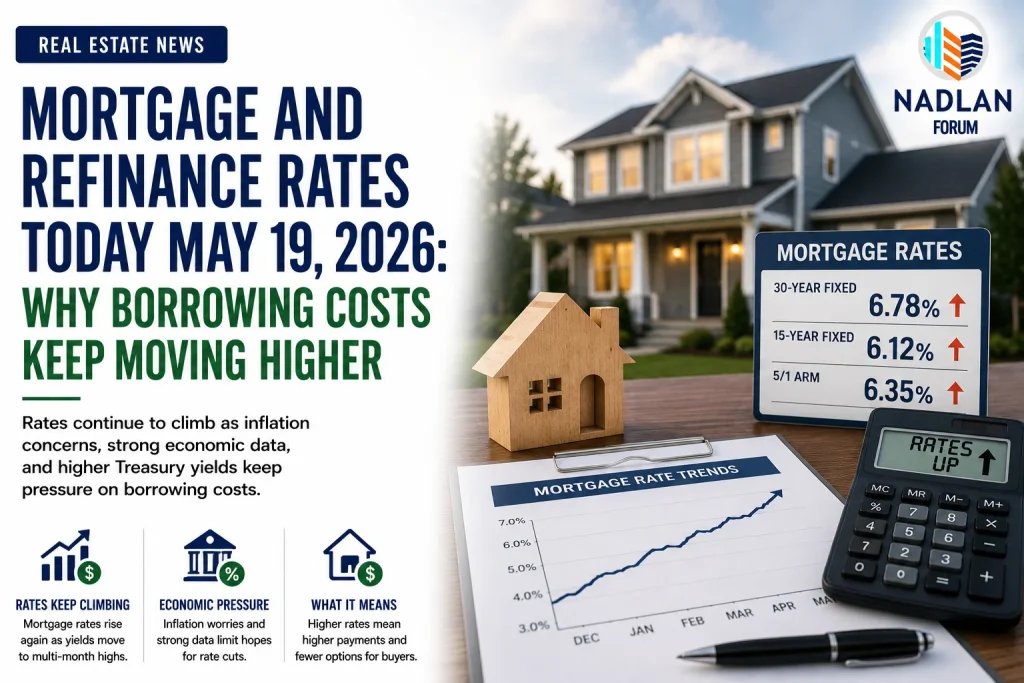
Mortgage rates across the United States continued trending higher this week as inflation concerns and economic uncertainty kept pressure on the housing market.
According to the latest Zillow lender marketplace data, most major mortgage products moved upward again on May 19, 2026, with several loan categories now sitting near some of their highest levels in recent months.
The steady rise in borrowing costs is making affordability more difficult for homebuyers while also limiting refinance opportunities for many homeowners.
Current Mortgage Rates Today
National average mortgage rates currently include:
- 30-year fixed: 6.41%
- 20-year fixed: 6.39%
- 15-year fixed: 5.84%
- 5/1 ARM: 6.50%
- 7/1 ARM: 6.57%
- 30-year VA: 6.00%
- 15-year VA: 5.63%
- 5/1 VA: 5.61%
While the 30-year fixed rate held unchanged from the previous day, most other major loan categories increased.
The largest jump came from the 20-year fixed mortgage, which climbed by 32 basis points in just one day.
Refinance Rates Also Moved Higher
Mortgage refinance rates also remained elevated as borrowing conditions tightened.
Current refinance averages include:
- 30-year fixed refinance: 6.43%
- 20-year fixed refinance: 6.24%
- 15-year fixed refinance: 5.87%
- 5/1 ARM refinance: 6.42%
- 7/1 ARM refinance: 6.21%
- 30-year VA refinance: 5.87%
- 15-year VA refinance: 5.42%
- 5/1 VA refinance: 5.65%
For many homeowners who locked in mortgage rates below 4% during 2020 and 2021, refinancing at today’s rates remains financially difficult.
Why Mortgage Rates Keep Rising
Mortgage rates have remained under pressure because of several ongoing economic factors.
Key drivers include:
- Higher inflation readings
- Rising Treasury yields
- Federal Reserve uncertainty
- Elevated energy prices
- Stronger-than-expected labor market data
- Ongoing geopolitical tensions
Financial markets have increasingly reduced expectations for Federal Reserve rate cuts in 2026.
Some traders are now even pricing in the possibility of future rate hikes if inflation remains stubbornly high.
Because mortgage rates closely follow bond market movements, those expectations continue pushing home loan costs upward.
Inflation Concerns Continue Impacting Borrowing Costs
Recent inflation reports showed stronger price growth across both consumer and wholesale markets.
Higher fuel prices, rising service costs, and ongoing supply pressures have all contributed to elevated inflation readings in recent months.
Bond investors typically demand higher yields during inflationary periods because inflation reduces the long-term value of fixed-income investments.
As Treasury yields move higher, mortgage rates generally follow.
That relationship has kept mortgage borrowing costs elevated throughout much of 2026.
Higher Rates Are Affecting Housing Affordability
The recent rate increases are creating additional affordability challenges for buyers already facing elevated home prices.
Even small rate changes can significantly impact monthly mortgage payments.
For example, a buyer financing a $400,000 home loan at today’s average 30-year fixed rate near 6.41% could face monthly principal and interest payments around $2,500 before taxes and insurance.
Over the full life of the loan, total interest costs can exceed hundreds of thousands of dollars.
This has forced many buyers to:
- Lower their budgets
- Delay purchases
- Consider smaller homes
- Move to more affordable markets
- Explore adjustable-rate loans
15-Year vs. 30-Year Mortgage Rates
Many buyers continue comparing shorter-term mortgages with traditional 30-year loans.
A 15-year mortgage usually offers:
- Lower interest rates
- Faster loan payoff
- Lower total interest costs
However, monthly payments are significantly higher because the loan balance must be repaid in half the time.
For some homeowners, the long-term savings can be substantial.
But affordability concerns often make 30-year loans the more realistic option for monthly budgeting.
Adjustable-Rate Mortgages Are Becoming More Popular
As fixed mortgage rates remain elevated, some buyers are exploring adjustable-rate mortgages, commonly known as ARMs.
With products like:
- 5/1 ARMs
- 7/1 ARMs
borrowers receive a fixed rate for an introductory period before rates begin adjusting annually.
Traditionally, ARMs offered noticeably lower starting rates than fixed mortgages.
However, in today’s market, some ARM rates are now similar to — or even higher than — certain fixed-rate loans.
Because of that, experts recommend comparing all loan types carefully before making financing decisions.
Buyers Continue Facing Tough Market Conditions
Housing affordability remains one of the largest challenges in the U.S. housing market.
Buyers are now dealing with a combination of:
- Elevated mortgage rates
- Higher insurance costs
- Rising property taxes
- Limited inventory in some regions
- Higher monthly housing expenses overall
Even though inventory has improved in some areas compared to the pandemic years, financing costs remain a major obstacle.
Some Buyers Are Turning to Rate Buydowns
To reduce monthly costs, some buyers are using mortgage rate buydowns.
These programs temporarily or permanently lower the interest rate in exchange for upfront fees paid at closing.
Popular options include:
- Permanent discount points
- Temporary 2-1 buydowns
- Seller-paid rate reductions
These strategies can lower initial monthly payments, although buyers must carefully evaluate whether the upfront cost creates long-term savings.
Mortgage Forecasts Remain Uncertain
Industry forecasts for mortgage rates remain mixed.
Current projections from major housing groups suggest rates may stay near current levels through much of 2026 and possibly into 2027.
Some forecasts expect average 30-year fixed mortgage rates to remain between:
- 6.2%
- 6.5%
for the foreseeable future.
However, future inflation trends, Federal Reserve policy decisions, labor market conditions, and geopolitical developments could still change the outlook.
Homebuyers Are Becoming More Cautious
As rates continue rising, buyers are becoming more selective and cautious about entering the market.
Many households are taking additional time to:
- Compare lenders
- Improve credit scores
- Save for larger down payments
- Reduce debt
- Shop for better loan terms
Lenders continue offering different pricing structures, so comparing multiple mortgage providers remains important in today’s market.
Existing Homeowners Remain Locked Into Low Rates
One major factor limiting housing inventory is the large number of existing homeowners holding ultra-low mortgage rates from earlier years.
Many homeowners currently have mortgage rates below 4%.
Selling a home and purchasing another property at today’s rates could dramatically increase monthly housing costs.
As a result, many owners are delaying moves, which continues restricting available housing supply in some markets.
The Housing Market Remains Sensitive to Interest Rates
Mortgage rates remain one of the most important drivers of housing market activity.
Even modest increases can quickly reduce purchasing power and slow buyer demand.
If rates continue climbing throughout the summer, some analysts expect:
- Slower home sales
- Increased price reductions
- Longer listing times
- Reduced refinancing activity
At the same time, any unexpected improvement in inflation or economic conditions could eventually help stabilize borrowing costs later in the year.
For now, however, mortgage rates today remain elevated, and both buyers and homeowners continue adjusting to a higher-cost financing environment. For direct financing consultations or mortgage options for you visit 👉 Nadlan Capital Group.
