


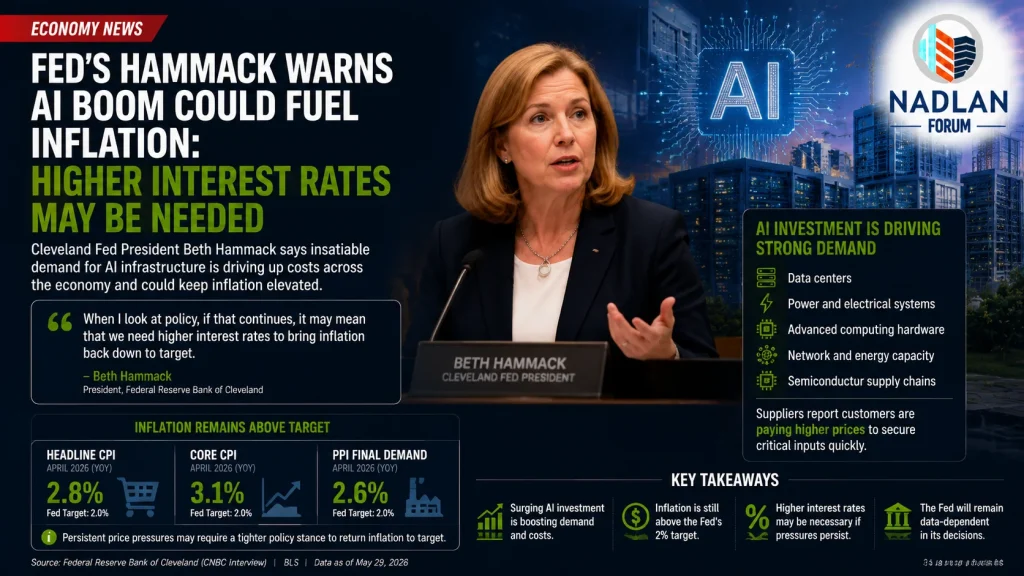
Cleveland Federal Reserve President Beth Hammack has warned that the rapid expansion of artificial intelligence infrastructure could become a new source of inflationary pressure in the U.S. economy, potentially forcing the central bank to consider higher interest rates if price pressures persist.
Speaking in a recent CNBC interview, Hammack said that strong and sustained demand from large technology companies building AI systems and data centers is contributing to rising costs across parts of the economy.
She noted that this level of demand appears highly persistent and is not showing signs of slowing despite higher borrowing costs.
AI Investment Is Creating Strong Demand Pressures
According to Hammack, companies involved in AI development—particularly large technology firms and so-called hyperscalers—are continuing to invest heavily in infrastructure such as:
- Data centers
- Electrical and power systems
- Advanced computing hardware
- Network and energy capacity
- Semiconductor-related supply chains
She described demand as “insatiable,” noting that suppliers in her district report customers willing to pay elevated prices to secure critical inputs quickly.
This type of sustained demand can put upward pressure on prices in key sectors of the economy, contributing to broader inflationary trends.
Inflation Remains Above Target
Hammack emphasized that inflation remains too high and has been above the Federal Reserve’s target for several years.
While overall inflation has cooled from previous peaks, it continues to remain elevated in key areas such as services, housing, and energy-related costs.
Because of this, Fed policymakers continue to monitor whether underlying price pressures are fully easing or whether new drivers—such as AI-related investment—could slow the disinflation process.
Higher Rates Could Be Considered if Inflation Persists
Hammack stated that if inflation remains elevated, the Federal Reserve may need to maintain restrictive policy or even raise interest rates further.
Higher interest rates are typically used by central banks to:
- Slow economic demand
- Reduce borrowing activity
- Stabilize prices
- Bring inflation back toward target levels
However, she also noted that the economic impact of AI investment could work in both directions, depending on whether productivity gains eventually offset higher costs.
AI: Inflationary Pressure or Productivity Boost?
Economists remain divided on the long-term inflation impact of artificial intelligence.
Inflationary View:
AI expansion may increase demand for:
- Energy
- Construction materials
- Skilled labor
- Semiconductor supply chains
This can push prices higher in the short term.
Disinflationary View:
Over time, AI could:
- Improve productivity
- Lower labor costs
- Increase efficiency across industries
- Reduce production expenses
If productivity gains dominate, AI could actually help reduce inflation over the long term.
Hammack acknowledged that both outcomes are possible, depending on how the technology evolves and how quickly efficiency gains spread across the economy.
Investment Demand Shows Little Sign of Slowing
One key concern for policymakers is that businesses appear to have limited sensitivity to higher interest rates when it comes to AI investment.
Hammack noted that many companies continue to expand aggressively, suggesting that financing conditions are not currently slowing down major infrastructure spending.
This raises concerns for the Federal Reserve, because strong investment demand can keep overall economic activity elevated even in a high-rate environment.
Fed Policy Still Focused on Inflation Control
Despite ongoing debates about technology-driven growth, the Federal Reserve continues to prioritize its inflation mandate.
Recent policy meetings have kept interest rates steady, but projections still indicate the possibility of additional tightening if inflation does not move closer to target levels.
The central bank remains focused on ensuring that inflation expectations do not become entrenched at elevated levels.
What This Means for Interest Rates
If AI-driven investment continues accelerating, it could influence interest rates in several ways:
- Delayed rate cuts
- Longer period of high borrowing costs
- Potential for additional rate increases
- Increased volatility in bond markets
- Stronger sensitivity to inflation data
For mortgage markets, sustained high interest rates could keep borrowing costs elevated even if inflation improves in other areas.
Impact on Housing and Mortgage Markets
Higher interest rates have direct implications for housing affordability.
If the Federal Reserve maintains or increases rates due to inflation concerns:
- Mortgage rates may remain elevated
- Homebuyer affordability could stay constrained
- Housing demand may slow further
- Refinancing activity could remain limited
This could continue the current “lock-in effect,” where homeowners with low pandemic-era mortgage rates are reluctant to sell or refinance.
Final Thoughts
The Cleveland Fed’s warning highlights a new and unexpected factor in the inflation outlook: the rapid expansion of artificial intelligence infrastructure.
While AI has the potential to improve productivity and reduce costs over time, in the short term it may also contribute to higher prices through strong investment demand and supply chain pressure.
As a result, the Federal Reserve may face continued challenges in balancing economic growth, inflation control, and interest rate policy in 2026.
For now, policymakers remain focused on ensuring that inflation returns to target—whatever forces, including AI, may be driving it. For direct financing consultations or mortgage options for you visit 👉 Nadlan Capital Group.