


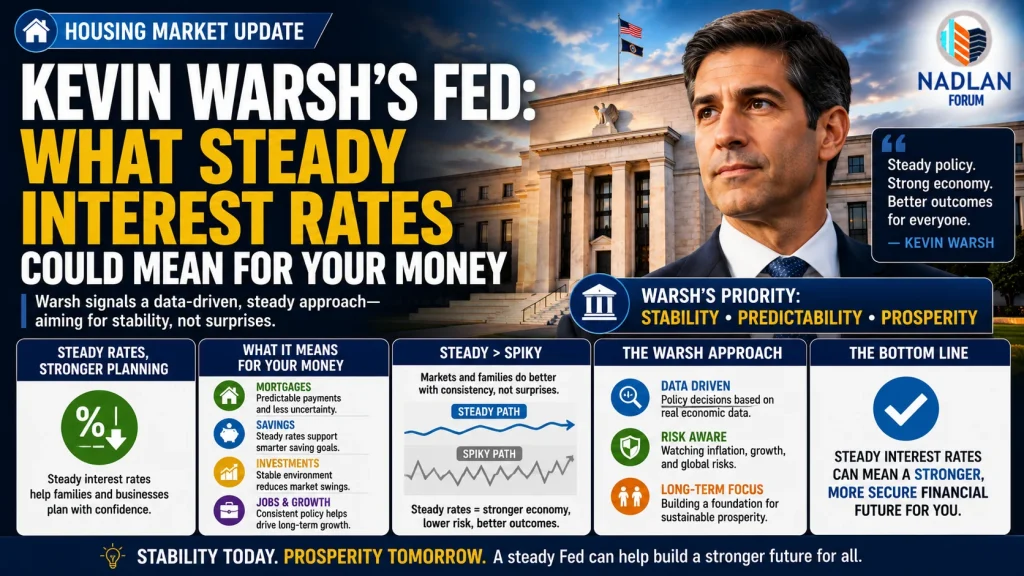
The Federal Reserve enters a new chapter as Kevin Warsh takes over as chair of the central bank. While many Americans hoped for lower borrowing costs, financial markets expect the Fed to leave interest rates unchanged at its latest policy meeting.
For households already dealing with higher living costs, elevated mortgage rates, and expensive credit card debt, the decision means affordability challenges are likely to continue for now.
Although the Federal Reserve’s actions do not directly control every consumer interest rate, its policies influence mortgages, auto loans, credit cards, savings accounts, and many other parts of the economy.
Markets Expect Rates To Stay Unchanged
Financial markets largely anticipate that the Federal Reserve will keep its benchmark interest rate steady.
Despite earlier discussions about possible rate cuts, recent economic data has complicated the outlook.
Several factors are influencing policymakers:
- Strong employment growth.
- Elevated inflation.
- Rising energy prices.
- Global economic uncertainty.
- Financial market volatility.
Many economists believe the Fed will remain cautious until inflation moves closer to its long-term target.
Inflation Remains A Key Concern
One of the Federal Reserve’s primary responsibilities is maintaining stable prices.
Although inflation has eased from previous highs, it remains above the central bank’s long-term goal.
Higher energy costs and ongoing global uncertainties have contributed to recent price increases.
Persistent inflation creates a difficult balancing act for policymakers.
Lower interest rates could stimulate economic growth but might also increase inflationary pressures.
Higher rates help slow inflation but make borrowing more expensive for consumers and businesses.
Kevin Warsh’s Approach To Inflation
Kevin Warsh has indicated that he pays close attention to alternative measures of inflation.
Rather than focusing only on traditional core inflation data, he has discussed using a measure known as the “trimmed mean.”
This approach attempts to remove unusually large monthly price movements that may not reflect long-term inflation trends.
Common Inflation Measures
| Measure | Description |
|---|---|
| Headline Inflation | Includes all consumer prices |
| Core Inflation | Excludes food and energy prices |
| Trimmed Mean Inflation | Removes unusually large monthly price changes |
Supporters believe the trimmed mean provides a clearer picture of underlying inflation trends.
Critics argue that some large price movements can become long-lasting and should not be ignored.
Why Inflation Measures Matter
The inflation measure policymakers emphasize can influence future interest-rate decisions.
If inflation appears to be slowing under one method, policymakers may become more comfortable holding or lowering rates.
If inflation remains elevated under another measure, they may prefer keeping rates higher.
The difference between these indicators has become increasingly important as the Federal Reserve evaluates future policy moves.
How The Federal Reserve Affects Consumers
The Federal Reserve sets the federal funds rate, which influences borrowing costs throughout the economy.
Although consumers do not borrow directly at this rate, many financial products are affected by changes in monetary policy.
Consumer Financial Products Influenced By The Fed
| Financial Product | Impact |
| Credit Cards | High |
| Home Equity Loans | High |
| Adjustable Mortgages | Moderate to High |
| Auto Loans | Moderate |
| Personal Loans | Moderate |
| Savings Accounts | Moderate |
| Fixed Mortgage Rates | Indirect |
Mortgage rates depend more heavily on inflation expectations and Treasury yields than on direct Fed actions.
What Higher Rates Mean For Homebuyers
Mortgage affordability remains a major challenge.
Although mortgage rates are influenced by several factors, Federal Reserve policy shapes overall financial conditions.
Higher rates can:
- Increase monthly mortgage payments.
- Reduce purchasing power.
- Slow housing demand.
- Encourage price negotiations.
- Increase refinancing costs.
Potential homebuyers may continue facing affordability pressures if borrowing costs remain elevated.
Credit Card Borrowers Could Feel Pressure
Credit cards tend to react quickly to Federal Reserve policy.
If benchmark rates remain high, consumers carrying credit card balances may continue paying elevated interest charges.
Households can reduce interest costs by:
- Paying balances faster.
- Consolidating higher-interest debt.
- Avoiding unnecessary borrowing.
- Improving credit scores.
Savings Accounts Benefit From Higher Rates
Not all consumers are negatively affected by higher interest rates.
Higher benchmark rates often allow banks to offer more competitive returns on savings products.
Potential beneficiaries include:
- Savings accounts.
- Certificates of deposit.
- Money market accounts.
- Short-term Treasury investments.
Savers may continue enjoying relatively attractive yields while rates remain elevated.
Household Budgets Face Ongoing Challenges
Many families continue dealing with rising everyday expenses.
Higher energy costs, housing expenses, and borrowing costs have placed additional pressure on household budgets.
Some economic analysts describe current conditions as a “K-shaped” economy.
K-Shaped Economic Recovery
| Higher-Income Households | Lower-Income Households |
| Stronger financial positions | Greater affordability challenges |
| Better investment returns | Higher borrowing costs |
| More savings opportunities | Increased budget pressure |
Economic conditions can affect households differently depending on income, debt levels, and financial resources.
Global Events Continue Influencing Policy
Federal Reserve decisions do not occur in isolation.
Several external factors can influence inflation and interest rates:
- Energy prices.
- International conflicts.
- Supply chain disruptions.
- Trade policies.
- Government spending.
- Labor market conditions.
Unexpected developments can quickly alter the economic outlook.
What This Means For Homeowners
Existing homeowners may continue facing higher borrowing costs for:
- Home equity loans.
- Adjustable-rate mortgages.
- Cash-out refinancing.
- Personal financing.
However, homeowners with fixed-rate mortgages remain protected from future interest-rate increases.
What This Means For Investors
Interest-rate expectations affect many investment markets.
Higher rates can influence:
- Stock valuations.
- Bond prices.
- Real estate activity.
- Corporate borrowing.
- Consumer spending.
Investors often monitor Federal Reserve statements for clues about future policy direction.
Tips For Consumers In A Higher-Rate Environment
Consumers can prepare by focusing on financial stability.
Helpful strategies include:
- Building emergency savings.
- Paying down high-interest debt.
- Shopping for competitive loan rates.
- Maintaining strong credit.
- Avoiding unnecessary borrowing.
- Reviewing household budgets regularly.
Small financial improvements can provide valuable flexibility during periods of economic uncertainty.
Key Economic Factors To Watch
| Economic Indicator | Why It Matters |
| Inflation | Influences Fed decisions |
| Employment Growth | Reflects economic strength |
| Energy Prices | Affects household budgets |
| Treasury Yields | Impacts mortgage rates |
| Consumer Spending | Measures economic activity |
| Federal Reserve Policy | Shapes borrowing costs |
What Could Happen Next?
Several possible scenarios remain on the table.
Base Case
The Federal Reserve keeps rates relatively stable while monitoring inflation.
Lower Inflation Scenario
Improving inflation could eventually allow policymakers to consider rate reductions.
Higher Inflation Scenario
Persistent price pressures could increase the likelihood of future rate hikes.
Much will depend on incoming economic data over the coming months.
Bottom Line
Kevin Warsh begins his leadership of the Federal Reserve during a challenging economic period marked by elevated inflation, higher borrowing costs, and ongoing affordability concerns. Financial markets largely expect the central bank to leave interest rates unchanged for now, but future decisions will depend on inflation, employment, and broader economic conditions.
For consumers, stable but elevated interest rates mean mortgages, credit cards, and other borrowing costs are likely to remain relatively high, while savers may continue benefiting from stronger deposit yields. As the economy evolves, households may be best served by focusing on debt management, savings, and long-term financial planning while monitoring future Federal Reserve policy changes. For direct financing consultations or mortgage options for you visit 👉 Nadlan Capital Group.
