


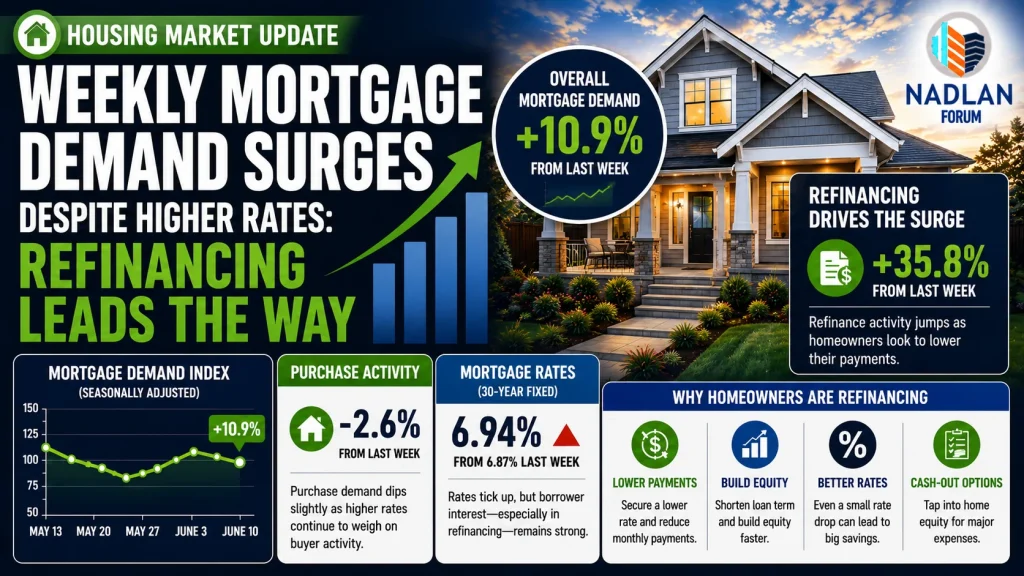
Mortgage demand strengthened significantly during the latest reporting period, showing that homebuyers and homeowners remain active even as interest rates continue to fluctuate.
Despite a modest increase in borrowing costs, total mortgage application activity climbed sharply, supported by strong refinance demand and steady home purchase applications. Adjustable-rate mortgages also attracted more interest as borrowers searched for ways to lower monthly payments.
The latest data suggests that many consumers are adapting to today’s higher-rate environment instead of waiting for dramatic declines in borrowing costs.
Mortgage Applications Jump Nearly 11%
Total mortgage application volume increased by 10.8% compared with the previous week.
The improvement came despite mortgage rates moving slightly higher and ongoing uncertainty surrounding inflation, Federal Reserve policy, and global events.
Many borrowers appear to be taking advantage of temporary rate dips during periods of market volatility.
The spring homebuying season may also be encouraging both buyers and homeowners to move forward with financing decisions before summer activity typically slows.
Mortgage Rates Edge Higher
The average interest rate for a standard 30-year fixed mortgage increased modestly during the week.
Weekly Mortgage Rate Snapshot
| Metric | Previous Week | Latest Week |
|---|---|---|
| 30-Year Fixed Mortgage Rate | 6.57% | 6.60% |
| Average Points | 0.67 | 0.63 |
| Five-Year ARM Rate | — | 5.96% |
Although rates moved slightly higher overall, daily fluctuations created opportunities for some borrowers to secure better financing terms.
Mortgage markets continue reacting to economic reports, inflation data, Treasury yields, and geopolitical developments.
Refinancing Activity Sees Strong Growth
The refinance market delivered one of the strongest performances of the week.
Applications to refinance existing home loans increased by 15% compared with the previous week.
Refinance demand was also 20% higher than the same period one year ago.
Several factors contributed to the increase:
- Small improvements in daily mortgage rates.
- Higher mortgage rates last year.
- Homeowners seeking payment reductions.
- Borrowers looking to adjust loan terms.
- Opportunities to consolidate debt or access home equity.
Mortgage Application Activity
| Category | Weekly Change | Annual Change |
| Total Mortgage Applications | +10.8% | — |
| Refinance Applications | +15% | +20% |
| Purchase Applications | +7% | +4% |
Home Purchase Demand Improves
Mortgage applications for home purchases also increased.
Purchase demand rose 7% from the previous week and remained 4% above year-ago levels.
Some buyers who delayed decisions earlier in the spring due to volatile mortgage rates may now be returning to the market.
Others may be trying to complete purchases before the traditionally slower summer season.
The increase suggests that housing demand remains resilient despite affordability challenges.
Adjustable-Rate Mortgages Gain Attention
Adjustable-rate mortgages, commonly known as ARMs, attracted more borrowers during the week.
The share of ARM applications increased to 8.6% of total mortgage activity.
ARM Market Snapshot
| Metric | Latest Reading |
| ARM Share of Applications | 8.6% |
| Average Five-Year ARM Rate | 5.96% |
Because ARM rates remain below many fixed-rate products, some buyers are considering these loans as a way to reduce initial monthly payments.
Borrowers who expect to move or refinance before the adjustment period may find ARMs particularly attractive.
Why Mortgage Demand Is Rising
Several factors are helping support mortgage activity.
Market Volatility
Interest rates continue moving up and down as investors react to economic news.
Borrowers often use temporary declines as opportunities to lock in financing.
Seasonal Buying Patterns
Spring and early summer traditionally represent one of the busiest periods for home purchases.
Many buyers prefer to complete transactions before the school year begins.
Rate Expectations
Some consumers believe mortgage rates could remain elevated for an extended period.
Instead of waiting for major declines, many are choosing to buy or refinance under current conditions.
Inflation and Economic Data Remain Important
Mortgage rates remain closely tied to economic conditions.
Upcoming inflation reports and other government data releases could influence borrowing costs.
Higher-than-expected inflation could push Treasury yields and mortgage rates higher.
Lower inflation readings could provide support for more favorable financing conditions.
Financial markets generally react quickly to major economic surprises.
What This Means for Homebuyers
The increase in purchase applications suggests that buyers are adjusting to today’s mortgage environment.
Rather than waiting for significantly lower rates, many households are focusing on finding homes that fit their budgets.
Buyers can improve affordability by:
- Shopping among multiple lenders.
- Improving credit scores.
- Increasing down payments.
- Comparing fixed and adjustable loan products.
- Exploring available assistance programs.
What This Means for Homeowners
Refinancing activity indicates that homeowners continue searching for opportunities to improve their financial situations.
Refinancing may help borrowers:
- Lower monthly payments.
- Shorten loan terms.
- Switch from adjustable to fixed rates.
- Access home equity.
- Consolidate higher-interest debt.
Homeowners should carefully evaluate closing costs and long-term savings before refinancing.
Mortgage Market Outlook
Mortgage rates remain highly sensitive to economic developments.
Inflation, employment reports, Federal Reserve policy, and geopolitical events will likely continue influencing borrowing costs throughout the remainder of 2026.
While short-term volatility is expected, many housing economists believe mortgage rates could remain within a relatively stable range unless major economic surprises occur.
Key Mortgage Market Numbers
| Indicator | Latest Reading |
| Total Mortgage Demand | +10.8% |
| Refinance Applications | +15% |
| Purchase Applications | +7% |
| 30-Year Fixed Rate | 6.60% |
| Five-Year ARM Rate | 5.96% |
| ARM Share of Applications | 8.6% |
Bottom Line
Mortgage demand increased sharply despite higher interest rates, showing that both homebuyers and homeowners remain active in the housing market. Total application volume climbed nearly 11%, supported by a 15% jump in refinancing activity and a solid increase in purchase applications.
Adjustable-rate mortgages also gained popularity as borrowers looked for lower initial payments. While mortgage rates continue to experience short-term volatility, many consumers appear to be adapting to the current market rather than waiting for significant rate declines.
As inflation data and broader economic conditions evolve, mortgage activity is expected to remain closely tied to changes in interest rates and consumer confidence throughout the rest of 2026. For direct financing consultations or mortgage options for you visit 👉 Nadlan Capital Group.
