


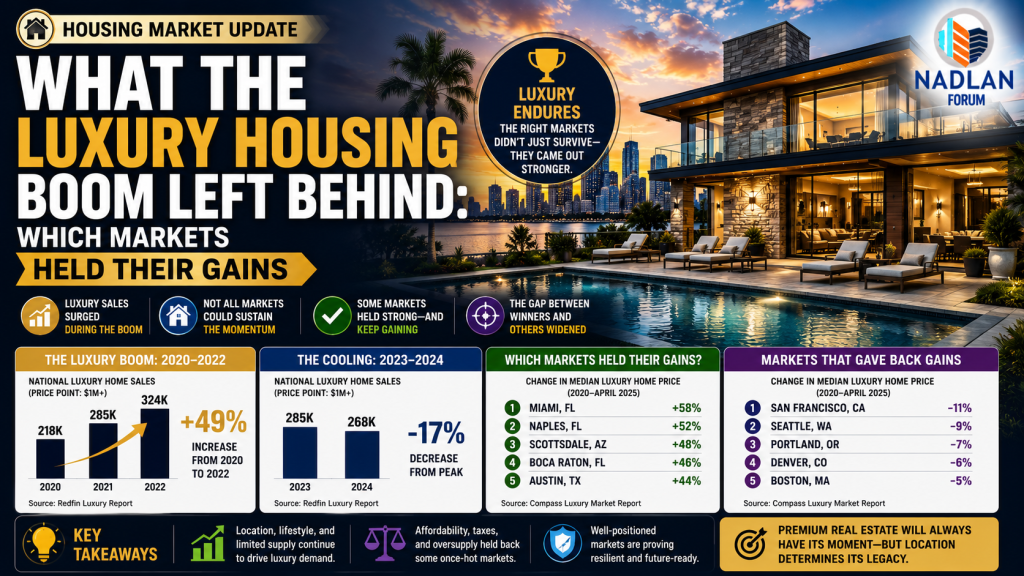
The pandemic transformed the luxury housing market across the United States. Historically low mortgage rates, remote work flexibility, and changing lifestyle preferences created a surge in demand for high-end homes, sending prices sharply higher in many markets.
Several years later, the luxury housing market is settling into a new phase. While some cities have maintained or even exceeded their pandemic-era gains, others have given back much of the appreciation they experienced during the housing boom.
Recent housing data suggests that luxury real estate is no longer moving as one national market. Instead, local economic conditions, employment growth, housing supply, and long-term demand are playing a much larger role.
Luxury Housing Continues to Adjust
National luxury home prices remain elevated, but the pace of growth has slowed considerably.
The luxury price threshold, representing the top 10% of home listings, reached approximately $1.28 million during May 2026. While this remains historically high, it marked another annual decline compared with the previous year.
Higher-end luxury and ultra-luxury segments have also experienced modest price adjustments as the market finds a more sustainable balance.
National Luxury Housing Snapshot
| Metric | May 2026 | Monthly Change | Year-over-Year Change |
|---|---|---|---|
| Luxury Threshold (Top 10%) | $1,283,432 | +0.7% | -1.4% |
| High-End Luxury Threshold (Top 5%) | $2,000,466 | -0.1% | -5.5% |
| Ultra-Luxury Threshold (Top 1%) | $5,566,377 | -2.5% | -4.4% |
| Million-Dollar Listing Share | 13.8% | +0.3 percentage points | -0.6 percentage points |
Although prices have softened, the pace of declines has slowed significantly, suggesting that the luxury market may be approaching greater stability.
Most Luxury Markets Kept Some Gains
Nationally, luxury markets have retained roughly 59% of the price appreciation generated during the pandemic housing boom.
However, performance varies widely from one city to another.
Some markets have exceeded previous highs, while others have erased nearly all of their gains.
Cities That Retained the Most Luxury Gains
Only a handful of luxury markets have completely surpassed their pandemic peaks.
Top Luxury Markets
| Rank | Metro Area | Pandemic Gains Retained |
| 1 | Minneapolis-St. Paul | 133.2% |
| 2 | Boise, ID | 109.0% |
| 3 | Boston-Cambridge-Newton | 89.0% |
| 4 | Bend, OR | 88.8% |
| 5 | Riverside-San Bernardino | 84.8% |
Minneapolis-St. Paul
The Minneapolis luxury market experienced moderate appreciation during the pandemic but has continued climbing even after the broader housing boom slowed.
Strong local economic conditions and steady demand have supported ongoing growth.
Boise
Boise experienced one of the largest luxury housing surges during the pandemic.
Despite market adjustments, prices have remained above previous highs, reflecting continued demand and economic expansion.
Boston
Boston benefits from a stable economy supported by healthcare, life sciences, education, and financial services.
Limited housing supply and high-income buyers continue supporting luxury home values.
Bend
Lifestyle-driven demand remains strong in Bend, where luxury buyers continue seeking recreational and second-home properties.
High-end housing prices have remained resilient compared with many other markets.
Markets That Lost Momentum
Not every luxury market performed well after the pandemic.
Several cities have experienced substantial corrections.
Luxury Markets Facing Larger Declines
| Market | Key Trend |
| San Francisco | Fell below pre-pandemic levels |
| San Jose | Significant correction |
| Denver | Luxury gains largely erased |
| Urban Honolulu | Below pre-pandemic baseline |
| Kahului-Wailuku | Continued adjustment |
| Washington, D.C. | Minimal gains retained |
San Francisco Shows a Unique Story
San Francisco experienced one of the largest luxury market reversals.
Luxury prices initially increased during the pandemic but later declined enough to erase those gains and move below pre-pandemic levels.
Several factors contributed:
- Technology sector layoffs.
- Population shifts.
- Smaller buyer pools.
- Changing remote work patterns.
However, a new source of demand may be emerging.
Artificial intelligence companies and technology startups have created substantial wealth for employees and investors through stock sales and secondary market transactions.
This new group of high-income buyers has helped support activity at the top end of the luxury market.
AI Wealth Is Influencing Luxury Real Estate
Technology-driven wealth creation is becoming an increasingly important factor in certain luxury housing markets.
Employees and investors associated with successful artificial intelligence companies have generated significant liquidity, creating new demand for high-end homes.
In some markets, these buyers are making larger down payments and purchasing premium properties, partially offsetting broader market weakness.
This trend highlights how local economic factors can significantly influence luxury real estate performance.
Million-Dollar Homes Remain Common
One of the lasting effects of the pandemic housing boom is the growth in million-dollar properties.
Before the pandemic, homes priced above $1 million typically represented between 7% and 9% of all listings nationwide.
Today, million-dollar homes account for nearly 14% of listings.
Million-Dollar Listing Trends
| Period | Share of Listings |
| Pre-Pandemic Average | 7% – 9% |
| Pandemic Peak | 15.4% |
| May 2026 | 13.8% |
The total number of million-dollar listings remains significantly higher than before the pandemic despite recent price adjustments.
Why Luxury Markets Are Performing Differently
Several factors help explain the varying performance across luxury housing markets.
Local Economies
Cities with strong employment growth and diversified industries tend to support luxury demand.
Housing Supply
Markets with limited luxury inventory often experience greater price stability.
Lifestyle Appeal
Destination communities continue attracting affluent buyers seeking quality of life and recreational opportunities.
Technology and Finance
Regions benefiting from technology and financial sector growth often maintain stronger luxury housing activity.
What This Means for Luxury Buyers
Today’s luxury market offers more opportunities than during the height of the pandemic housing boom.
Buyers may find:
- Greater inventory.
- Improved negotiating power.
- More stable pricing.
- Less competition in some markets.
At the same time, desirable luxury markets continue attracting strong demand from high-income households.
What This Means for Sellers
Luxury sellers must adapt to changing market conditions.
Proper pricing, high-quality marketing, and realistic expectations have become increasingly important.
Properties in markets with strong local economies and limited inventory continue to perform relatively well.
However, overpriced homes may remain on the market longer than they did during the pandemic surge.
Luxury Housing Outlook
The luxury housing market appears to be entering a more balanced phase.
Rather than experiencing rapid nationwide appreciation, local economic conditions are increasingly determining outcomes.
Markets supported by strong employment, lifestyle advantages, and growing wealth creation are likely to remain resilient.
At the same time, areas that benefited primarily from temporary pandemic trends may continue adjusting.
Bottom Line
The luxury housing boom created dramatic price increases across the country, but the correction has been far from uniform. Some cities, including Minneapolis-St. Paul and Boise, have surpassed their pandemic-era highs, while others such as San Francisco have fallen below pre-pandemic levels.
Despite recent price adjustments, luxury real estate remains historically strong. Million-dollar homes continue representing a larger share of the housing market, and new sources of wealth, including the growing artificial intelligence industry, are creating fresh demand in select regions.
As the luxury market evolves, local economic strength, housing supply, and long-term buyer demand are becoming more important than the pandemic-driven factors that shaped the previous housing boom. For direct financing consultations or mortgage options for you visit 👉 Nadlan Capital Group.
