


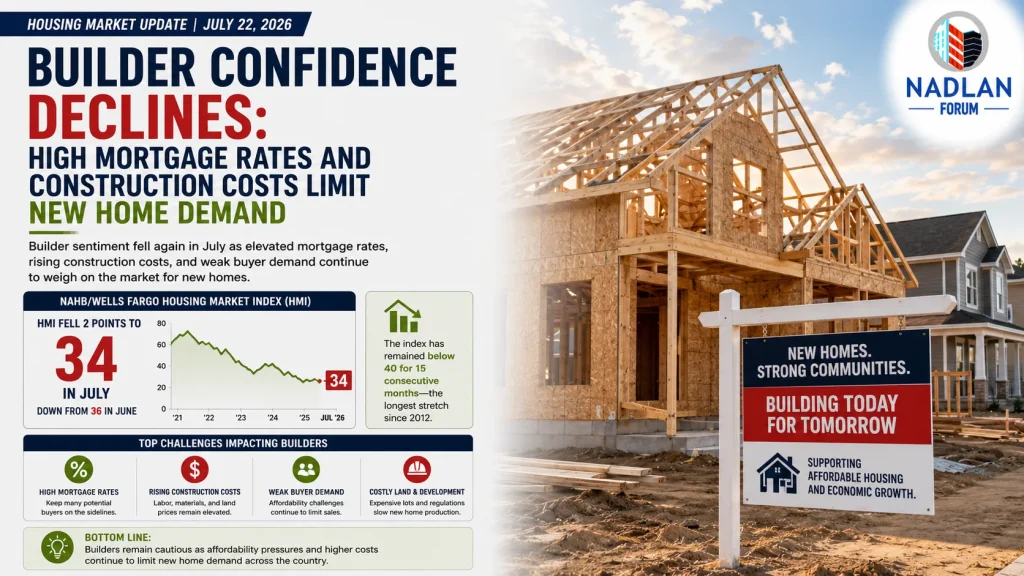
Confidence among U.S. home builders declined again in July as high mortgage rates, expensive land, rising construction costs, and weak buyer demand continued to affect the new-home market.
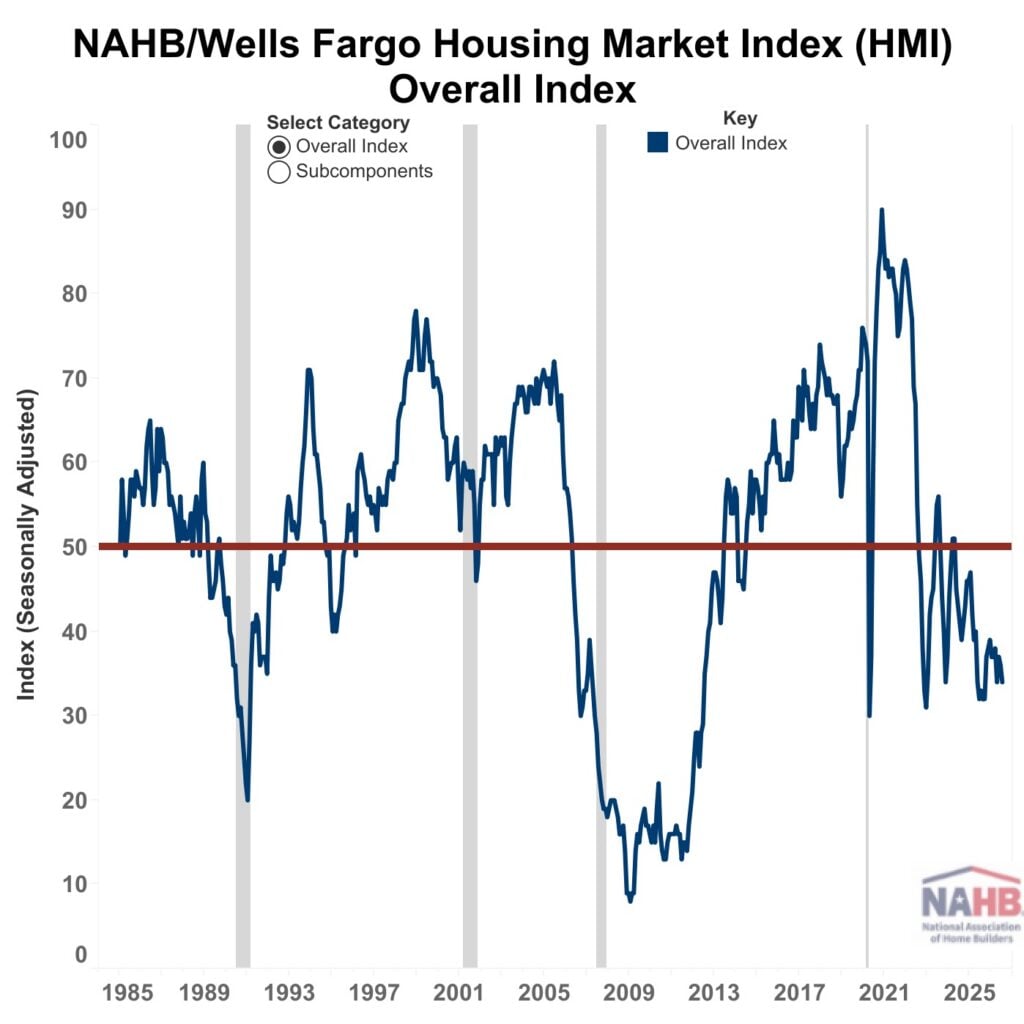
The latest Housing Market Index fell two points to 34, down from a revised reading of 36 in June. The index has now remained below 40 for 15 consecutive months, its longest period at that level since 2012.
A reading below 50 means more builders consider market conditions poor than good.
The continued weakness shows that the new-construction market remains under pressure even though the country still needs more housing. Builders are dealing with high development expenses at the same time that many potential buyers cannot afford current home prices and mortgage payments.
As a result, more builders are reducing prices, offering mortgage-rate incentives, and covering buyer costs to generate sales.
Buyers Continue to Wait for Lower Rates
Mortgage rates remain one of the biggest reasons potential buyers are delaying new-home purchases.
Rates near or above the mid-6% range can significantly increase the monthly payment on a newly constructed home. Buyers who could have qualified for a certain loan amount when rates were lower may now need to purchase a less expensive property, increase their down payment, or wait for financing conditions to improve.
Economic uncertainty is also affecting buyer decisions.
Households are watching inflation, employment conditions, energy costs, and future interest-rate policy before committing to a large purchase.
Even buyers with stable employment may hesitate when they are unsure whether mortgage rates or home prices could decline later.
This caution is reducing traffic at new-home communities and making it harder for builders to convert interested shoppers into completed sales.

Affordability Remains the Main Challenge
The current weakness is not caused by one issue alone.
Builders face high costs for:
- Developed land
- Building materials
- Skilled labor
- Permits and inspections
- Construction financing
- Insurance
- Utility connections
- Local development fees
These expenses limit how far builders can reduce home prices while keeping projects financially workable.
At the same time, buyers are dealing with elevated mortgage rates, higher insurance premiums, property taxes, closing costs, and general living expenses.
The combination creates an affordability gap.
Builders need prices high enough to cover the cost of producing homes, while buyers need lower prices and payments to qualify for financing.
This gap has kept builder sentiment below 40 for more than a year.
More Builders Are Cutting Prices
The July survey found that 37% of builders reduced home prices, up from 35% in June and 32% in May.
The average price reduction remained at 6%, unchanged from the previous month.
Price cuts are becoming more common as builders compete for a smaller group of qualified buyers.
A 6% reduction can be meaningful. On a new home originally priced at $450,000, a 6% cut would reduce the price by $27,000 to $423,000.
However, a lower selling price does not always fully offset the effect of high mortgage rates.
The monthly payment may still be above the buyer’s budget, especially after taxes, insurance, and homeowners association fees are added.
Builders must also decide whether reducing the price could affect the value of other homes already sold or currently listed within the same development.
For this reason, some builders prefer financial incentives instead of direct price reductions.
Sales Incentives Remain Common
Approximately 63% of builders used sales incentives in July, up slightly from 62% in June.
This marked the 16th consecutive month in which at least 60% of builders reported using incentives.
Common builder incentives include:
- Temporary mortgage-rate buydowns
- Permanent mortgage points
- Seller-paid closing costs
- Design or appliance upgrades
- Reduced lot premiums
- Help with homeowners association fees
- Flexible deposit requirements
A mortgage-rate buydown can sometimes provide more immediate monthly savings than a similar reduction in the purchase price.
For example, a builder may contribute money toward discount points that permanently reduce the buyer’s mortgage rate.
Temporary buydowns may lower the rate for the first one to three years. These offers can make the initial payments easier, but buyers must be prepared for the full payment after the temporary reduction ends.
Buyers should compare the value of each incentive rather than assuming the largest advertised offer is automatically the best choice.
Current Sales Conditions Declined
All three major parts of the Housing Market Index weakened in July.
The index measuring current sales conditions fell one point to 37.
The measure of expected sales during the next six months declined two points to 43.
The index tracking prospective-buyer traffic also fell two points to 23.
Buyer traffic remains the weakest part of the index.
A reading of 23 indicates that relatively few builders are seeing strong levels of potential buyers visiting new-home communities.
The lower future-sales score also suggests that builders do not expect a rapid improvement during the second half of the year.
Future expectations remain higher than current sales conditions, but both measures are below the neutral level of 50.
Regional Builder Confidence Remains Uneven
Builder conditions vary significantly across the country.
Based on three-month moving averages, the regional readings were:
- Northeast: Increased one point to 45
- Midwest: Increased two points to 45
- South: Declined one point to 33
- West: Declined one point to 26
The Northeast and Midwest reported the highest regional confidence, although both remained below 50.
The West recorded the lowest score.
Western builders face some of the country’s highest land prices, regulatory costs, labor expenses, and home prices. These conditions make it difficult to produce properties that average-income households can afford.
The South has generally benefited from stronger construction activity and more available land. However, rising inventory in some Southern markets has increased competition among builders while buyer demand has slowed.
New Construction Provides Buyers With More Options
Although builders remain concerned, current conditions may offer opportunities for buyers.
New homes are often more available than existing homes in markets where current owners are unwilling to give up older mortgages with low rates.
Builders may also have more flexibility than individual sellers when offering rate buydowns or closing-cost assistance.
Potential advantages of new construction include:
- Lower expected maintenance costs
- New roofing and mechanical systems
- Modern energy-efficiency standards
- Updated electrical and plumbing systems
- Builder warranties
- Available financial incentives
However, buyers should compare the full cost.
New communities may have higher property taxes, homeowners association fees, special district assessments, landscaping costs, or longer commuting distances.
An advertised mortgage rate may also require the use of a preferred lender, a specific down payment, excellent credit, or payment of additional loan fees.
High Land Costs Limit Lower-Priced Construction
Land is one of the largest obstacles facing builders.
In many growing communities, available lots are limited or require expensive infrastructure work before construction can begin.
Builders may need to pay for roads, drainage, utility systems, environmental studies, permit fees, and other improvements.
These costs are included in the final price of the home.
When land and development expenses are high, builders often focus on larger or more expensive homes because the financial return may be better.
This makes it difficult to create small, basic starter homes even when buyer demand for them is strong.
Allowing smaller lots, townhouses, duplexes, and other housing types could help reduce the amount of land required for each home.
Material Prices Continue to Pressure Builders
Construction material costs also remain elevated.
A new home requires lumber, concrete, steel, roofing, insulation, drywall, glass, appliances, electrical equipment, plumbing products, and many other materials.
Price increases in any of these categories can affect the builder’s budget.
Unexpected cost changes are especially difficult for projects that take many months to complete.
Builders may set a sale price before every construction expense is known. If materials or labor become more expensive during the project, profit margins can decline.
Smaller builders may have fewer opportunities to negotiate volume discounts than large national companies.
This can make independent builders more vulnerable to changing material prices and financing costs.
Skilled Labor Shortages Add Delays
The construction industry continues to face shortages of skilled workers.
Builders may have difficulty finding enough:
- Electricians
- Plumbers
- Carpenters
- Roofers
- Concrete workers
- HVAC technicians
- Equipment operators
- Site supervisors
Labor shortages can delay completion dates and increase wages.
Longer construction periods also raise financing costs because builders often use loans to purchase land and fund projects before homes are sold.
These expenses eventually affect the price paid by buyers.
Workforce training, apprenticeships, immigration policy, and career education could all influence the long-term supply of construction workers.
Housing Law May Help Over Time
Builders have welcomed the recently enacted 21st Century ROAD to Housing Act, which includes provisions involving zoning, land use, regulatory reform, financing, and housing supply.
Industry leaders believe the law may help reduce some barriers to construction and support the development of additional homes.
However, the effects will not be immediate.
Federal programs must be created, rules may need to be written, and state or local governments may need to participate before many of the reforms affect individual projects.
Local zoning and permitting policies will remain especially important.
Even broad federal housing reforms may have limited effects in communities where local rules prevent smaller lots, attached homes, apartments, or higher-density construction.
State and Local Changes Are Still Needed
Many of the costs affecting home construction are controlled at the local level.
Zoning rules determine where homes can be built, how large lots must be, how much parking is required, and which types of housing are allowed.
Permit delays can add months to a project.
Development fees and regulatory requirements may also add thousands of dollars to each home.
Supporters of housing reform argue that local governments can improve supply by:
- Allowing smaller homes and lots
- Expanding areas where townhouses are permitted
- Speeding up permit reviews
- Reducing unnecessary development fees
- Allowing accessory dwelling units
- Updating density restrictions
- Simplifying approval processes
Local officials must balance these changes with infrastructure, traffic, environmental, and community concerns.
Lower Mortgage Rates Would Support Demand
A meaningful decline in mortgage rates would likely improve buyer traffic and builder confidence.
Lower rates would reduce monthly payments and increase the amount borrowers can qualify to purchase.
For example, on a $400,000 mortgage, the payment at 6.5% is significantly higher than the payment at 5.5%.
Even a reduction of half a percentage point can improve affordability for some households.
However, lower rates could also increase competition and support higher prices if housing supply remains limited.
The strongest long-term improvement would come from a combination of lower financing costs and increased construction.
Buyers Should Compare Price Cuts and Incentives
A builder’s price reduction is not always more valuable than a rate incentive.
Buyers should ask for written estimates showing:
- Purchase price
- Mortgage rate
- Annual percentage rate
- Monthly principal and interest
- Estimated taxes and insurance
- Closing costs
- Required down payment
- Cost after temporary incentives expire
A lower rate may create greater monthly savings, while a lower price may reduce the loan balance, down payment, and future property-tax assessment.
The better option depends on how long the buyer expects to own the home and whether the buydown is temporary or permanent.
Buyers should also compare the builder’s preferred financing offer with outside mortgage quotes.
Builder Weakness Could Slow Future Supply
Low confidence can eventually affect the number of homes started.
When builders expect slow sales, they may purchase fewer lots, reduce new construction plans, or delay future communities.
This could limit housing supply later, even if buyer demand improves.
The housing market therefore faces a difficult cycle.
High rates reduce demand, causing builders to become cautious. Less construction may then keep the country’s housing shortage in place and prevent prices from becoming more affordable.
Maintaining a steady level of construction is important for meeting long-term household growth and replacing aging housing stock.
What the Housing Market Index Measures
The Housing Market Index is based on a monthly survey of single-family home builders.
Builders rate:
- Current new-home sales
- Expected sales over the next six months
- Traffic from prospective buyers
Current and expected sales are rated as good, fair, or poor. Buyer traffic is rated from high to very high, average, or low to very low.
The responses are converted into a seasonally adjusted index from zero to 100.
A reading above 50 means more builders view conditions as good than poor. A reading below 50 means negative responses are more common.
The index is a measure of sentiment rather than the number of homes sold or constructed, but it can provide an early indication of future housing activity.
Bottom Line
Builder confidence fell two points to 34 in July 2026, extending the longest stretch of readings below 40 since 2012.
Current sales conditions declined to 37, future expectations fell to 43, and buyer traffic dropped to 23.
Builders are responding to slow demand by lowering prices and increasing incentives. Approximately 37% reported price cuts, while 63% used some form of sales incentive.
High mortgage rates remain a major obstacle, but builders are also facing costly land, expensive materials, labor shortages, financing expenses, and regulatory barriers.
New housing legislation may support construction over time, but meaningful improvement will also depend on state and local reforms.
Until mortgage payments become more manageable or construction costs decline, builder confidence is likely to remain weak and incentives will continue to play an important role in the new-home market. For direct financing consultations or mortgage options for you visit 👉 Nadlan Capital Group.
