
Home Insurance Claim Severity Reaches Record High: Extreme Weather Raises Property Risks

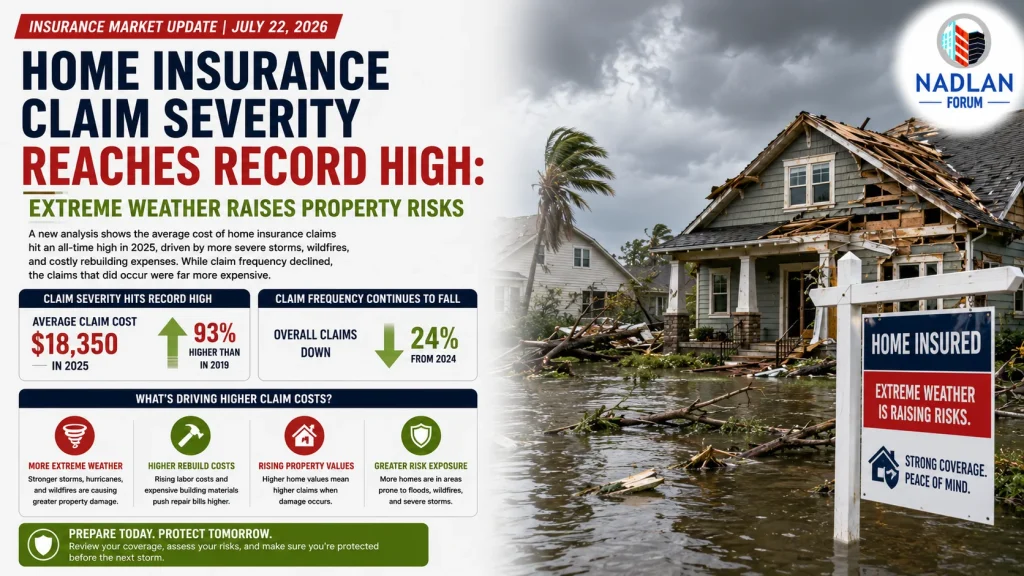
Home insurance claims became significantly more expensive in 2025, even though homeowners filed fewer claims across most major categories.
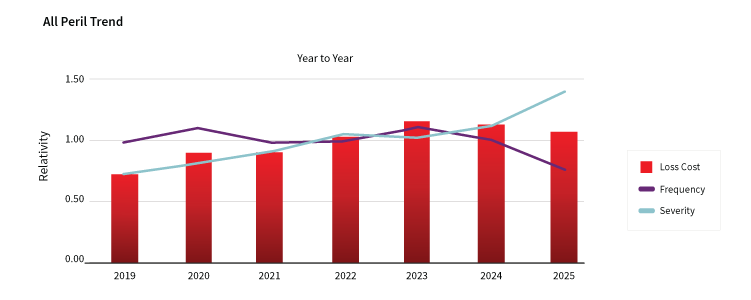
A new analysis of U.S. property insurance losses between 2019 and 2025 found that the average cost of a claim reached its highest level in seven years. Claim severity increased 25.9% from 2024 and was 93.2% higher than in 2019. At the same time, overall claim frequency declined by 23.8% from the previous year.
The combination created an unusual pattern for insurers and homeowners: claims happened less often, but the claims that did occur were far more expensive.
Total loss cost across all types of home insurance claims declined only 4.4% from 2024, despite the large drop in frequency. Loss cost remained the third highest recorded during the seven-year period and stood 50% above its 2019 level.
Wildfires, severe storms, higher labor expenses, expensive construction materials, and growing property values all contributed to the rise.
What Claim Severity Means
Insurance claim severity measures the average financial cost of each claim.
Claim frequency, by comparison, measures how often claims occur.
A year can therefore have fewer total claims while still creating large losses if each event causes more expensive damage.
Several factors can increase severity:
- Higher contractor labor costs
- More expensive roofing and building materials
- Larger and more valuable homes
- Longer repair times
- Temporary housing expenses
- Damage involving several home systems
- Catastrophic weather in densely populated areas
This distinction is important because lower claim frequency does not necessarily mean the insurance market is becoming less risky.
If one wildfire, hailstorm, or tornado outbreak damages thousands of high-value homes, the resulting costs can outweigh reductions in ordinary claims elsewhere.
U.S. Faced 23 Billion-Dollar Disasters
The United States experienced 23 climate and weather disasters that each caused at least $1 billion in damage during 2025.
The combined estimated cost reached approximately $115 billion, making 2025 the third-highest year for the number of billion-dollar climate disasters in the historical record.
The events included wildfires, hailstorms, tornadoes, flooding, drought, and severe wind.
Although 2025 did not experience the same level of major hurricane landfalls seen during some earlier years, widespread severe weather still produced major property losses.
This shows that insurance risk is not limited to coastal hurricanes. Inland communities are increasingly exposed to hail, tornadoes, flash flooding, wildfire, and damaging straight-line winds.
Los Angeles Wildfires Dominated Property Losses
The January 2025 Los Angeles wildfires were the most expensive weather-related event of the year.
The fires caused an estimated $61.2 billion in damage, accounting for more than half of the country’s total billion-dollar disaster losses in 2025. They were also identified as the costliest wildfire disaster recorded in the United States.
The damage was especially severe because the fires affected densely developed areas containing high-value homes, expensive infrastructure, and limited replacement capacity.
Wildfire claims can include much more than the cost of rebuilding a house.
Covered losses may involve:
- Structural reconstruction
- Smoke and water damage
- Personal property
- Debris removal
- Landscaping
- Temporary accommodation
- Building-code upgrades
- Additional living expenses
When thousands of claims arrive at the same time, labor and material shortages can further increase rebuilding costs.
Fire and Lightning Claims Rose Sharply
Fire and Lightning was the only major peril category to record a year-over-year increase in claim frequency during 2025.
The frequency of these claims rose 6%, while average severity increased 67.3% from 2024. Total Fire and Lightning loss cost jumped 76.8%.
The Los Angeles fires were the main reason for the increase.
However, the wider trend also reflects the rising cost of repairing or replacing homes after fires.
Modern homes contain more electronics, appliances, complex mechanical systems, and expensive finishes. Even a fire contained to one room may result in smoke, electrical, structural, and water damage throughout the property.
Wildfires also create growing concerns in areas that were not previously viewed as major fire zones.
Prolonged dry conditions, extreme heat, vegetation growth, wind patterns, and development near wildland areas can increase exposure.
California Recorded the Highest Loss Cost
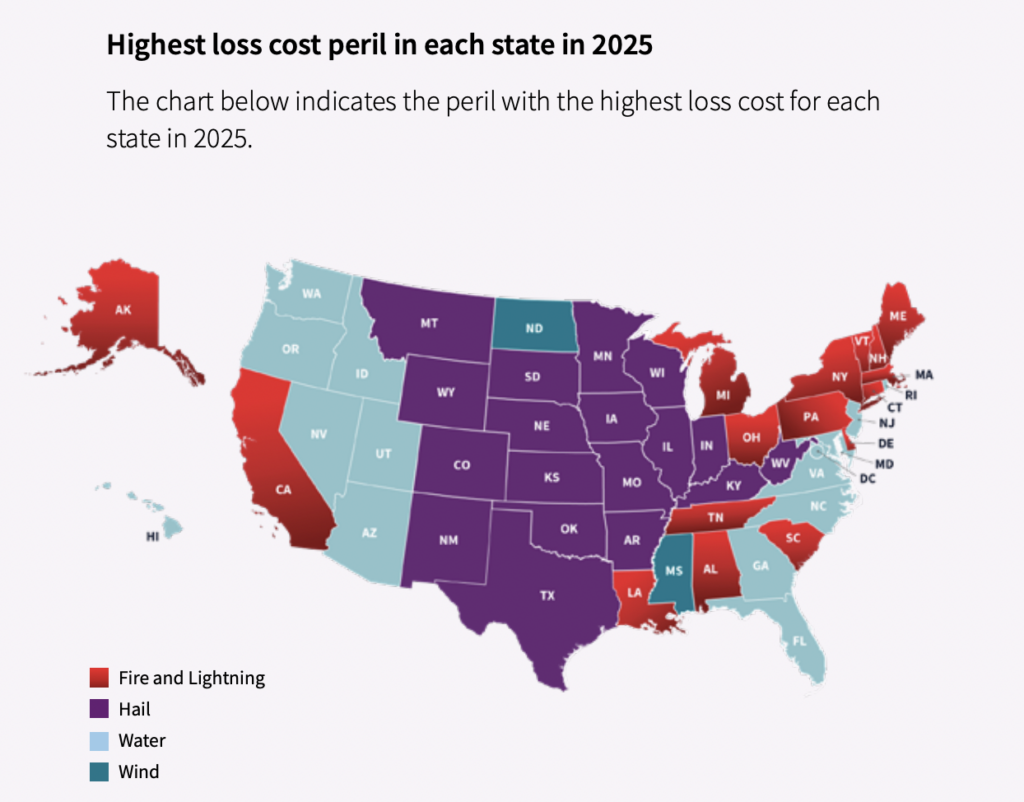
California had the country’s highest combined home insurance loss cost in 2025, largely because of the Los Angeles wildfires.
The state has faced a long-running insurance crisis as carriers respond to wildfire exposure, rebuilding costs, regulatory requirements, and repeated catastrophic events.
Some homeowners in high-risk areas have experienced:
- Higher premiums
- Larger deductibles
- Reduced coverage
- Nonrenewal notices
- Difficulty finding private insurance
- Greater dependence on state-backed coverage
The growing cost of wildfire losses may increase pressure on insurance availability in California and other fire-prone states.
Even homeowners located far from active fires may be affected if insurers spread rising loss costs across a broader group of policyholders.
Wyoming and Missouri Also Faced High Losses
Wyoming and Missouri ranked among the states with the highest overall loss costs in 2025.
Their losses were influenced largely by wind, hail, and severe convective storms affecting the central United States.
Severe convective weather includes:
- Tornadoes
- Large hail
- Thunderstorms
- Straight-line winds
- Heavy rainfall
These events may affect smaller areas than a hurricane, but they can create extensive damage when they pass through populated communities.
Hail can destroy roofs, siding, windows, vehicles, solar panels, and outdoor equipment in a matter of minutes.
Wind can remove roof coverings, damage trees, break windows, and allow rainwater to enter homes.
Wind Claims Declined but Risk Remained High
Wind-related claim costs fell during 2025 compared with the previous year.
Wind loss cost declined 50.4%, frequency fell 43.9%, and severity decreased by 12%. The reductions were linked partly to fewer catastrophic wind claims.
However, the lower annual total does not mean wind risk disappeared.
A major tornado and severe-storm outbreak in the central United States during March was estimated to have caused approximately $11 billion in damage, making it the second-most expensive billion-dollar weather event of the year.
Wind losses can vary widely from one year to another depending on storm location.
A tornado passing through open land may produce limited insured damage. The same storm crossing a city, suburb, or warehouse district can create billions of dollars in losses.
Hail Losses Provided Temporary Relief
Hail loss cost declined 38.4% from its seven-year high in 2023, while hail claim frequency fell 35.4% over the same period. Severity was approximately unchanged from 2024.
This provided some relief after several costly years.
However, hail losses remain highly sensitive to geography.
A single storm affecting a densely populated neighborhood can produce thousands of roof, siding, and vehicle claims.
Replacement costs also depend on:
- Roof size and material
- Local labor prices
- Building-code requirements
- Housing density
- Home value
- Contractor availability
As roof replacement costs rise, even an average hailstorm can create much larger insurance losses than a similar event did several years ago.
Water Damage Remains a Major Concern
Non-weather-related water damage continues to be one of the most common and preventable sources of property loss.
This category can include damage caused by:
- Broken pipes
- Failed washing machine hoses
- Water heater leaks
- Appliance failures
- Plumbing problems
- Overflowing fixtures
- Interior supply-line failures
Non-weather-related water claim severity increased 63.16% between 2019 and 2025.
From 2024 to 2025, its loss cost declined 6.4% and frequency fell 7.8%, but severity still increased by 2.5%.
Water damage becomes expensive when it is not discovered quickly.
A slow leak can damage drywall, flooring, cabinets, insulation, electrical systems, and structural materials. It can also create mold and require specialized remediation.
Leak Detection Could Reduce Losses
Many interior water claims can be reduced or prevented through early detection.
Homeowners can lower their risk by:
- Installing smart leak sensors
- Using automatic water shutoff devices
- Replacing old supply hoses
- Inspecting water heaters
- Checking under sinks
- Monitoring water bills
- Insulating pipes
- Repairing small leaks quickly
Some insurers offer discounts for approved leak-detection systems because these devices can stop water flow before a small plumbing failure becomes a major claim.
Homeowners should also review manufacturer recalls for appliances, water heaters, plumbing fixtures, and supply lines.
Although prevention cannot eliminate all water damage, fast detection can significantly reduce repair costs.
Weather-Related Water Claims Were Less Catastrophic
Catastrophe claims represented approximately 42% of weather-related water claims in 2025, the lowest share recorded during the seven-year period.
This means a larger share of water claims came from ordinary weather events rather than formally classified catastrophes.
Weather-related water damage can result from:
- Roof leaks
- Wind-driven rain
- Flooding
- Ice dams
- Snowmelt
- Storm-damaged windows
- Drainage failures
Standard homeowners insurance may cover some forms of sudden water damage, but it usually does not cover ordinary flooding from rising water.
Homeowners in exposed areas may need a separate flood policy.
They should also understand the difference between covered sudden damage and excluded maintenance problems.
Liability Claims Became More Expensive
Liability claim severity rose 12.8% from 2024, even though liability claim frequency fell 14.6% and total loss cost declined 4%.
Liability coverage may apply when someone is injured on an insured property or when a policyholder is legally responsible for certain types of damage.
Higher claim severity can reflect:
- Medical expenses
- Legal fees
- Larger settlements
- Jury awards
- Litigation costs
- Wage-loss claims
The rise may also reflect social inflation, a term used to describe liability costs increasing faster than general economic inflation because of changing legal outcomes, litigation patterns, and settlement expectations.
Homeowners should review their liability limits carefully.
Higher-value households or owners with significant assets may also consider an umbrella insurance policy.
Theft Claims Continued to Decline
Theft claim frequency and loss cost continued to fall in 2025, reaching their lowest levels during the seven-year period.
The decline may reflect better home-security systems, smart cameras, alarm devices, improved locks, and changes in reporting or criminal activity.
However, theft severity still increased.
The property inside homes has become more expensive, with households owning high-value electronics, appliances, jewelry, tools, and other personal items.
Standard policies may place special limits on categories such as jewelry, collectibles, firearms, business equipment, and cash.
Homeowners with valuable personal property should confirm whether additional scheduled coverage is necessary.
Fewer Claims Did Not Mean Lower Risk
Overall claim frequency declined for every major category except Fire and Lightning.
At first, that may appear to be positive news for homeowners and insurers.
However, the record rise in severity shows that lower frequency can provide a misleading picture when viewed alone.
A smaller number of extremely expensive claims can create more financial pressure than a large number of minor losses.
This pattern is especially important in states facing wildfire, hail, hurricane, or tornado exposure.
Insurers must collect enough premium to cover future losses, operating expenses, reinsurance, and reserves.
When claim severity rises, homeowners may eventually experience higher premiums even if they have never filed a claim.
Rising Repair Costs Affect Insurance Prices
Inflation is one of the main reasons insurance claims have become more expensive.
The cost of rebuilding a home has increased because of:
- Higher construction wages
- Material price increases
- Contractor shortages
- Supply-chain delays
- Building-code changes
- Permit expenses
- Debris removal costs
A home’s insurance replacement value is different from its market value.
Market value includes land, location, local demand, and other factors.
Replacement cost estimates how much it would take to rebuild the structure using current materials and labor.
A property may therefore have a rebuilding cost that is higher or lower than its sale price.
Homeowners should review dwelling coverage regularly to ensure that policy limits reflect current construction costs.
Higher Home Values Increase Exposure
Rising home prices have also increased the amount of property value exposed to disasters.
Storms affecting high-cost housing markets create larger claims because the homes, contents, landscaping, and temporary living expenses are more expensive.
Population growth in wildfire zones, coastal communities, and severe-storm regions has added to total exposure.
Even when the number or strength of weather events does not change, total losses may increase because more homes have been built in vulnerable locations.
This is one reason disaster costs can rise alongside climate-related changes.
Billion-Dollar Disasters Are Happening More Often
The average time between billion-dollar weather disasters has shortened considerably over recent decades.
Research cited in the insurance analysis shows that the average interval decreased from roughly 82 days during the 1980s to 16 days over the past decade.
During 2025, the average gap between billion-dollar disasters was approximately 10 days.
This trend reflects several overlapping factors:
- More intense weather events
- Climate-related changes
- Population growth
- Development in exposed regions
- Higher property values
- Increased rebuilding costs
The shorter interval gives homeowners, insurers, contractors, and public agencies less time to recover before another costly event occurs.
Insurance Availability Could Become More Limited
Rising claim costs can affect more than premiums.
Insurers may respond by reducing exposure in high-risk areas.
Possible changes include:
- Fewer new policies
- More nonrenewals
- Higher deductibles
- Separate wind or hail deductibles
- Roof payment schedules
- Increased inspections
- Coverage restrictions
- Stronger maintenance requirements
Homeowners may also need to prove that roofs, electrical systems, plumbing, or heating equipment have been updated before a carrier agrees to provide coverage.
In areas with limited private options, homeowners may depend on state-backed insurance programs or surplus-lines carriers.
These alternatives may have higher costs or more limited coverage.
Roof Age Is Becoming More Important
Roofs are among the most expensive parts of a home to repair after wind or hail.
Many insurers now consider roof age and material when setting eligibility and coverage.
Some policies may pay the full replacement cost for newer roofs but apply depreciation to older ones.
Others may provide actual cash value coverage instead of full replacement cost once the roof reaches a certain age.
Homeowners should ask:
- Whether the roof is covered at replacement cost
- Whether age-based depreciation applies
- What wind or hail deductible is used
- Whether cosmetic damage is excluded
- What documentation is required
A lower-priced policy may offer less protection after a major storm.
Deductibles Can Create Large Out-of-Pocket Costs
Many policies use a fixed deductible, such as $1,000 or $2,500.
However, catastrophe-related deductibles may be calculated as a percentage of the home’s insured value.
For example, a 2% wind deductible on a home insured for $500,000 would require the homeowner to pay the first $10,000 of covered damage.
A 5% deductible would equal $25,000.
Homeowners should calculate these amounts before choosing a policy.
A percentage-based deductible may appear small on the declarations page but create a serious financial challenge after a disaster.
Homeowners Can Reduce Some Property Risks
Not every loss can be prevented, but property improvements can reduce damage.
Useful steps may include:
- Maintaining the roof
- Sealing windows and doors
- Installing storm shutters
- Trimming trees
- Cleaning gutters
- Improving drainage
- Using fire-resistant materials
- Clearing vegetation near the home
- Updating electrical systems
- Installing leak-detection devices
Homeowners in wildfire areas can create defensible space and reduce combustible materials near structures.
Those in hail-prone markets may consider impact-resistant roofing.
Properties in hurricane or tornado regions may benefit from stronger roof connections, garage-door reinforcement, and protected openings.
Some insurers offer discounts for verified mitigation work.
Buyers Should Review Insurance Before Closing
Home insurance has become an important part of the homebuying process.
A buyer should not assume that every property can be insured at an affordable price.
Before completing a purchase, buyers should request quotes and ask about:
- Annual premium
- Deductibles
- Roof coverage
- Flood requirements
- Wildfire exposure
- Wind and hail exclusions
- Previous claims
- Replacement-cost estimates
- Available discounts
The insurance cost can materially affect the total monthly housing payment.
In some markets, a property with a lower purchase price may be more expensive to own because of its insurance risk.
Homeowners Should Maintain an Updated Inventory
A home inventory can make the claims process easier after a fire, storm, or theft.
Homeowners should document:
- Furniture
- Electronics
- Appliances
- Tools
- Clothing
- Jewelry
- Art and collectibles
- Outdoor equipment
Photos, videos, receipts, serial numbers, and purchase records can help establish ownership and value.
Copies should be stored securely outside the home or in cloud storage.
Homeowners should also review personal-property limits and determine whether the policy provides replacement-cost or depreciated-value coverage.
The Insurance Market May Remain Volatile
The small decline in total loss cost during 2025 may provide temporary relief, but it does not signal a clear improvement in long-term risk.
Severity reached a record level, catastrophic weather remained frequent, and the Los Angeles wildfires showed how one event can reshape an entire year’s results.
Property insurers will continue evaluating risk at the state, neighborhood, and individual-home level.
Factors such as roof condition, wildfire protection, plumbing age, construction type, local weather history, and proximity to emergency services may play a larger role in pricing.
Homeowners may therefore see growing differences in premiums between properties located only a few miles apart.
Bottom Line
Home insurance claim severity reached its highest level in seven years during 2025.
Average claim costs increased 25.9% in one year and 93.2% since 2019, even as overall claim frequency declined sharply. Total loss cost fell only 4.4%, showing that fewer claims did not provide much financial relief.
The Los Angeles wildfires were the main driver of Fire and Lightning losses, with estimated damage of $61.2 billion. Wind, hail, water damage, liability claims, inflation, and higher rebuilding expenses also continued to affect the market.
For homeowners, the findings point to higher premiums, stricter underwriting, and greater out-of-pocket exposure in vulnerable areas.
Reviewing policy limits, deductibles, roof coverage, flood protection, and home-safety upgrades is becoming increasingly important as property risks and rebuilding costs continue to rise. For direct financing consultations or mortgage options for you visit 👉 Nadlan Capital Group.



























Responses