


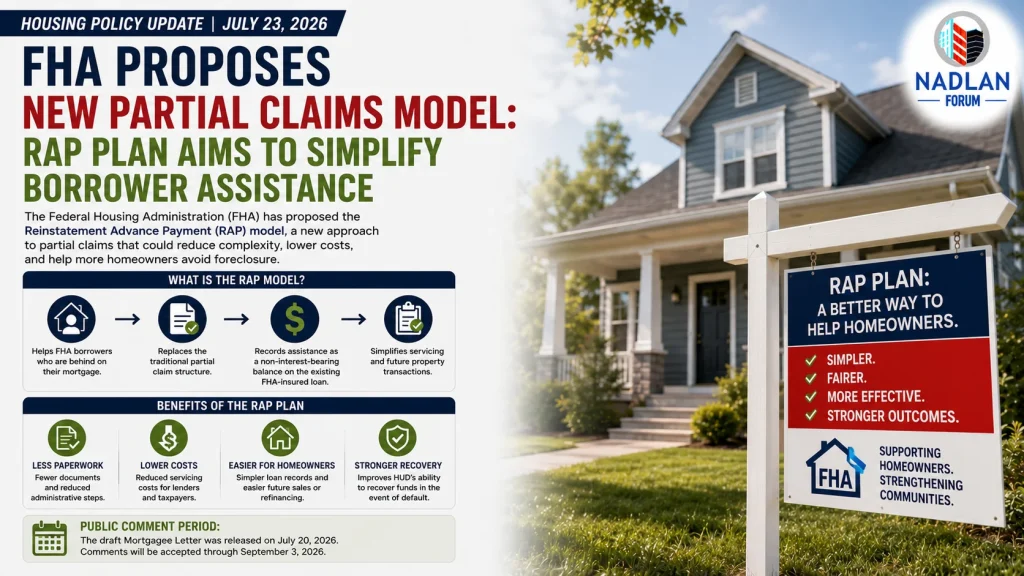
The Federal Housing Administration (FHA) has proposed a new loss mitigation framework designed to simplify how mortgage servicers help borrowers who fall behind on their FHA-insured home loans.
The proposal introduces the Reinstatement Advance Payment (RAP) program, an optional pilot that would replace the traditional structure used for new FHA partial claims. Instead of creating a separate zero-interest subordinate mortgage and lien, participating servicers would record the assistance as a non-interest-bearing balance attached to the existing FHA-insured first mortgage. HUD released the draft Mortgagee Letter for public comment on July 20, with feedback accepted through September 3, 2026.
If implemented, the proposal could reduce paperwork, lower servicing costs, simplify future property transactions, and improve HUD’s ability to recover funds when distressed loans end in foreclosure.
Why FHA Is Considering the Change
FHA borrowers have experienced increasing financial pressure over the past several years.
Higher mortgage payments, inflation, insurance costs, and rising household expenses have made it more difficult for some homeowners to remain current on their loans.
Although FHA has several loss mitigation programs that help borrowers avoid foreclosure, the current partial claims process has become increasingly complex after years of pandemic-era assistance.
Many borrowers accumulated one or more partial claims through previous relief programs, creating a growing number of subordinate liens that servicers must manage throughout the life of the mortgage.
HUD believes simplifying this process could reduce administrative work while making the system easier for both servicers and borrowers.
How Partial Claims Work Today
Under the current FHA system, a borrower who qualifies for assistance may receive a partial claim.
HUD advances funds to bring the mortgage current, allowing the homeowner to avoid immediate foreclosure.
That assistance becomes a zero-interest subordinate mortgage, often called a silent second lien.
The borrower generally does not make monthly payments on that balance.
Instead, repayment normally occurs when:
- The home is sold
- The mortgage is refinanced
- The first mortgage is paid off
- The loan reaches maturity
- FHA insurance ends
Although the system has helped many borrowers remain in their homes, it also requires servicers to prepare, execute, and record separate lien documents for every new partial claim.
How the RAP Proposal Changes the Process
The proposed RAP model removes the need to create a new subordinate lien for participating servicers.
Instead, the servicer would advance the funds needed to reinstate the mortgage.
That amount would then be recorded as a non-interest-bearing balance connected to the existing FHA-insured first mortgage, rather than as a separate subordinate loan.
From the homeowner’s perspective, the assistance would continue to function much like today’s partial claim.
The advance would generally remain interest free and would still become due upon sale, refinance, mortgage payoff, loan maturity, or termination of FHA insurance.
Borrowers Would See Few Immediate Changes
For most borrowers, the application process and available assistance would remain largely unchanged.
Eligible homeowners could still receive help bringing their mortgages current after experiencing financial hardship.
The primary difference is how the assistance would be documented and administered behind the scenes.
Borrowers would no longer receive a newly recorded subordinate mortgage each time assistance is provided under the RAP structure.
Monthly mortgage payments would generally continue according to the modified loan terms established through FHA’s loss mitigation process.
Benefits for Mortgage Servicers
HUD believes the RAP structure could significantly reduce administrative work.
Under the current process, servicers must complete numerous legal and recording steps whenever a partial claim is created.
The proposal would eliminate much of that work.
Potential benefits include:
- Less paperwork
- Lower recording costs
- Fewer legal documents
- Simpler title administration
- Faster processing
- Lower operational expenses
- More consistent servicing procedures
HUD also notes that the proposal more closely aligns FHA servicing practices with approaches already used by conventional mortgage programs.
Easier Sales and Refinancing
One practical advantage of eliminating new subordinate liens involves future real estate transactions.
When a homeowner sells or refinances a property, every recorded lien must usually be identified and resolved before closing.
Multiple subordinate liens can make those transactions more complicated.
Under RAP, there would no longer be a separate subordinate mortgage to clear for newly created advances.
This could simplify:
- Home sales
- Mortgage refinancing
- Loan assumptions
- Property transfers
- Certain foreclosure procedures
Although borrowers would still owe the assistance balance when repayment becomes due, the legal process could become less complicated.
Why HUD Wants to Recover More Funds
The proposal also reflects growing concern about losses associated with FHA-insured foreclosures.
Recent FHA performance data showed substantially larger losses on properties acquired through foreclosure and later sold by HUD.
Average losses on real estate owned (REO) sales increased sharply over the past year, while the share of defaulted balances lost through collateral disposition also grew. Those trends have increased pressure on the insurance fund and encouraged HUD to evaluate ways to improve recovery of assistance provided through loss mitigation.
By attaching future RAP balances directly to the first mortgage instead of creating separate subordinate liens, HUD expects to improve its ability to recover funds in situations where foreclosure cannot be avoided.
Existing Partial Claims Created Operational Challenges
During the pandemic and its recovery period, many FHA borrowers received payment assistance through emergency loss mitigation programs.
Some homeowners accumulated multiple partial claims over several years.
As the number of subordinate liens increased, servicing those accounts became more complicated.
Managing title records, recording documents, payoff calculations, and foreclosure procedures required additional administrative work.
HUD’s proposal attempts to simplify those future cases while maintaining borrower assistance.
Existing subordinate liens created under previous programs would not automatically disappear because of the new proposal.
FHA Delinquencies Remain Elevated
The proposal comes as FHA loans continue to represent a significant share of seriously delinquent mortgages.
Borrowers using FHA financing often have lower down payments and may have fewer financial reserves than conventional borrowers.
These characteristics help expand homeownership opportunities but can also leave borrowers more vulnerable during periods of financial stress.
Higher insurance costs, inflation, property taxes, and elevated mortgage expenses have added additional pressure in recent years.
Strengthening loss mitigation tools is intended to reduce avoidable foreclosures while protecting the FHA insurance fund.
Introducing the RAPTOR Repayment Plan
The proposal also introduces the RAP Terms of Repayment (RAPTOR) Plan.
This option is designed for borrowers who cannot repay the entire RAP balance in one lump sum when repayment becomes due.
Instead of requiring immediate repayment, participating servicers could offer installment plans based on the amount owed.
Under the proposal:
- Balances up to $5,000 could be repaid over as many as 18 months.
- Balances from $5,000 to $15,000 could be repaid over as many as 36 months.
- Balances above $15,000 could be repaid over as many as 48 months.
The repayment schedule would give borrowers additional flexibility if they are unable to satisfy the balance immediately.
Incentives for Participating Servicers
The RAP proposal is voluntary rather than mandatory.
Servicers choosing to participate would receive financial incentives from HUD.
The draft proposes:
- $500 for eligible RAP partial claims.
- $1,750 for RAP payment supplements.
- Reimbursement of up to $250 for qualifying title-related expenses.
These incentives are intended to offset implementation costs while encouraging participation in the pilot program.
Servicers Would Have Greater Responsibility
Although RAP simplifies documentation, participating servicers would assume additional responsibilities.
Servicers would be responsible for:
- Tracking RAP balances.
- Monitoring borrower repayments.
- Maintaining accurate records.
- Returning collected funds to HUD.
- Administering repayment agreements.
- Ensuring proper accounting throughout the life of the loan.
This represents a shift toward greater servicing responsibility while reducing legal recording requirements.
A Five-Year Pilot Program
HUD has proposed implementing RAP as a five-year pilot program.
The trial period would allow the agency to evaluate:
- Borrower outcomes.
- Operational efficiency.
- Administrative savings.
- Recovery rates.
- Servicer participation.
- Program performance.
The agency can then determine whether RAP should become a permanent component of FHA loss mitigation.
Public comments submitted during the review period may also influence the final version of the program before implementation.
How RAP Differs From Conventional Programs
One reason many servicing professionals support the proposal is that it brings FHA procedures closer to those used in parts of the conventional mortgage market.
Reducing unique documentation requirements may allow servicers that manage both FHA and conventional loans to use more consistent internal processes.
Greater consistency could lower training requirements, reduce processing errors, and improve servicing efficiency.
However, FHA loans remain subject to their own eligibility requirements and insurance rules, so RAP would not make FHA servicing identical to conventional programs.
What Borrowers Should Know
The RAP proposal does not automatically forgive missed mortgage payments.
Borrowers would still be responsible for repaying assistance received through the program.
Homeowners experiencing payment difficulties should contact their mortgage servicer as early as possible.
Waiting until foreclosure proceedings begin may reduce the number of available assistance options.
Borrowers should also understand:
- RAP is currently only a proposed program.
- Participation would be voluntary for servicers.
- Final program rules could change after public comments.
- Existing FHA loss mitigation options remain available while the proposal is under review.
Industry Feedback Will Shape the Final Rule
HUD is currently accepting public comments on the draft Mortgagee Letter before deciding whether to finalize the RAP framework.
Mortgage servicers, housing organizations, consumer advocates, and other industry participants have the opportunity to review the proposal and provide recommendations before the program is finalized.
Bottom Line
The FHA’s proposed Reinstatement Advance Payment (RAP) program represents a significant update to how future FHA partial claims could be handled.
Instead of creating new subordinate liens, participating servicers would record assistance as a non-interest-bearing balance tied to the existing FHA-insured first mortgage. HUD believes the change could reduce paperwork, simplify future home sales and refinancing, improve operational efficiency, and strengthen recovery of loss mitigation funds when foreclosure occurs. The proposal also introduces the RAPTOR repayment plan, financial incentives for participating servicers, and a five-year pilot period while the agency evaluates the program’s effectiveness. For direct financing consultations or mortgage options for you visit 👉 Nadlan Capital Group.
