
Mortgage Rates Today: Purchase and Refinance Rates Move Lower on July 23

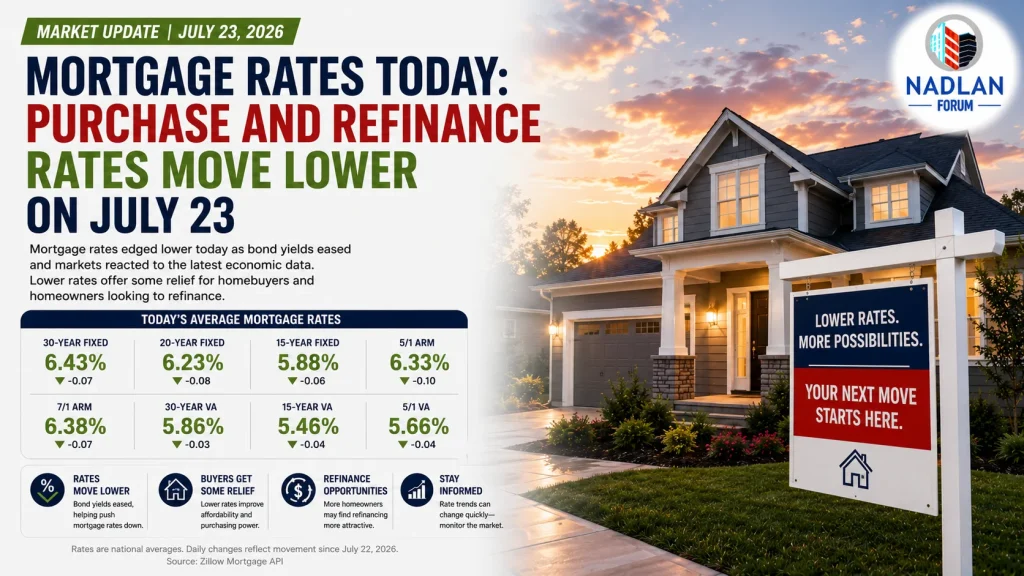
Mortgage rates moved slightly lower on Thursday, providing limited relief after a sharp increase one day earlier.
The average 30-year fixed purchase mortgage declined to 6.514%, down 4.4 basis points from Wednesday. The 15-year fixed rate recorded a larger decline, falling 15.4 basis points to 5.826%.
The average 5/1 adjustable-rate mortgage also dropped, moving down 15.2 basis points to 6.336%.
Although the daily figures improved, borrowing costs remain high by recent standards. The average 30-year fixed rate is still above 6.5%, keeping monthly payments expensive for many buyers.
A separate weekly mortgage survey reported that the average 30-year fixed rate increased to 6.58% for the week ending July 23, its highest level in nearly a year. The 15-year weekly average rose to 5.96%.
The difference between the daily and weekly figures reflects separate data sources, borrower profiles, loan assumptions, and collection periods.
Today’s Purchase Mortgage Rates
The national average purchase mortgage rates for Thursday, July 23, 2026, are:
- 30-year fixed: 6.514%
- 20-year fixed: 6.385%
- 15-year fixed: 5.826%
- 5/1 ARM: 6.336%
- 7/1 ARM: 6.271%
- 30-year VA: 5.998%
- 15-year VA: 5.705%
- 5/1 VA: 5.909%
These percentages are national averages. An individual borrower’s offer may differ depending on credit, income, debt, down payment, property type, location, mortgage points, and loan size.
Rates can also change during the day as financial markets move.
Today’s Mortgage Refinance Rates
Average refinance rates also moved lower:
- 30-year fixed refinance: 6.451%
- 20-year fixed refinance: 6.362%
- 15-year fixed refinance: 5.749%
- 5/1 ARM refinance: 6.148%
- 7/1 ARM refinance: 6.25%
- 30-year VA refinance: 5.812%
- 15-year VA refinance: 5.612%
- 5/1 VA refinance: 5.788%
Unlike the previous day, several refinance averages were lower than comparable purchase rates.
For example, the average 30-year refinance rate of 6.451% was below the 6.514% purchase rate. The 5/1 ARM refinance rate was also noticeably lower than the purchase average.
Refinance loans are often more expensive than purchase mortgages, but that is not always the case. Pricing depends on loan type, available equity, credit qualifications, whether the borrower is taking out cash, and broader market conditions.
Rates Fall After Wednesday’s Increase
Thursday’s movement partially reversed the increases recorded on Wednesday.
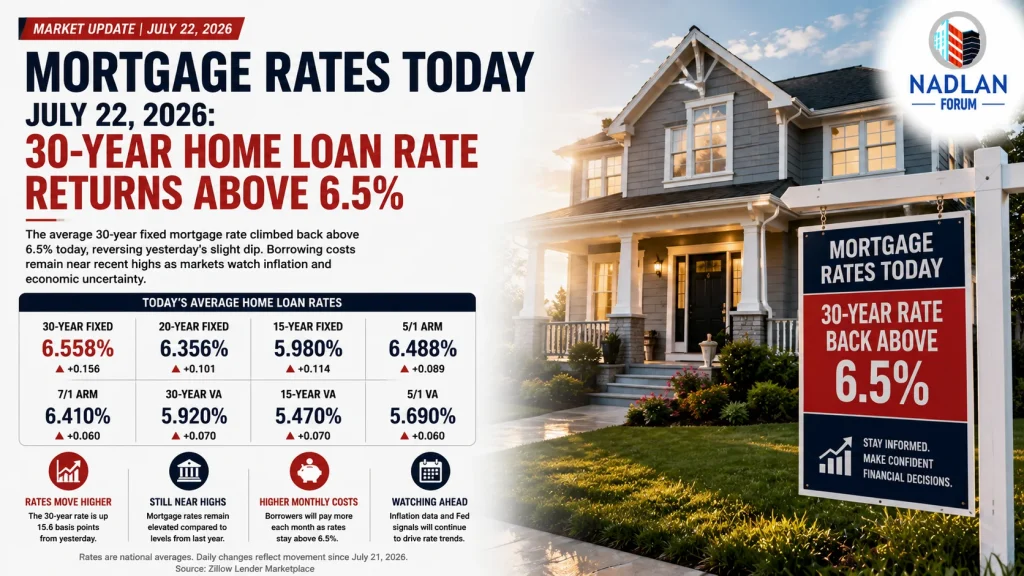
The average 30-year fixed purchase rate had risen to 6.558% on July 22 before declining to 6.514%.
The 15-year fixed rate fell from 5.98% to 5.826%, while the 5/1 ARM declined from 6.488% to 6.336%.
The change was welcome, but it did not return mortgage rates to the lower levels seen earlier in the year.
Daily mortgage rates can move in opposite directions from weekly surveys because daily data reflects more recent market activity. A weekly average may continue rising even when rates ease on the final day of the survey period.
A Small Decline Can Still Help Buyers
A decline of a few basis points does not dramatically change affordability, but it can slightly reduce the monthly payment and lifetime interest cost.
One basis point equals one-hundredth of a percentage point. Therefore, a decline of 4.4 basis points equals 0.044 percentage points.
The effect becomes more noticeable on larger mortgages.
Buyers should also remember that the rate is only one part of a mortgage offer. Fees, points, closing costs, and mortgage insurance can significantly affect the total cost.
Comparing the annual percentage rate, or APR, can provide a broader view because it includes certain loan charges in addition to interest.
Example Monthly Mortgage Payment
Consider a home priced at $425,000 with a 20% down payment of $85,000.
This leaves a mortgage balance of $340,000.
At an interest rate of approximately 6.6%, the estimated monthly principal-and-interest payment would be around $2,173.
After adding estimated monthly property taxes of $354 and homeowners insurance of $150, the total payment would be approximately $2,677.
That estimate does not include:
- Homeowners association fees
- Flood insurance
- Private mortgage insurance
- Maintenance
- Utilities
- Special property assessments
A buyer making less than a 20% down payment may also need mortgage insurance, increasing the monthly cost.
How Fixed Mortgage Rates Work
A fixed-rate mortgage keeps the same interest rate for the full repayment term.
For example, a borrower who accepts a 30-year mortgage at 6.5% will keep that rate unless the home is sold, the loan is refinanced, or the mortgage is otherwise paid off.
The principal-and-interest portion of the payment remains predictable.
However, the total monthly payment can still change if property taxes, insurance premiums, mortgage insurance, or association fees increase.
Fixed mortgages are popular among borrowers who want stable payments and do not want to take the risk of future rate adjustments.
How Adjustable-Rate Mortgages Work
An adjustable-rate mortgage keeps its initial rate for a set period and then adjusts according to the loan agreement.
A 5/1 ARM generally keeps the introductory rate for five years. After that, the rate can change once per year.
The new rate is normally based on a market index plus a lender margin.
An ARM may be useful when its introductory rate is significantly below the fixed-rate alternative.
On July 23, the average 5/1 ARM purchase rate was 6.336%, compared with 6.514% for a 30-year fixed mortgage.
The difference provides some initial savings, but borrowers must consider the risk that the ARM rate could increase after the first five years.
When an ARM May Be Suitable
An adjustable mortgage may be appropriate for a buyer who expects to sell or repay the loan before the introductory period ends.
It may also work for borrowers who:
- Receive a meaningfully lower initial rate
- Expect their income to rise
- Understand the adjustment rules
- Can afford the possible maximum payment
- Have a clear plan for leaving or refinancing the loan
Before choosing an ARM, borrowers should review the initial adjustment cap, annual cap, lifetime cap, index, margin, and maximum possible interest rate.
They should not rely entirely on the assumption that refinancing will be available later.
30-Year Versus 15-Year Mortgages
The 30-year and 15-year fixed-rate loans are two of the most common mortgage choices.
A 30-year mortgage offers lower required monthly payments because the balance is repaid over a longer period.
This can make it easier to qualify and may leave more room in the household budget.
However, the interest rate is usually higher than the rate on a 15-year loan. Borrowers also pay interest for twice as long, producing a much larger total interest cost.
A 15-year mortgage usually offers:
- A lower interest rate
- Faster equity growth
- Less total interest
- Full repayment in half the time
The disadvantage is the much higher monthly payment.
Borrowers should avoid choosing a short loan term if the payment would leave too little money for emergencies, maintenance, retirement savings, and other expenses.
Why Mortgage Rates Change
Mortgage rates are affected by financial-market and economic conditions.
Important influences include:
- Treasury bond yields
- Inflation expectations
- Employment data
- Economic growth
- Energy prices
- Federal Reserve policy expectations
- Demand for mortgage-backed securities
- Global political and economic risk
Mortgage rates often move in the same general direction as the 10-year Treasury yield.
Treasury yields have risen recently as investors respond to inflation concerns, higher oil prices, and geopolitical uncertainty. These conditions have placed upward pressure on the broader mortgage market.
The Federal Reserve Does Not Directly Set Mortgage Rates
The Federal Reserve controls a short-term interest rate, not the rate charged on 30-year mortgages.
However, Federal Reserve decisions can influence borrowing costs by affecting inflation expectations and bond-market activity.
When investors expect inflation to remain high or believe the central bank may raise rates, long-term Treasury yields can increase.
Mortgage rates may then rise because investors demand higher returns for purchasing mortgage-backed securities.
Rates may decline when inflation cools, economic growth slows, or investors expect easier monetary policy.
Weekly Rates Reach an 11-Month High
While Thursday’s daily averages moved lower, broader weekly measures continued to show upward pressure.
The average 30-year fixed mortgage reached 6.58%, up from 6.55% the previous week. This was the highest weekly reading since August 2025.
The average 15-year rate rose from 5.93% to 5.96%.
Mortgage rates remain slightly lower than one year earlier, when the 30-year average was approximately 6.74%.
However, home prices and other ownership costs remain high, so the modest year-over-year rate improvement has not fully restored affordability.
High Rates Continue to Affect Homebuyers
Mortgage rates above 6% have reduced the amount many households can afford to borrow.
Higher rates can:
- Increase monthly payments
- Reduce purchasing power
- Raise required income
- Increase lifetime interest
- Make debt-to-income ratios less favorable
- Cause buyers to consider smaller homes
The pressure is especially significant for first-time buyers who do not have existing home equity to use toward a large down payment.
Buyers must also budget for rising insurance premiums, property taxes, closing costs, and home maintenance.
Buyers Should Compare Several Loan Offers
Mortgage rates can vary significantly between lenders on the same day.
Borrowers should compare offers from banks, credit unions, mortgage companies, and brokers.
Each loan estimate should be reviewed for:
- Interest rate
- Annual percentage rate
- Discount points
- Origination charges
- Processing fees
- Closing costs
- Required cash at closing
- Prepayment terms
- Mortgage insurance
A lender offering the lowest interest rate may charge higher upfront fees.
The best offer depends on how long the borrower expects to keep the mortgage and whether paying more at closing creates enough long-term savings.
Credit and Debt Affect the Offered Rate
Borrowers with stronger financial profiles generally qualify for better mortgage pricing.
Important factors include:
- Credit score
- Payment history
- Credit-card balances
- Debt-to-income ratio
- Down payment
- Cash reserves
- Employment stability
- Property type
Paying down revolving debt before applying may improve both the credit score and debt-to-income ratio.
Borrowers should avoid opening new credit accounts or making large financed purchases shortly before closing because these actions can affect approval.
Mortgage Points Can Lower the Rate
Mortgage points allow a borrower to pay money upfront in exchange for a lower interest rate.
One point usually equals 1% of the mortgage amount.
On a $340,000 loan, one point would cost $3,400.
Whether points make sense depends on how much the rate is reduced and how long the borrower expects to keep the loan.
The break-even period can be calculated by dividing the upfront cost by the monthly payment savings.
If the borrower expects to sell or refinance before reaching the break-even point, paying for points may not provide a financial benefit.
When Refinancing May Make Sense
Refinancing replaces an existing mortgage with a new loan.
Homeowners may refinance to:
- Reduce the interest rate
- Lower the monthly payment
- Shorten the loan term
- Change from an ARM to a fixed rate
- Remove or add a borrower
- Access home equity
There is no single rate difference that automatically makes refinancing worthwhile.
Some homeowners may benefit from a reduction of less than one percentage point, especially when the loan balance is large and closing costs are low.
Others may need a larger decline before the savings justify the expense.
Calculate the Refinance Break-Even Point
The break-even point measures how long it takes for monthly savings to recover the refinance closing costs.
For example, suppose refinancing costs $5,000 and lowers the payment by $200 per month.
The simple break-even period would be 25 months.
A homeowner expecting to sell or refinance again within two years might not recover the expense.
Borrowers should also consider whether the new mortgage restarts the repayment period.
A lower monthly payment may result from extending the debt into a new 30-year loan, which can increase the total interest paid over time.
Extremely Low Rates Are Unlikely Soon
Mortgage rates near 2.75% were available during the unusually low-rate environment of 2020 and 2021.
The record-low average 30-year fixed rate was 2.65% in January 2021.
Those conditions were connected to emergency monetary policy, weak economic activity, and unusually strong demand for bonds.
A return to rates below 3% is considered unlikely under normal economic conditions.
Borrowers should build their purchase plans around rates currently available rather than assuming pandemic-era financing will return.
Should Buyers Lock Their Rate?
A mortgage rate lock protects the borrower from market increases for a specified period.
Common lock periods may range from 30 to 60 days, although shorter and longer options are available.
Locking may make sense when:
- The purchase contract is signed
- The closing date is known
- The rate fits the budget
- Market volatility is high
- The borrower does not want to risk an increase
Some lenders offer float-down provisions that allow borrowers to receive a lower rate if market pricing improves before closing.
These provisions may involve fees or restrictions, so buyers should review the terms carefully.
Bottom Line
Mortgage and refinance rates moved modestly lower on Thursday, July 23, 2026.
The average 30-year fixed purchase rate declined to 6.514%, while the 15-year fixed rate fell to 5.826%. The 5/1 ARM dropped to 6.336%. Refinance rates also declined across most major loan categories.
The daily reductions provide some relief, but the broader mortgage market remains under pressure. A separate weekly survey placed the average 30-year rate at 6.58%, its highest level in nearly a year.
Borrowers should compare multiple offers, review rates and fees together, and choose a payment that remains affordable after taxes, insurance, maintenance, and other ownership costs are included. For direct financing consultations or mortgage options for you visit 👉 Nadlan Capital Group.




















Responses