


Mortgage rates moved sharply higher on Wednesday, reversing the modest decline borrowers received one day earlier.
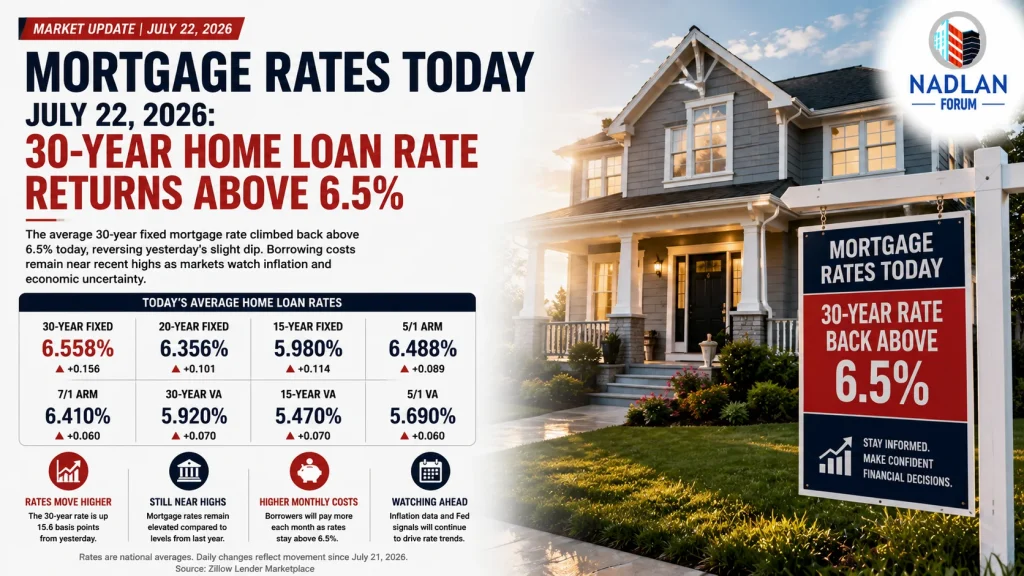
The average 30-year fixed purchase mortgage increased to 6.558%, up 15.6 basis points from Tuesday. The move returned the most common U.S. home loan to the mid-6% range and increased the estimated monthly cost of financing a home.
The average 15-year fixed purchase rate rose to 5.98%, an increase of 11.4 basis points, while the 5/1 adjustable-rate mortgage climbed 8.9 basis points to 6.488%.
The daily figures are consistent with the broader mortgage market, where borrowing costs have remained near their highest levels in almost a year. A separate weekly industry survey placed the average 30-year contract rate at 6.69% for the week ending July 17. Different surveys can report different averages because they measure separate groups of loans, lenders, application types, and time periods.
Today’s Purchase Mortgage Rates
The latest national purchase mortgage averages for Wednesday, July 22, 2026, are:
- 30-year fixed: 6.558%
- 20-year fixed: 6.356%
- 15-year fixed: 5.98%
- 5/1 ARM: 6.488%
- 7/1 ARM: 6.26%
- 30-year VA: 5.99%
- 15-year VA: 5.572%
- 5/1 VA: 5.83%
These percentages are national averages. The actual rate offered to an individual borrower may be higher or lower depending on credit history, down payment, debt, income, loan size, property type, location, and mortgage points.
Rates can also change during the day as bond-market conditions shift.
Today’s Mortgage Refinance Rates
Average refinance rates also remained elevated:
- 30-year fixed refinance: 6.682%
- 20-year fixed refinance: 6.797%
- 15-year fixed refinance: 5.991%
- 5/1 ARM refinance: 6.458%
- 7/1 ARM refinance: 6.229%
- 30-year VA refinance: 5.91%
- 15-year VA refinance: 5.602%
- 5/1 VA refinance: 5.713%
Refinance rates are often higher than purchase rates, although this is not true for every mortgage product.
Refinancing prices can vary based on the homeowner’s equity, credit score, loan purpose, property value, remaining mortgage balance, and whether the borrower is taking cash out of the home.
Homeowners should compare the potential monthly savings with closing costs before deciding to refinance.
Rates Erase Tuesday’s Improvement
Tuesday had brought a small amount of relief to mortgage borrowers.
The average 30-year fixed rate had fallen to 6.402%, while the 15-year fixed rate was 5.866%. Wednesday’s increases erased those declines and returned rates to levels closer to the recent market highs.
The daily increase illustrates how quickly mortgage pricing can change.
A buyer who receives an attractive quote may consider asking about a rate lock, particularly when the closing date is near. However, locking too early can also carry costs, and some lenders charge for longer lock periods.
Borrowers should ask whether a loan includes a float-down option that may allow them to receive a lower rate if market pricing improves before closing.
How Higher Rates Affect Monthly Payments
A mortgage rate increase affects both the monthly payment and the amount of interest paid over the life of the loan.
Consider a home priced at $425,000 with a 20% down payment of $85,000. This leaves a mortgage balance of $340,000.
At an interest rate near 6.5%, the monthly principal-and-interest payment would be approximately $2,150.
After adding estimated property taxes of $354 and homeowners insurance of $150, the total monthly housing payment would be around $2,654.
That estimate does not include homeowners association fees, flood insurance, maintenance, utilities, or private mortgage insurance. A buyer making a smaller down payment may also need to pay mortgage insurance.
The total monthly cost is therefore more useful than the principal-and-interest amount alone when deciding how much home is affordable.
Small Rate Changes Can Add Up
An increase of 15 or 16 basis points may appear minor, but the effect becomes more noticeable on a large mortgage.
Higher rates can:
- Increase the required monthly payment
- Reduce the loan amount a buyer can qualify for
- Raise total lifetime interest
- Make the debt-to-income ratio less favorable
- Reduce a buyer’s available budget for taxes, insurance, and repairs
Buyers near their maximum approval limit may need to increase their down payment, choose a less expensive home, reduce other monthly debt, or request a seller-paid rate buydown.
Why Mortgage Rates Are Rising
Mortgage rates are influenced by several economic and financial factors, including inflation expectations, Treasury yields, investor demand for mortgage-backed securities, and expected Federal Reserve policy.
The 30-year mortgage rate often moves in the same general direction as the 10-year Treasury yield.
Bond yields have risen recently as investors respond to inflation concerns, higher energy prices, geopolitical tension, and the possibility that interest rates may need to remain elevated.
The 10-year Treasury yield recently reached its highest level in approximately two months, placing additional upward pressure on home-loan pricing.
A weekly mortgage survey also found that the 30-year rate had reached its highest point since August 2025.
Inflation Remains a Major Risk
Recent inflation reports provided some evidence that price growth was slowing.
However, renewed increases in oil and energy costs have created concern that the improvement may not continue.
Energy prices can affect transportation, manufacturing, food distribution, construction materials, utilities, and other parts of the economy.
If inflation remains higher than expected, bond investors may demand higher yields to protect their returns. Mortgage rates generally rise when those long-term yields increase.
Financial markets have also been considering the possibility of at least one Federal Reserve rate increase before the end of 2026, although an immediate increase is not guaranteed.
The Federal Reserve does not directly set mortgage rates, but its policies and statements influence investor expectations and long-term borrowing costs.
30-Year Fixed Mortgage Advantages
The 30-year fixed-rate mortgage remains the most common choice for U.S. homebuyers.
Its main advantage is the lower required monthly payment compared with a shorter loan term.
Because repayment is spread across 30 years, buyers may qualify for a larger loan or keep more room in their monthly budget.
The interest rate and principal-and-interest payment also remain unchanged throughout the loan term.
This predictability can make budgeting easier.
However, property taxes, homeowners insurance, and association fees may still increase. As a result, the complete monthly payment can change even when the mortgage rate remains fixed.
30-Year Fixed Mortgage Disadvantages
The biggest disadvantage is the total interest cost.
A 30-year mortgage usually carries a higher rate than a 15-year loan. The borrower also pays interest over twice as many years.
This can result in hundreds of thousands of dollars in interest on a large mortgage.
Equity also builds more slowly during the early part of the loan because a larger share of each payment goes toward interest.
Borrowers can reduce this disadvantage by making additional principal payments when their budgets allow.
Even one extra payment per year may shorten the repayment period and reduce lifetime interest, provided the loan has no prepayment penalty.
How a 15-Year Mortgage Works
A 15-year fixed mortgage offers the same predictable rate structure but requires the loan to be repaid in half the time.
Its advantages include:
- A lower interest rate in many market conditions
- Faster equity growth
- Much lower total interest
- Full mortgage repayment 15 years sooner
The main disadvantage is the higher monthly payment.
A borrower must repay the same loan amount over 180 monthly payments instead of 360.
This option may work well for households with stable income, limited other debt, and enough savings to handle emergencies.
However, buyers should avoid choosing a payment that leaves too little money for property taxes, insurance, maintenance, retirement contributions, and other financial goals.
Understanding Adjustable-Rate Mortgages
An adjustable-rate mortgage keeps the interest rate fixed for an introductory period and then adjusts according to the loan agreement.
A 5/1 ARM, for example, normally keeps the original rate for five years. After that period, the rate may change once per year.
A 7/1 ARM usually keeps the introductory rate for seven years before annual adjustments begin.
ARM loans may be attractive when their introductory rates are significantly lower than fixed mortgage rates.
However, current averages do not always provide that advantage. The average 5/1 ARM purchase rate of 6.488% is only slightly below the 30-year fixed rate of 6.558%.
The small initial difference may not provide enough savings to justify the risk of future rate increases for some borrowers.
When an ARM May Make Sense
An adjustable mortgage may be worth considering when a buyer expects to sell the property or repay the loan before the introductory period ends.
It may also be useful when:
- The initial rate is meaningfully lower
- The borrower expects income to increase
- The buyer understands the adjustment limits
- The household can afford the maximum possible payment
- The borrower has a clear refinancing or repayment plan
Before accepting an ARM, buyers should review the initial adjustment cap, annual cap, lifetime cap, index, margin, and maximum possible rate.
They should not assume they will automatically be able to refinance before the first adjustment. Future rates, property values, credit conditions, and income may all change.
Purchase Rates and Refinance Rates Can Differ
Purchase and refinance loans are priced differently because they involve different borrower behavior and risks.
A purchase loan helps finance the acquisition of a property.
A refinance replaces an existing mortgage and may be used to:
- Reduce the interest rate
- Lower the monthly payment
- Shorten the repayment term
- Change from an ARM to a fixed loan
- Remove a borrower from the mortgage
- Access home equity through cash-out refinancing
Refinance rates may be higher because of lender pricing, investor rules, loan-level adjustments, or cash-out risk.
However, some adjustable and VA refinance rates may occasionally be lower than comparable purchase products.
When Refinancing Could Be Worthwhile
Homeowners do not always need a rate that is a full percentage point lower to benefit from refinancing.
The decision depends on:
- Current mortgage rate
- New interest rate
- Remaining loan balance
- Closing costs
- Remaining repayment period
- Expected time in the home
- Whether the new loan restarts a 30-year term
A borrower may achieve a lower payment by refinancing into a new 30-year mortgage, but extending the repayment period can increase total interest.
Calculating the break-even point is important.
For example, if refinancing costs $6,000 and saves $200 per month, the simple break-even period would be 30 months.
The homeowner would generally need to keep the mortgage beyond that point for the savings to exceed the upfront expense.
How to Qualify for a Lower Mortgage Rate
Borrowers cannot control financial markets, but they can improve the personal factors used to price a mortgage.
Steps that may help include:
- Improving the credit score
- Paying down credit-card balances
- Reducing the debt-to-income ratio
- Increasing the down payment
- Maintaining stable employment
- Comparing several loan offers
- Reviewing both rates and lender fees
- Considering a shorter loan term
- Purchasing discount points when financially appropriate
The lowest advertised rate may require excellent credit, a large down payment, mortgage points, and a specific property or loan structure.
Borrowers should therefore compare the annual percentage rate, closing costs, and estimated cash needed at closing—not only the headline interest rate.
Mortgage Points and Rate Buydowns
Discount points allow a borrower or seller to pay money upfront in exchange for a lower mortgage rate.
One point normally equals 1% of the mortgage amount.
On a $340,000 loan, one point would cost $3,400.
Whether buying points makes financial sense depends on how much the rate falls and how long the borrower expects to keep the mortgage.
A temporary buydown may lower payments for the first one, two, or three years without permanently reducing the note rate.
This can provide short-term relief, but the buyer must be able to afford the full payment once the temporary discount ends.
A permanent buydown may be more useful for a buyer expecting to own the home for many years.
Buyers May Have More Negotiating Power
Although mortgage rates are elevated, housing inventory has improved in many markets.
Homes are generally taking longer to sell than they did during the pandemic buying boom, and more sellers are offering concessions.
Buyers may be able to request:
- Closing-cost assistance
- Repair credits
- Mortgage points
- Temporary rate buydowns
- Price reductions
- Appliance replacement
- Flexible closing terms
A seller credit used to lower the mortgage rate may sometimes create greater monthly savings than an equal reduction in the purchase price.
However, the best choice depends on the buyer’s loan size, available cash, ownership plans, and lender rules.
Mortgage Rates Remain Near a One-Year High
The broader mortgage market remains challenging for buyers.
A separate weekly measure recently placed the average 30-year fixed rate at 6.55%, its highest level in nearly one year.
Mortgage applications have weakened as high rates and home prices reduce purchasing power. Purchase-loan applications recently declined, showing that many buyers are responding to the higher monthly cost by delaying plans or lowering their budgets.
Pending home sales have also fallen, reflecting slower activity across the housing market.
Mortgage Rate Outlook for the Rest of 2026
Most forecasts expect the average 30-year mortgage rate to remain within the low- to mid-6% range through the end of 2026.
Some forecasts place the rate near 6.4%, while others expect it to remain closer to 6.5%.
That outlook suggests borrowers may receive occasional periods of relief, but a return to the extremely low rates of 2020 and 2021 remains unlikely in the near term.
Rates could move lower if inflation cools, economic growth weakens, and Treasury yields decline.
They could rise if energy prices remain high, inflation accelerates, or markets expect tighter Federal Reserve policy.
Daily volatility is therefore likely to continue.
Is It a Good Time to Buy a Home?
The right time to buy depends on personal finances rather than a single national mortgage-rate average.
A buyer may be ready when they have:
- Reliable income
- Manageable debt
- Emergency savings
- Money for closing costs
- A realistic monthly budget
- Plans to remain in the home long enough
- Room for repairs and future expenses
Waiting for lower rates does not guarantee a lower total cost.
Home prices, competition, and available inventory may change while the buyer waits.
Some borrowers may prefer to purchase when they find a suitable home and refinance later if rates fall. However, refinancing should be viewed as a possibility rather than a guarantee.
The original mortgage payment should be affordable without depending on a future refinance.
Bottom Line
Mortgage rates moved higher on Wednesday, July 22, 2026, returning the average 30-year fixed purchase rate to 6.558%.
The 15-year fixed rate rose to 5.98%, while the 5/1 adjustable rate increased to 6.488%. Refinance rates also remained elevated, with the average 30-year fixed refinance rate reaching 6.682%.
The increases erased the previous day’s modest relief and added new pressure to buyer affordability.
Rates are likely to remain sensitive to inflation, energy prices, Treasury yields, Federal Reserve expectations, and global economic developments.
Borrowers can limit their costs by comparing multiple loan offers, improving their financial profiles, reviewing seller concessions, and selecting a mortgage payment that remains comfortable even if taxes, insurance, and maintenance expenses increase. For direct financing consultations or mortgage options for you visit 👉 Nadlan Capital Group.
