
Mortgage Rates Today: Home Loan Rates Edge Lower on July 21, 2026

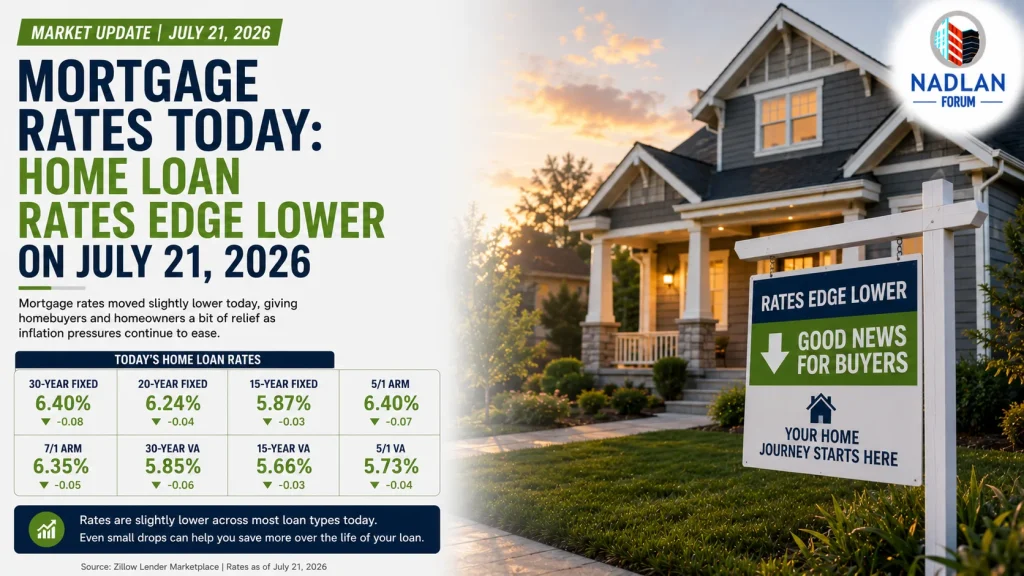
Mortgage rates continued their gradual decline on Tuesday, giving buyers another small improvement after recent market volatility. Although borrowing costs remain above the levels seen a few years ago, lower rates are helping improve affordability as inflation shows signs of easing and financial markets stabilize.
The latest movement follows last week’s better-than-expected inflation reports, which reduced concerns about another near-term Federal Reserve rate increase and pushed bond yields lower. While the changes are modest, even small declines can reduce monthly mortgage payments and improve purchasing power for borrowers shopping for a home or considering refinancing.
Mortgage Rates Continue Moving Lower
According to the latest national averages, most major mortgage products posted small declines compared with the previous day.
Current purchase mortgage rates include:
- 30-year fixed: 6.402%
- 20-year fixed: 6.244%
- 15-year fixed: 5.866%
- 5/1 ARM: 6.399%
- 7/1 ARM: 6.346%
- 30-year VA: 5.853%
- 15-year VA: 5.659%
- 5/1 VA: 5.725%
The average 30-year fixed mortgage fell by approximately 8.2 basis points, while the 15-year fixed loan declined about 3.2 basis points. Adjustable-rate mortgages also moved slightly lower.
Although these are national averages, actual rates vary depending on factors such as credit score, down payment, loan size, property type, debt-to-income ratio, and lender pricing.
Current Refinance Rates
Refinance rates also remained relatively stable, with several products showing modest improvements.
Current average refinance rates are:
- 30-year fixed: 6.444%
- 20-year fixed: 6.524%
- 15-year fixed: 5.847%
- 5/1 ARM: 6.215%
- 7/1 ARM: 6.227%
- 30-year VA: 5.91%
- 15-year VA: 5.761%
- 5/1 VA: 5.545%
Refinance rates are often slightly higher than purchase mortgage rates because pricing depends on market demand, investor preferences, loan characteristics, and lender strategies.
However, some refinance products continue to offer competitive opportunities for homeowners looking to lower monthly payments, shorten their loan term, or switch from an adjustable-rate mortgage to a fixed-rate loan.
Lower Rates Can Improve Affordability
A decline of only a few basis points may seem small, but it can make a meaningful difference over the life of a mortgage.
Lower interest rates reduce the amount borrowers pay each month toward principal and interest. Over a 30-year loan, even a modest reduction can save thousands of dollars in total interest.
Combined with growing housing inventory and more seller concessions in many markets, slightly lower financing costs are gradually improving conditions for buyers who have struggled with affordability during the past two years.
Comparing 30-Year and 15-Year Mortgages
One of the biggest decisions homebuyers face is choosing between a 30-year and a 15-year fixed mortgage.
A 30-year fixed mortgage offers:
- Lower monthly payments
- Predictable payments for the life of the loan
- Greater flexibility within household budgets
The trade-off is paying considerably more interest over time because repayment is spread across three decades.
A 15-year fixed mortgage generally offers:
- Lower interest rates
- Faster loan repayment
- Much lower lifetime interest costs
- Quicker equity growth
However, because the loan is repaid over half the time, monthly payments are significantly higher.
For example, a $400,000 mortgage with a 30-year term at roughly 6.19% would require a monthly principal and interest payment of approximately $2,447.
The same loan with a 15-year term at around 5.65% would increase the monthly payment to about $3,300, but lifetime interest costs would be dramatically lower.
Borrowers who cannot comfortably afford a 15-year payment may still reduce total interest by making occasional extra payments on a 30-year mortgage.
Fixed-Rate or Adjustable-Rate Mortgage?
Borrowers also need to decide whether a fixed-rate mortgage or an adjustable-rate mortgage (ARM) better fits their financial plans.
With a fixed-rate mortgage, the interest rate remains unchanged throughout the life of the loan, providing predictable monthly payments.
An adjustable-rate mortgage keeps the initial rate fixed for a specific period before adjusting periodically based on market conditions.
For example, a 7/1 ARM keeps the same interest rate during the first seven years before adjusting annually.
ARMs often begin with lower introductory rates than fixed loans, although that has not always been true in today’s market. In recent months, some adjustable-rate mortgages have carried rates similar to—or even higher than—fixed-rate products.
Borrowers considering an ARM should understand that future payments could increase if market interest rates rise.
Understanding Your Total Monthly Payment
When evaluating affordability, buyers should look beyond the mortgage interest rate alone.
A complete monthly housing payment usually includes:
- Principal and interest
- Property taxes
- Homeowners insurance
- Private mortgage insurance (PMI), when required
- Homeowners association (HOA) dues
- Flood insurance, if applicable
Mortgage calculators that include these costs provide a much more realistic estimate of monthly expenses than calculations based solely on loan principal and interest.
For many homeowners, rising insurance premiums and property taxes have become increasingly important parts of their monthly housing budget.
How Buyers Can Secure Better Rates
Although national averages provide a useful benchmark, many borrowers can qualify for lower rates by improving their financial profile.
Common strategies include:
- Increasing the down payment
- Improving credit scores
- Reducing outstanding debt
- Lowering the debt-to-income ratio
- Comparing offers from several lenders
- Considering discount points if planning to stay in the home for many years
Shopping around remains one of the simplest ways to reduce borrowing costs.
Even small differences between lenders can translate into substantial savings over the life of a mortgage.
Why Mortgage Rates Are Moving Lower
Mortgage rates closely follow the bond market, particularly U.S. Treasury yields and mortgage-backed securities.
Recent economic data showed inflation slowing more than expected, leading investors to reduce expectations for another Federal Reserve rate hike this year.
As bond yields declined, mortgage rates followed.
Although the Federal Reserve does not directly set mortgage rates, expectations about future monetary policy strongly influence long-term borrowing costs.
If inflation continues easing and economic growth remains moderate, mortgage rates could stay relatively stable during the second half of 2026.
Mortgage Rate Outlook for 2026 and 2027
Most major housing economists expect mortgage rates to remain within a relatively narrow range through the rest of 2026.
Current forecasts generally place the average 30-year fixed mortgage between 6.4% and 6.5% for the remainder of the year.
Looking ahead to 2027, expectations remain similar.
Most forecasts anticipate mortgage rates remaining close to current levels, although some economists expect modest additional improvement if inflation continues cooling and financial markets remain stable.
Future movements will depend on several factors, including:
- Inflation reports
- Employment data
- Federal Reserve policy expectations
- Treasury bond yields
- Consumer spending
- Global economic developments
Is It a Good Time to Buy?
While mortgage rates remain well above the record lows of 2020 and 2021, today’s housing market offers several advantages that were unavailable during the pandemic housing boom.
Many markets now feature:
- More homes available for sale
- Longer listing periods
- Greater negotiating opportunities
- Seller-paid closing costs
- Mortgage rate buydown incentives
For financially prepared buyers, today’s market may offer better overall opportunities despite higher interest rates.
Likewise, homeowners considering refinancing should compare available rates with their current mortgage to determine whether potential savings justify refinancing costs.
Bottom Line
Mortgage rates moved modestly lower again on July 21, giving borrowers another small improvement as financial markets continue responding to easing inflation.
Although affordability remains a challenge in many parts of the country, lower borrowing costs, increasing housing inventory, and more balanced market conditions are gradually creating better opportunities for both homebuyers and homeowners.
If inflation continues to moderate over the coming months, mortgage rates may remain close to current levels or drift slightly lower, providing additional support for the housing market during the remainder of 2026. For direct financing consultations or mortgage options for you visit 👉 Nadlan Capital Group.
























Responses