


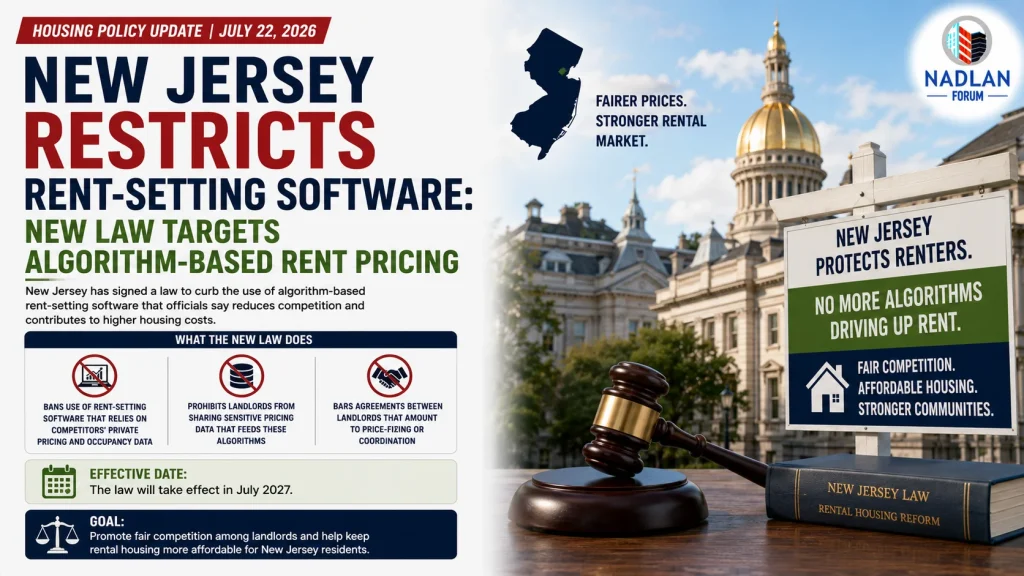
New Jersey has approved new legislation designed to limit the use of algorithm-based rent-setting software, becoming one of the latest states to regulate technology that officials say can contribute to higher housing costs.
Governor Mikie Sherrill signed the Forbidding the Algorithmic Inflation of Rent (FAIR) Act on July 20, 2026. The law restricts landlords from using software that relies on competitors’ private pricing and occupancy data to recommend rental prices or coordinate occupancy levels. It also prohibits landlords from sharing certain nonpublic information with these systems and bans agreements that amount to price coordination. The law is scheduled to take effect in July 2027.
State officials say the measure is intended to encourage genuine competition among landlords instead of allowing technology to recommend similar rent increases across competing properties.
Why the State Approved the Law
Housing affordability has become one of New Jersey’s biggest economic challenges.
Rental prices have increased substantially over the past several years, making it more difficult for many households to keep up with monthly housing costs.
State leaders argue that landlords should compete by offering better prices and services instead of relying on software that analyzes confidential market information to recommend rent increases.
Supporters of the FAIR Act believe these platforms can reduce competition by encouraging multiple landlords to follow similar pricing recommendations.
According to state officials, preventing this type of coordinated pricing should help create a more competitive rental market.
What the FAIR Act Does
The new law focuses specifically on algorithmic rent-setting systems that use nonpublic information from competing landlords.
Among other provisions, the law:
- Restricts the use of software that recommends rents using competitors’ private pricing and occupancy information.
- Prohibits landlords from sharing certain confidential data that feeds these pricing systems.
- Bans agreements that coordinate rental pricing or occupancy levels through these tools.
- Creates enforcement authority for state officials and provides reporting options for suspected violations.
The legislation does not prohibit landlords from setting rents independently or from using publicly available market information to evaluate local conditions. Instead, it targets software that officials say can facilitate coordinated pricing between competing property owners.
Why Algorithmic Pricing Has Drawn Attention
Over the past several years, rent-setting software has become increasingly common among large apartment owners and property managers.
These platforms can analyze large amounts of market information, including:
- Current asking rents
- Lease expiration dates
- Occupancy levels
- Available units
- Local demand
- Historical pricing trends
Supporters of the technology argue that it helps property owners respond more efficiently to changing market conditions.
Critics, however, argue that when competing landlords contribute confidential information into the same system, the software may encourage similar pricing decisions that reduce normal competition.
Instead of each landlord independently deciding how much to charge, opponents say many owners may receive nearly identical pricing recommendations, making it more difficult for renters to benefit from competitive pricing.
This concern has led to growing scrutiny from state and federal regulators.
The Law Follows Ongoing Legal Challenges
New Jersey’s action follows broader legal investigations into algorithmic rent-setting software.
In 2025, the New Jersey Attorney General filed a lawsuit against RealPage and several large landlords, alleging that algorithm-based pricing contributed to higher rents in violation of state antitrust and consumer-protection laws.
The lawsuit remains separate from the FAIR Act, but state officials have pointed to similar concerns when supporting the new legislation.
Across the country, algorithmic pricing has become a major topic in discussions about housing affordability and competition.
State Officials Say Housing Costs Need More Competition
Governor Sherrill said the legislation is part of a broader effort to improve housing affordability.
State officials argue that rental markets work best when landlords compete independently rather than relying on shared pricing systems.
They believe limiting algorithmic coordination can help create a fairer marketplace for tenants.
The governor also acknowledged that the legislation alone will not solve New Jersey’s housing shortage or affordability problems.
Instead, it is intended to address one factor that may contribute to higher rents while additional housing policies continue to be developed.
Supporters Say Technology Can Increase Housing Costs
Tenant advocates and labor organizations welcomed the legislation.
Supporters argue that technology should improve efficiency rather than reduce competition.
They believe restricting algorithmic pricing can help slow excessive rent increases and improve fairness for renters already struggling with higher housing costs.
Many supporters also note that housing affordability depends on multiple factors, including housing supply, construction costs, wages, interest rates, and local zoning rules.
The FAIR Act is viewed as one piece of a broader strategy rather than a complete solution.
Critics Question the Long-Term Impact
Some housing economists note that rent prices are influenced by many different factors beyond pricing software.
Among the largest drivers are:
- Housing supply
- Population growth
- Construction costs
- Mortgage rates
- Property taxes
- Insurance costs
- Local demand
- Land availability
If housing supply remains limited while demand stays strong, rents may continue rising even without algorithm-based pricing systems.
For that reason, many housing experts argue that increasing the supply of apartments and homes will remain essential for improving affordability over the long term.
Law Written to Reduce Legal Challenges
State officials said the legislation was carefully drafted after reviewing legal challenges involving similar laws in other states.
The governor said lawmakers attempted to narrowly target conduct involving coordinated pricing while avoiding unintended effects on legitimate real estate activities.
Because of its narrower language, officials believe the FAIR Act will be better positioned to withstand potential legal challenges.
Some Cities Already Had Similar Rules
Several New Jersey municipalities had already moved in a similar direction before the statewide law.
Cities including Hoboken and Jersey City previously adopted local restrictions limiting the use of algorithmic rent-setting software.
The FAIR Act creates a statewide framework that applies beyond individual municipalities.
This provides more consistent rules for landlords operating across multiple New Jersey markets.
How the Law Could Affect Landlords
For most landlords, day-to-day leasing activities will continue much as before.
Owners may still:
- Study local market conditions.
- Review publicly available rental listings.
- Adjust rents based on demand.
- Consider property improvements.
- Respond to neighborhood competition.
The primary change involves the use of software that relies on confidential information from competing landlords to recommend coordinated pricing decisions.
Property owners using those systems may need to change how they evaluate rents before the law takes effect in July 2027.
What Renters Should Expect
The new law does not place direct limits on how much landlords may charge for rent.
Instead, it focuses on how rental prices are determined.
Whether renters ultimately experience slower rent growth will depend on several factors, including housing construction, vacancy rates, local demand, and overall economic conditions.
Even if algorithmic pricing becomes less common, limited housing supply could continue placing upward pressure on rents in some communities.
For renters, the legislation may increase confidence that pricing decisions are based on independent market competition rather than coordinated software recommendations.
Housing Supply Remains a Key Issue
Most housing economists agree that increasing housing supply remains one of the most effective long-term ways to improve affordability.
Building additional apartments, townhomes, and single-family homes can help reduce competition among renters and provide more housing choices.
New Jersey continues to face strong demand for housing in many communities while available inventory remains limited.
As a result, state officials continue pursuing additional policies aimed at expanding housing production alongside tenant protections.
Other States Are Watching Similar Policies
New Jersey joins a small but growing group of states regulating algorithmic rent-setting practices.
The governor’s office said New Jersey is the fourth state to explicitly regulate these systems through statewide legislation.
As investigations into rent-setting software continue nationwide, more states may consider similar legislation over the coming years.
The debate highlights the growing role technology plays in the housing market and the challenge of balancing innovation with fair competition.
Bottom Line
New Jersey’s FAIR Act represents one of the state’s latest efforts to address housing affordability by restricting the use of algorithmic rent-setting software.
Beginning in July 2027, landlords will face new limits on using systems that rely on competitors’ private pricing information or facilitate coordinated rent-setting. Supporters believe the law will encourage stronger competition and provide additional protection for renters, while critics note that expanding housing supply will still be necessary to meaningfully improve affordability over the long term. For direct financing consultations or mortgage options for you visit 👉 Nadlan Capital Group.
