


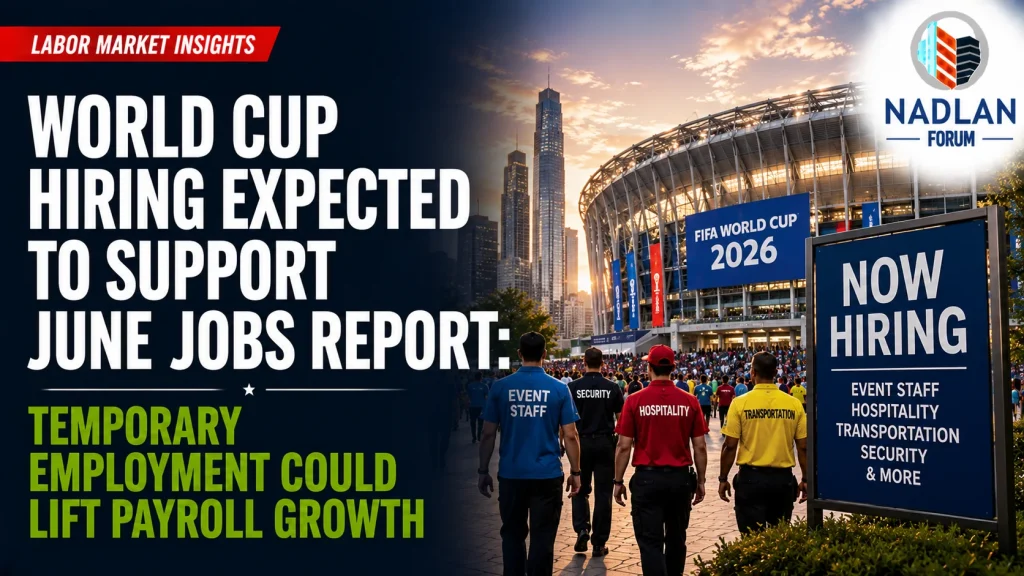
Major international events often create short-term economic activity, and the 2026 FIFA World Cup is no exception. As millions of visitors travel to host cities across the United States, businesses have expanded hiring to meet increased demand for hotels, restaurants, transportation, entertainment, and event services.
Before the release of the June employment report, economists expected the tournament to provide a temporary boost to payroll growth. While overall hiring was projected to slow compared with previous months, World Cup-related employment was expected to help offset some of that weakness.
Although these additional jobs are largely temporary, they highlight how large sporting events can influence labor market data and local economic activity.
Economists Expected Slower Job Growth
Before the June employment report was released, economists generally expected the U.S. labor market to continue cooling.
The consensus forecast projected approximately 115,000 new nonfarm payroll jobs, representing slower growth than the 172,000 jobs reported during May.
While employment remained positive, forecasts suggested businesses were becoming more cautious about hiring amid elevated interest rates, slower economic growth, and continued uncertainty surrounding inflation.
World Cup Hiring Could Add Thousands of Jobs
Some economists believed the World Cup would provide meaningful support for June employment.
Private payroll data suggested the tournament could contribute approximately 40,000 additional jobs during the month.
Those positions were expected to be concentrated in industries directly benefiting from increased tourism and event-related spending.
While temporary, this hiring could partially offset broader slowing across the labor market.
Hospitality Businesses Increased Hiring
One of the industries expected to benefit most from the tournament was leisure and hospitality.
Restaurants, hotels, bars, entertainment venues, and tourism businesses typically require additional workers when large international events attract significant numbers of visitors.
Private employment data indicated hospitality hiring increased approximately 9.5%, reflecting stronger demand in cities hosting World Cup matches.
Additional hiring helped businesses prepare for higher customer traffic, longer operating hours, and increased tourism throughout the competition.
Host Cities Outperformed Other Markets
Employment trends also differed between World Cup host cities and other metropolitan areas.
Private payroll data suggested businesses located in host cities experienced noticeably stronger hiring than markets not directly participating in tournament activities.
While many parts of the country continued experiencing slower employment growth, cities hosting World Cup matches benefited from additional demand generated by:
- International tourism
- Domestic travel
- Sporting events
- Restaurants
- Hotels
- Transportation services
- Entertainment venues
- Retail spending
These temporary economic benefits often extend beyond the tournament itself as visitors continue traveling before and after scheduled matches.
Several Industries Were Expected to Benefit
Economists expected hiring gains to extend beyond hotels and restaurants.
Industries likely benefiting from World Cup activity included:
- Leisure and hospitality
- Professional and business services
- Transportation
- Warehousing
- Retail trade
- Event management
- Security services
- Facility operations
Many businesses increased staffing to accommodate larger customer volumes, expanded operating hours, and additional event-related logistics.
Although many of these positions may be temporary, they contribute to overall employment during the reporting period.
Forecasts Suggested Stronger Payroll Growth
Some analysts expected stronger employment growth than the broader market consensus.
Instead of approximately 115,000 jobs, projections suggested payroll gains could reach around 140,000 if World Cup hiring proved as significant as anticipated.
Even under that scenario, employment growth would still remain below the pace recorded in May but would represent continued expansion of the labor market.
The difference illustrates how temporary events can influence monthly employment reports without necessarily changing long-term labor market trends.
Seasonal Events Can Influence Employment Reports
Large sporting events frequently affect labor market statistics.
Temporary hiring often increases in areas such as:
- Tourism
- Food services
- Hotels
- Transportation
- Retail
- Event staffing
- Security
- Cleaning services
Because these jobs are tied to short-term demand, economists generally separate them from underlying employment trends when evaluating the long-term health of the labor market.
Once the event concludes, many temporary positions naturally disappear as visitor activity returns to normal.
Temporary Hiring Does Not Always Reflect Long-Term Growth
Although special events can improve monthly employment numbers, they do not necessarily indicate lasting improvements in the economy.
Temporary hiring differs from permanent employment expansion because businesses often reduce staffing once event-related demand ends.
For this reason, economists analyze multiple employment reports over several months rather than relying on a single data release.
Long-term labor market strength depends on sustained hiring across a broad range of industries rather than one-time events.
Employment Data Often Undergoes Revisions
Another important consideration is that monthly employment reports frequently change after their initial release.
The first payroll estimate is based on incomplete survey responses and is revised as additional employer information becomes available.
Historically, June employment reports have often received revisions during subsequent months.
As a result, the first published payroll number may not fully reflect final employment conditions.
Investors, policymakers, and economists generally pay close attention to these revisions when evaluating broader labor market trends.
Why Employment Reports Matter for Mortgage Rates
Labor market data remains one of the most closely watched economic indicators because it influences expectations for Federal Reserve policy.
Strong employment growth may contribute to:
- Higher consumer spending
- Increased wage growth
- Stronger inflation pressures
- Higher interest rate expectations
Conversely, weaker hiring may reduce pressure on policymakers to tighten monetary policy further.
Because mortgage rates closely follow expectations for inflation and interest rates, employment reports often have a direct impact on borrowing costs for homebuyers.
Impact on the Housing Market
A healthy labor market supports the housing sector in several ways.
Stable employment helps households:
- Qualify for mortgages
- Save for down payments
- Purchase homes
- Refinance existing loans
- Maintain consumer confidence
Temporary hiring related to major events like the World Cup may provide a short-term boost to local economies, particularly in host cities.
However, long-term housing demand will continue to depend primarily on permanent job growth, wage increases, mortgage rates, and housing affordability.
Looking Ahead
The 2026 FIFA World Cup illustrates how major international events can temporarily influence economic data, particularly employment reports. Increased hiring across hospitality, transportation, retail, and business services demonstrates the positive short-term impact large sporting events can have on local labor markets.
Even so, economists continue focusing on broader employment trends rather than one-time hiring surges when assessing the overall health of the U.S. economy. As the second half of 2026 unfolds, future jobs reports, inflation data, and Federal Reserve policy decisions will remain the primary drivers of interest rates, mortgage costs, and housing market activity. For direct financing consultations or mortgage options for you visit 👉 Nadlan Capital Group.
