
U.S. Job Growth Slows in June: What the Latest Employment Report Means for the Economy

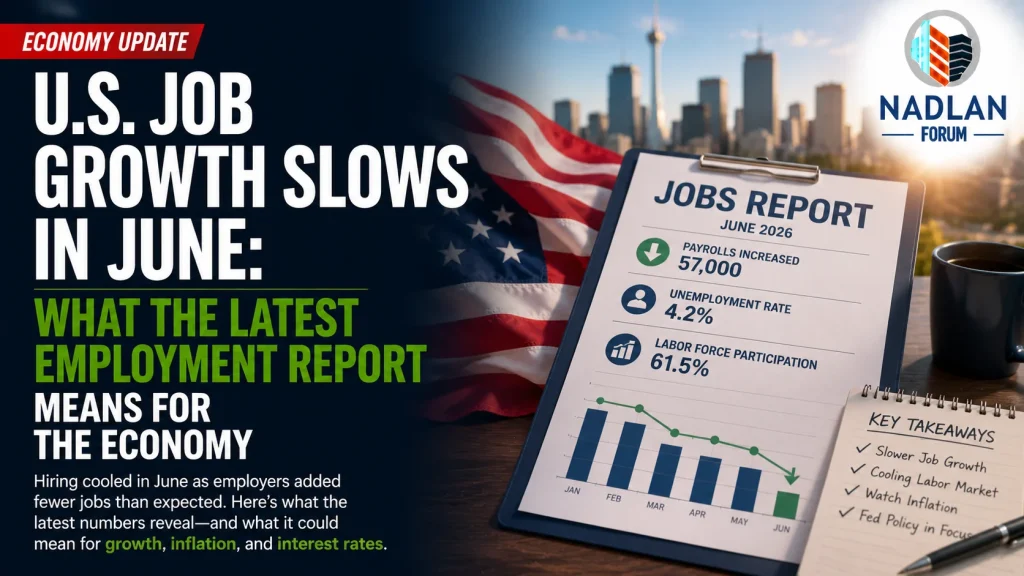
The U.S. labor market lost momentum in June as employers added far fewer jobs than economists had expected. While unemployment remained relatively low, hiring slowed noticeably, labor force participation declined, and earlier payroll estimates were revised lower, suggesting that employment growth is cooling after several months of resilience.
The latest employment report indicates that businesses are becoming more cautious about hiring as elevated interest rates, slower economic growth, and persistent inflation continue to influence the economy.
Although the labor market remains historically healthy, the softer employment data may influence future Federal Reserve policy decisions and could have important implications for mortgage rates, consumer spending, and the housing market during the second half of 2026.
Payroll Growth Falls Well Below Expectations
According to the latest employment report, nonfarm payrolls increased by 57,000 jobs in June, significantly below economists’ expectations of 115,000 new jobs.
The result also marked a sharp slowdown from May, when payroll growth was revised downward from earlier estimates to 129,000 jobs.
April’s employment figures were also revised lower, bringing total payroll growth for that month to 148,000 jobs.
The combined revisions suggest that hiring has been weaker than previously believed over the past several months.
While job creation continues, employers appear to be expanding their workforces at a much slower pace than earlier in the year.
Unemployment Rate Holds at 4.2%
Despite slower hiring, the national unemployment rate edged down to 4.2%.
At first glance, the decline appears encouraging. However, the improvement was largely driven by fewer people participating in the labor force rather than stronger employment growth.
The labor force participation rate fell 0.3 percentage points to 61.5%, its lowest level since March 2021.
When fewer people are actively looking for work, the unemployment rate can decline even if hiring slows, making participation an important indicator when evaluating overall labor market health.
Household Employment Declines
Another notable sign of slowing labor conditions came from the household employment survey.
The report showed approximately 507,000 fewer people were employed during June compared with the previous month.
Although the household survey often differs from the payroll survey because they measure employment differently, such a large monthly decline suggests that the labor market may be losing some momentum.
Economists will closely monitor upcoming reports to determine whether this represents a temporary fluctuation or the beginning of a broader slowdown.
Wage Growth Remains Stable
One area that continues to show resilience is wage growth.
Average hourly earnings increased:
- 0.3% during June
- 3.5% compared with one year earlier
Both figures matched market expectations.
Steady wage growth suggests that employers continue to compete for workers even as hiring slows.
At the same time, wages are not accelerating rapidly enough to create significant new inflation concerns, which may provide additional flexibility for monetary policymakers.
Which Industries Added Jobs?
Hiring remained uneven across different sectors of the economy.
The strongest employment gains occurred in:
- Professional and business services: +36,000 jobs
- Social assistance: +25,000 jobs
- Healthcare: +22,000 jobs
- Government: +8,000 jobs
Healthcare continued to add jobs, although at a slower pace than has been typical over the past several years.
Professional services also remained one of the strongest contributors to overall employment growth.
Leisure and Hospitality Saw Large Job Losses
The weakest performance came from the leisure and hospitality sector.
Employment declined by approximately 61,000 jobs, making it the largest monthly loss among major industries.
Seasonal hiring patterns played an important role in the decline, as businesses hired fewer workers than is typical during the summer travel season.
Some analysts had expected international events and increased tourism to support additional hiring, but those gains did not fully materialize during June.
Most other sectors experienced relatively little change.
Markets React to Softer Employment Data
Financial markets responded quickly following the release of the employment report.
Investors interpreted the weaker payroll growth as reducing the likelihood of additional near-term interest rate increases.
Treasury yields moved lower after the report, while stock index futures advanced as investors anticipated a less aggressive monetary policy outlook.
Lower Treasury yields are particularly important for mortgage markets because mortgage rates often move in the same general direction as longer-term government bond yields.
If economic growth continues to moderate, mortgage rates could remain relatively stable or gradually decline during the coming months.
What This Means for the Federal Reserve
The June employment report arrives as Federal Reserve officials continue balancing two competing priorities:
- Bringing inflation back toward the long-term 2% target.
- Maintaining a healthy labor market.
The slower pace of hiring suggests that previous interest rate increases continue to cool economic activity.
However, unemployment remains relatively low, and wage growth continues to support household income.
This combination gives policymakers additional time to evaluate future inflation data before making further decisions regarding monetary policy.
Many economists now believe the Federal Reserve is under less pressure to raise interest rates again in the near future unless inflation unexpectedly accelerates.
Jobless Claims Continue to Improve
Separate labor market data released alongside the employment report offered a slightly more positive signal.
Initial unemployment claims declined to 215,000 for the week ending June 27, falling below market expectations.
Weekly jobless claims remain near historically low levels, indicating that layoffs have not increased significantly despite slower hiring.
This suggests employers may still be holding onto workers even as they become more cautious about expanding payrolls.
Why the Jobs Report Matters for Housing
Employment remains one of the most important drivers of the housing market.
A healthy labor market supports:
- Homebuyer confidence
- Mortgage qualification
- Consumer spending
- Household formation
- Housing demand
Slower hiring can reduce demand for homes if households delay major financial decisions.
At the same time, weaker employment growth often contributes to lower Treasury yields and reduced expectations for future interest rate increases, which may eventually help stabilize or lower mortgage rates.
For prospective homebuyers, lower borrowing costs could partially offset affordability challenges created by elevated home prices.
What to Watch in the Months Ahead
Several economic indicators will determine whether June represents a temporary slowdown or the beginning of a broader moderation in labor market growth.
Key reports to monitor include:
- Monthly employment reports
- Inflation data
- Consumer spending
- Retail sales
- Gross Domestic Product (GDP) growth
- Federal Reserve policy announcements
Together, these indicators will shape expectations for interest rates, mortgage costs, and broader economic activity during the remainder of 2026.
Looking Ahead
The June employment report suggests the U.S. labor market is transitioning from rapid growth toward a more moderate pace.
While payroll gains were weaker than expected, unemployment remains relatively low, wage growth continues, and layoffs remain limited. These mixed signals indicate that the economy is cooling rather than contracting.
For financial markets and the housing sector, slower job growth may reduce pressure on the Federal Reserve to tighten monetary policy further, supporting a more stable interest rate environment.
As the second half of 2026 unfolds, upcoming economic reports will play a crucial role in determining whether this moderation continues and how it influences borrowing costs, homebuying activity, and the broader U.S. economy. For direct financing consultations or mortgage options for you visit 👉 Nadlan Capital Group.
















Responses