


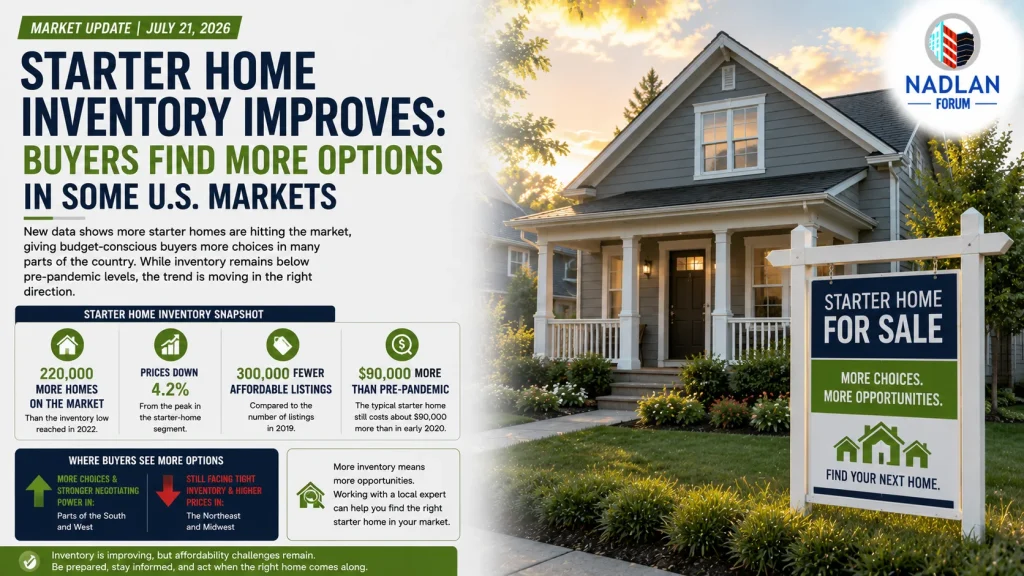
Budget-conscious homebuyers are beginning to see more entry-level properties for sale as the supply of starter homes slowly improves across the United States.
The change is providing limited relief to first-time buyers who were pushed out of the market by rapid home-price growth, low inventory, and rising mortgage rates after the pandemic.
There are now about 220,000 more homes priced below $350,000 on the market than there were at the lowest point in 2022. Prices in the starter-home segment have also declined by approximately 4.2% from their peak.
However, the recovery remains incomplete.
The country still has approximately 300,000 fewer affordable listings than it did in 2019, and the typical starter home costs nearly $90,000 more than it did before the pandemic.
The availability of entry-level homes also varies sharply by region. Buyers in parts of the South and West have more choices and stronger negotiating power, while those in the Northeast and Midwest continue to face tight inventory and rising prices.
What Is Considered a Starter Home?
A starter home is generally a smaller, less expensive property that allows a first-time buyer to enter homeownership and begin building equity.
Rather than using one fixed price for every city, housing researchers often define a starter home as a property priced at roughly 80% of the local median listing price.
They also monitor the number of homes listed for less than $350,000 to measure how many properties may be accessible to moderate-income buyers.
For example, if the median asking price in a city is $490,000, the local starter-home threshold would be close to $392,000.
Starter homes are often:
- Smaller than the typical house in the area
- Older or less updated
- Located farther from major employment centers
- Attached homes such as townhouses or condominiums
- Properties that may need minor repairs
For many buyers, these homes are not intended to meet every long-term need. They provide an opportunity to purchase a property, build equity, and potentially move to a larger home later.
The Starter Home Shortage Peaked in 2022
The entry-level housing market reached its most difficult point in 2022.
Pandemic-era demand increased sharply while the number of available homes remained extremely low. Buyers competed for a limited supply of properties, often making offers above the asking price and giving up inspection or financing protections.
At the same time, home prices rose rapidly across nearly every price range.
Starter homes became particularly difficult to find because buyers who could not afford larger properties were all competing for the same lower-cost listings.
The situation became even harder when mortgage rates increased from near 3% to almost 8% in less than two years.
Prices remained close to record levels while monthly mortgage payments increased dramatically.
Inventory Has Improved Since the Market Peak
The starter-home market is now showing signs of gradual recovery.
There are approximately 220,000 more homes priced below $350,000 than there were during the 2022 inventory low.
The share of listings in this affordable range has also increased by around 1.6 percentage points over the past year.
Several factors have helped increase supply.
More homeowners are listing properties despite holding older mortgages with low interest rates. New construction has also reached the market, particularly in areas where builders started large projects during the pandemic housing boom.
Homes are staying on the market longer as buyers become more cautious, giving shoppers additional time to compare properties and negotiate with sellers.
In markets with higher inventory, buyers may also have more success requesting price reductions, closing-cost assistance, repairs, or mortgage-rate buydowns.
Affordable Listings Remain Below 2019 Levels
Although current conditions are better than they were in 2022, the market has not returned to its pre-pandemic balance.
In June 2019, approximately 55.1% of active listings nationwide were priced below $350,000.
That share has fallen to about 37.6%, leaving buyers with roughly 300,000 fewer low-cost listings than seven years earlier.
Smaller homes have also experienced some of the largest price increases.
Since 2019, prices for two-bedroom listings have increased about 44.5%, while three-bedroom homes have risen roughly 41%.
By comparison, prices increased around 36.9% for four-bedroom homes and 34% for properties with five or more bedrooms.
This trend is especially difficult for first-time buyers because smaller homes are traditionally the most practical entry point into the market.
Starter Home Prices Are Nearly $90,000 Higher
The typical starter home increased from approximately $256,000 in 2019 to $344,000 in 2026.
That represents an increase of about $88,000 in seven years.
The higher purchase price is only part of the affordability problem.
Mortgage rates remain above 6%, meaning buyers must pay significantly more each month than someone purchasing the same home when rates were near 3%.
Property taxes, homeowners insurance, maintenance, closing costs, and homeowners association fees have also increased in many markets.
As a result, a lower-priced home may still require a much larger household budget than it did before the pandemic.
Buyers Need Higher Incomes to Qualify
A household now needs an annual income of approximately $78,000 to qualify for the typical starter home.
In 2019, the required income was closer to $43,000.
The income needed to purchase a starter home has therefore increased by more than 80%.
Median household income has also increased, but not quickly enough to match the rise in home prices and mortgage payments.
National median household income increased approximately 28.3% during the same period, from around $69,000 to $88,100.
This gap explains why many households earning what would normally be considered a solid middle-class income still struggle to purchase an entry-level home.
The South Offers the Most Starter Home Options
The South currently provides the strongest conditions for buyers seeking affordable homes.
Builders in Texas, Florida, the Carolinas, Georgia, and other fast-growing markets increased construction during the pandemic years.
Many of those new homes have now been completed and listed for sale.
Since 2022, the Southern starter-home price threshold has declined approximately 3.5%, falling from $323,000 to about $311,000.
The share of Southern listings priced below $350,000 has increased from less than 40% in mid-2023 to approximately 43.6%.
That increase represents nearly 170,000 additional affordable listings compared with the most difficult period of the housing shortage.
Higher inventory has also reduced competition and created more room for negotiation.
New Construction Is Helping Southern Buyers
New construction has played an important role in improving starter-home availability across the South.
Builders responded to population growth by creating subdivisions, townhomes, condominiums, and smaller single-family properties.
As buyer demand slowed because of high mortgage rates, some builders began lowering prices or offering financial incentives.
Common new-construction incentives include:
- Mortgage-rate buydowns
- Seller-paid closing costs
- Appliance packages
- Design upgrades
- Reduced lot premiums
- Lower down-payment requirements through preferred lenders
These incentives do not always reduce the listed price, but they can lower the buyer’s upfront expenses or monthly mortgage payment.
Buyers should still compare the total cost carefully, including taxes, insurance, homeowners association fees, and future maintenance.
Western Markets Are Slowly Improving
The starter-home picture in the West is more mixed.
The regional starter-home threshold has declined approximately 7.3% since 2022, falling to around $480,000.
However, that price remains well above the 2019 threshold of approximately $368,000.
Only about 16.7% of Western listings are currently priced below $350,000, although the region has gained roughly 23,000 listings in that price range since 2022.
Markets such as Phoenix and Denver have experienced some of the most meaningful changes.
Both cities added substantial housing inventory during the construction boom. As supply increased and demand softened, sellers began facing more competition.
Phoenix Buyers Have More Choices
Phoenix became one of the fastest-growing housing markets during the pandemic.
Strong population growth and low mortgage rates pushed prices upward as buyers competed for a limited supply of homes.
Builders responded by increasing construction throughout the metropolitan area.
As those homes reached the market, inventory began rising faster than buyer demand.
Today, Phoenix buyers generally have more time to make decisions and may face fewer bidding wars than they did several years ago.
Price reductions and builder incentives have also become more common.
However, entry-level affordability remains difficult because many lower-cost properties are located far from central employment areas or carry homeowners association fees and higher transportation costs.
Denver Sellers Offer More Concessions
Denver has also seen a significant increase in housing inventory.
Local supply has risen to nearly five months in some parts of the market, placing downward pressure on prices and increasing seller competition.
Many sellers are now offering concessions at closing.
These concessions may cover:
- Buyer closing costs
- Prepaid taxes or insurance
- Property repairs
- Temporary mortgage-rate buydowns
- Permanent discount points
- Homeowners association fees
In some cases, buyers have received large seller credits, particularly on higher-priced homes or properties that have remained on the market for several months.
New-home builders are also using rate buydowns to reduce monthly payments and attract buyers.
Attached Homes Can Provide a Lower-Cost Option
Increasing the number of detached houses is not the only way to improve starter-home affordability.
Condos, townhomes, duplexes, and other attached properties often cost less than traditional single-family homes.
They may also be located closer to jobs, public transportation, schools, restaurants, and shopping areas.
In markets such as Denver, Phoenix, and Philadelphia, attached homes can provide a more realistic path to ownership for buyers with limited budgets.
However, buyers should review homeowners association fees carefully.
A condo with a lower purchase price may still have a high total monthly cost if the association charges several hundred dollars per month.
Buyers should also review the association’s financial health, insurance coverage, maintenance responsibilities, and any planned special assessments.
Midwest Buyers Face Rising Prices
The Midwest remains the most affordable region in absolute terms, but entry-level buyers are losing some of that advantage.
The regional starter-home threshold is approximately $263,920, the lowest of the four major U.S. regions.
However, that figure has increased nearly 10% since 2022 and more than 37% since 2019.
The share of listings considered affordable has also declined.
Approximately 70% of Midwestern listings were priced within the starter-home range in 2019. By spring 2026, that share had fallen to around 55%.
The region is still less expensive than much of the country, but affordable and move-in-ready homes often attract strong competition.
Detroit Buyers Compete With Investors
Detroit continues to offer homes at prices below those found in many large metropolitan areas.
However, the most affordable properties may require major repairs or may be located in neighborhoods with limited services and fewer employment opportunities.
Move-in-ready homes at entry-level prices can attract significant interest from both traditional buyers and real estate investors.
Investors may have an advantage if they can pay cash, waive financing conditions, or accept properties that need renovation.
First-time buyers using mortgages may need extra time for inspections, appraisals, and lender approval.
To compete successfully, buyers may benefit from obtaining full mortgage preapproval, preparing proof of funds, and expanding their search beyond the most obvious neighborhoods.
New Midwest Construction Often Targets Higher Prices
One reason starter-home supply remains limited is that smaller homes can be difficult for builders to produce profitably.
Land, labor, permits, materials, and utility connections create fixed costs regardless of a home’s size.
Builders may therefore earn a higher return by constructing larger and more expensive homes.
This means new housing supply does not always reach the price range needed by first-time buyers.
Improving entry-level inventory may require:
- Smaller lots
- Townhomes and duplexes
- Manufactured housing
- Reduced parking requirements
- Faster permits
- Lower development fees
- More financing for small-dollar mortgages
Without these changes, the Midwest may remain affordable compared with other regions while still losing many of its lowest-cost options.
The Northeast Has the Greatest Affordability Pressure
The Northeast remains the most difficult region for starter-home buyers.
Its starter-home price threshold has increased to approximately $443,600.
That is nearly 50% higher than in 2019 and about 12.6% above the 2022 level.
Many Northeast markets are already densely developed and have limited land available for new construction.
Local zoning rules may restrict apartments, duplexes, townhomes, and other smaller properties in areas currently reserved for detached single-family houses.
Lengthy permit processes and high construction costs also make it difficult to add affordable housing.
At the same time, demand remains strong from high-income households seeking access to major job centers, schools, transportation, and established neighborhoods.
Location Matters as Much as Price
Finding a low-priced home does not always solve the affordability problem.
Buyers are usually searching for a home in a location that provides reasonable access to work, transportation, schools, healthcare, shopping, and family.
Affordable listings may exist within a metropolitan area, but they may be concentrated in neighborhoods far from the buyer’s preferred location.
Long commutes can add fuel, vehicle maintenance, tolls, parking, and lost time to the true cost of homeownership.
Buyers also consider neighborhood safety, property taxes, school quality, flood risk, insurance costs, and future resale demand.
This is why competition can remain strong in popular neighborhoods even when a city’s overall inventory appears to be improving.
Condos Help Some Philadelphia Buyers
Philadelphia remains more affordable than several other major Northeast cities, but entry-level buyers still face challenges in the most popular neighborhoods.
In central and walkable parts of the city, condominiums may provide one of the few practical paths to ownership.
Condos often have lower purchase prices than detached houses and may reduce the owner’s responsibility for exterior maintenance.
However, monthly association fees can significantly affect affordability.
Buyers should consider the full monthly payment rather than the listed price alone.
They should also review the building’s reserve funds, insurance, maintenance history, rental restrictions, and planned repairs before making an offer.
Mortgage Rates Remain a Major Barrier
Improving inventory helps buyers, but mortgage rates continue to limit purchasing power.
A buyer financing a $300,000 loan at 6.5% pays substantially more each month than someone who borrowed the same amount at 3%.
Higher rates can also reduce the maximum loan amount for which a household qualifies.
This means some buyers may see more starter homes listed for sale but still find that the monthly payment exceeds their budget.
Rate buydowns and seller credits may provide temporary relief, but buyers should make sure they can afford the permanent payment after any temporary discount expires.
Buyers Have More Negotiating Power
The increase in inventory is giving buyers more leverage in several markets.
Homes are generally taking longer to sell than they did during the pandemic boom, and sellers may be more willing to negotiate.
Possible buyer requests include:
- A lower purchase price
- Repair credits
- Closing-cost assistance
- Mortgage-rate buydowns
- Appliance replacement
- Home warranty coverage
- Flexible closing dates
Buyers should still focus on the total value of the agreement.
A seller credit may be more useful than a small price reduction if it helps reduce closing costs or lowers the mortgage rate.
The best option depends on the buyer’s cash reserves, loan program, expected ownership period, and monthly budget.
How First-Time Buyers Can Prepare
First-time buyers can improve their chances by preparing before making an offer.
Important steps include:
- Obtain full mortgage preapproval
- Review credit reports for errors
- Reduce high-interest debt
- Save for closing costs and repairs
- Compare several mortgage lenders
- Research taxes and insurance
- Consider condos and townhomes
- Expand the search area
- Request seller concessions
- Complete a professional inspection
Buyers should also avoid using the maximum loan amount simply because a lender approves it.
Owning a home involves ongoing expenses that may not be included in the initial mortgage estimate.
Starter Home Supply Needs Long-Term Support
The current improvement in inventory is encouraging, but it does not fully solve the shortage.
The U.S. still needs more small, basic, and moderately priced homes.
Policies that could support starter-home construction include allowing more duplexes, townhomes, accessory dwelling units, manufactured homes, and smaller-lot properties.
Reducing permit delays and development fees could also help builders produce homes at lower price points.
Financing remains another challenge.
Small-dollar mortgages can be less attractive to lenders because the processing cost is similar to that of a much larger loan. Expanding access to these loans could make lower-priced homes easier to purchase.
The Starter Home Market Remains Divided
The national starter-home market is moving in a better direction, but the progress is uneven.
Buyers in the South and parts of the West are seeing more inventory, slower price growth, and greater negotiating power.
Buyers in the Northeast and Midwest continue to face limited supply and competition for well-maintained homes in desirable locations.
The typical starter home remains far more expensive than it was in 2019, and the income needed to qualify has increased sharply.
For first-time buyers, location, mortgage rates, property condition, insurance, taxes, and household income will continue to determine whether homeownership is realistic.
Bottom Line
Starter-home inventory has improved since the market reached its lowest point in 2022.
There are now about 220,000 more affordable listings, and entry-level prices have eased slightly in some regions.
However, the country still has roughly 300,000 fewer low-cost homes than it did before the pandemic, and a typical starter home now requires an income of approximately $78,000.
The recovery is strongest in markets where builders added substantial supply and sellers face more competition.
For buyers, the increased inventory creates more time, more choices, and better negotiating opportunities. But a complete recovery will require more construction of smaller homes, wider use of attached housing, easier financing, and policies that lower the cost of building entry-level properties. For direct financing consultations or mortgage options for you visit 👉 Nadlan Capital Group.
