
Young Voters Rank Housing Costs as a Top Political Issue: Affordability Takes Center Stage in 2026

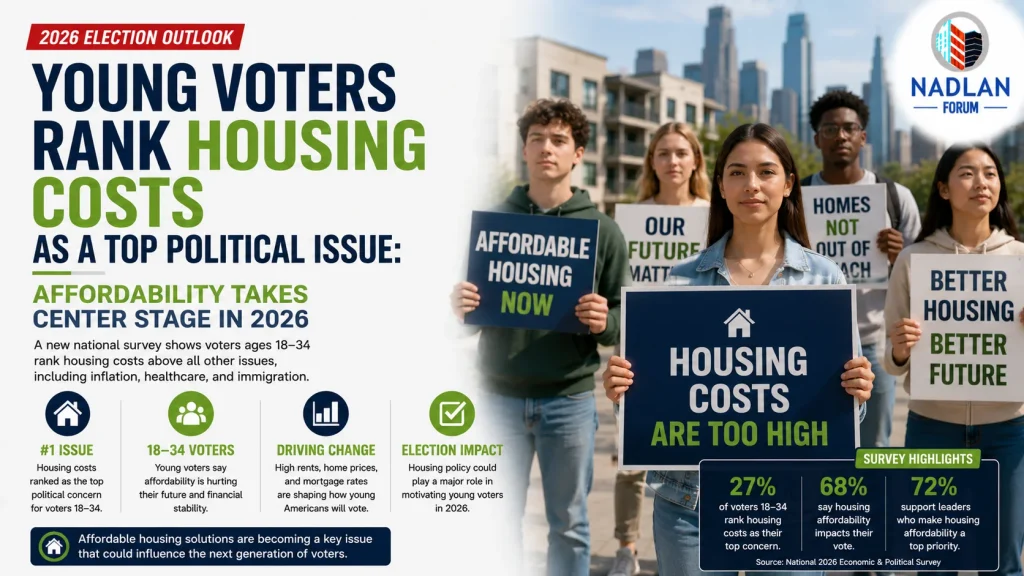
Housing affordability has become one of the most important political concerns for younger Americans as the country moves closer to the November 2026 midterm elections.
Among registered voters between the ages of 18 and 34, the cost of housing ranked as the leading issue in a recent national economic survey. It placed ahead of other major concerns, including food prices, healthcare costs, immigration, and the protection of democratic institutions.
The results show how deeply high rents, expensive home prices, mortgage rates, property taxes, and insurance costs are affecting younger adults. Many are struggling to rent independently, purchase their first homes, or build long-term financial security.
The survey also suggests that housing policy could play a larger role in determining which party receives support from younger voters in competitive congressional races.
Housing Leads the List for Younger Voters
The national survey questioned 1,000 registered voters between July 8 and July 12 as part of its second-quarter 2026 review of public opinion and the economy.
For respondents ages 18 to 34, housing costs ranked as the most important political concern.
That result is significant because younger voters are often less likely to participate in midterm elections than older Americans. Both major political parties are therefore looking for issues that could motivate this age group to vote.
Housing may become one of those issues.
Younger adults have entered the housing market during a difficult period. Home prices remain far above pre-pandemic levels in many areas, rents consume a large share of household income, and mortgage rates continue to make monthly payments expensive.
Even when home-price growth slows, affordability may not improve much if borrowing costs, taxes, maintenance, and insurance continue rising.
Housing Concerns Extend Beyond the Youngest Voters
Housing was especially important to younger adults, but it also ranked highly among other groups.
Across respondents of all ages, housing and healthcare costs were tied as the fourth-most important issues facing the country.
The three issues ranked ahead of them were:
- Food and grocery costs
- Protecting democracy
- Immigration and border security
Housing was the leading concern among male respondents between ages 18 and 49.
Among men and women between 35 and 49, housing ranked second, behind only the cost of food and groceries.
These findings suggest that affordability is not limited to recent graduates or first-time homebuyers. It is also affecting families, middle-aged renters, homeowners with rising monthly expenses, and people trying to move into larger homes.
Why Housing Has Become a Political Issue
Housing has always been an important household expense, but it has become more difficult to manage as costs have risen faster than incomes in many parts of the country.
Renters may face annual rent increases, utility bills, application fees, security deposits, parking charges, and moving expenses.
Homeowners and buyers face a different set of pressures, including:
- High mortgage payments
- Property taxes
- Homeowners insurance
- Maintenance and repair costs
- Association fees
- Closing costs
- Limited affordable inventory
Higher mortgage rates have also reduced the amount of home that many buyers can afford.
A buyer may qualify for a much smaller loan at a rate above 6% than at the lower rates available several years earlier. Even when the purchase price remains unchanged, the monthly payment can be hundreds of dollars higher.
Millions of Renters Face Heavy Cost Burdens
Housing pressure is particularly severe among renters.
A major national housing study found that 22.7 million renter households, or approximately 49% of all renters, spent more than 30% of their income on rent and utilities in 2024.
Housing experts generally describe a household as cost-burdened when housing expenses exceed 30% of income.
Of those renters, 12.1 million households were severely cost-burdened, meaning they spent more than half of their income on housing.
When such a large share of income goes toward rent and utilities, households have less money available for food, healthcare, transportation, childcare, education, and savings.
The pressure can also make it difficult to build an emergency fund or save enough for a home down payment.
Younger Adults Face Delayed Homeownership
Many younger Americans still view homeownership as a major financial goal, but reaching that goal has become harder.
High rents can prevent tenants from saving, while high home prices increase the amount needed for a down payment and closing costs.
At the same time, mortgage rates have raised monthly payments and reduced purchasing power.
Young buyers may also carry student debt, auto loans, credit card balances, or childcare expenses. These obligations can affect their debt-to-income ratios and reduce the mortgage amounts for which they qualify.
In expensive metro areas, even households with solid incomes may find that entry-level homes remain outside their budgets.
As a result, some younger adults are remaining with family members longer, sharing rentals with roommates, moving to less expensive cities, or delaying major life decisions.
Insurance and Property Taxes Add to the Problem
Housing affordability is no longer determined only by a home’s sale price or monthly rent.
Homeowners insurance has become a growing concern in areas exposed to hurricanes, wildfires, flooding, hail, and other weather risks.
In some markets, premiums have increased sharply. Some homeowners have struggled to find private coverage at all.
Property taxes have also risen in areas where home assessments increased during the past several years.
For buyers using a mortgage, taxes and insurance are often included in the total monthly payment. This means a household can face a higher payment even when its mortgage rate and principal balance remain unchanged.
These additional expenses are helping turn housing affordability into a wider cost-of-living issue.
Political Parties Compete Over Affordability
Both Democrats and Republicans are trying to persuade voters that their policies can reduce housing costs.
The survey showed that the issue is viewed differently across political groups.
Democratic respondents ranked housing as their third-most important concern, behind food prices and protecting democracy.
Independent voters placed housing behind food costs, democracy, and immigration.
Republican respondents ranked housing lower than immigration, food costs, and foreign-policy concerns.
Even so, housing remains politically important because it affects voters across party lines and is closely connected to personal finances.
A household may disagree with another household on national policy, but both may still be concerned about rent, mortgage payments, insurance, or the lack of affordable homes.
Democrats Hold a Survey Advantage on Housing
When respondents were asked which political party would do a better job handling housing, 38% selected Democrats, while 32% selected Republicans.
The Democratic advantage was larger among respondents who ranked housing as one of their two most important issues.
Within that group, 53% said Democrats would handle the issue better.
That advantage may give Democratic candidates an opportunity to focus on rents, starter homes, housing supply, tenant costs, and mortgage affordability during the midterm campaign.
However, public support may depend on whether voters believe proposed policies can produce real changes rather than simply offering campaign promises.
Republicans Point to Housing-Supply Measures
Republicans argue that building more homes and reducing government restrictions are necessary to lower costs.
They often support faster permits, simpler zoning rules, expanded manufactured housing, reduced development fees, and fewer regulatory delays.
Republican campaign officials have also argued that Democratic policies in major cities contributed to housing shortages through high construction costs, strict zoning rules, and slow approval processes.
From this view, affordability cannot be solved only through rental assistance or buyer subsidies. Supporters argue that increasing demand without increasing supply could push prices even higher.
Democrats Emphasize Household Costs and Market Access
Democrats generally place greater emphasis on tenant protections, down-payment assistance, affordable housing programs, rental support, and restrictions on large institutional investors.
They argue that many households need immediate help because new construction may take years to affect prices.
Democratic officials have also blamed the current administration and congressional Republicans for failing to provide faster relief from high rents, home prices, and mortgage expenses.
The political debate is therefore not only about whether housing is too expensive. It is also about which policies would provide the most effective relief.
New Federal Housing Law Addresses Supply and Investor Activity
Housing policy gained additional attention after Congress approved a major bipartisan housing measure in June.
The 21st Century ROAD to Housing Act became law on July 11, 2026, without the president’s signature.
The legislation includes measures intended to expand housing supply, streamline certain development and inspection processes, support manufactured housing, improve access to smaller mortgages, and limit some large institutional purchases of existing single-family homes.
The law received broad bipartisan support, but its political rollout became controversial after President Donald Trump declined to sign it.
Because the president neither signed nor vetoed the bill during the required period, it became law automatically.
Supporters described the legislation as one of the most important federal housing measures in decades, although experts noted that many of its effects will take time to appear.
Housing Supply Will Take Time to Improve
Increasing housing construction is a central goal of the new law, but new supply cannot appear immediately.
Developers still face high land costs, construction expenses, labor shortages, interest rates, permitting delays, and local opposition.
Projects may take years to move from planning to completion.
Housing policy also depends heavily on state and local governments because local officials control much of the zoning, permitting, density, and land-use process.
Federal action can provide incentives and reduce some barriers, but local rules will continue to influence how much housing is built and where it is located.
Institutional Investors Remain Part of the Debate
The role of private equity and large investors in the single-family housing market has become another political issue.
Critics argue that large buyers can compete with families for homes, particularly in lower-cost neighborhoods where first-time buyers are active.
Supporters of institutional investment say large landlords provide needed rental options and can finance new construction.
The new housing law places limits on additional purchases of certain existing homes by very large investors while continuing to allow investment in some newly built rental communities.
Whether those restrictions will improve affordability remains uncertain.
Reducing investor purchases may give some buyers more opportunities, but a sharp decline in rental-home investment could also reduce rental supply in certain markets.
Housing Could Drive Young Voter Turnout
Political strategists believe housing may become for the 2026 campaign what healthcare has been in previous elections: a personal issue that affects daily life and can motivate voters.
Young adults may not follow every housing bill or zoning debate, but they understand when rent increases, when buying a home feels impossible, or when they must move farther away from work.
Candidates who connect national policy to those personal experiences may have a stronger chance of gaining attention.
The challenge will be explaining how proposed solutions would affect actual monthly costs.
Broad promises to “make housing affordable” may have limited value unless campaigns explain whether they plan to build more homes, reduce fees, assist buyers, regulate investors, reform zoning, or expand rental support.
Housing Is Both a National and Local Problem
The national affordability crisis does not look the same everywhere.
In high-cost coastal cities, the main challenge may be severe shortages and very high land prices.
In fast-growing Sun Belt markets, buyers may have more inventory but face rising insurance costs, property taxes, or new construction expenses.
In rural areas, purchase prices may be lower, but incomes may also be lower, and access to financing or quality rental housing may be limited.
This means a single national policy is unlikely to solve every housing problem.
Effective solutions will probably require a combination of federal funding, state reforms, local zoning changes, private construction, and targeted assistance.
What Voters May Expect From Candidates
As the midterm elections approach, voters are likely to ask candidates for clear answers on several housing questions:
- How will they increase the supply of entry-level homes?
- What will they do about high rents?
- How will they help first-time buyers?
- Can they reduce insurance and property-tax pressure?
- Should large investors face further restrictions?
- How will they encourage local governments to approve more housing?
- What assistance should be available to cost-burdened renters?
Candidates may also need to explain how they will pay for their proposals and how quickly households should expect to see results.
Housing programs can require significant funding, while construction reforms often take years to affect supply.
Housing Affordability Could Shape the 2026 Election
The survey makes clear that housing is no longer only a real estate or economic issue.
For many younger voters, it is a measure of whether they can live independently, start a family, remain in their community, or build wealth.
High housing costs affect nearly every part of a household budget. They also influence job choices, commuting distances, family planning, and retirement savings.
Both political parties recognize the importance of affordability, but voters may judge them by results rather than statements.
The party that presents a practical plan for increasing supply, reducing monthly costs, and improving access to homes could gain an important advantage among younger Americans.
As the November midterms approach, housing is likely to remain one of the most closely watched domestic issues—and one of the clearest examples of how economic policy affects everyday life. For direct financing consultations or mortgage options for you visit 👉 Nadlan Capital Group.























Responses