
Analysis Paralysis

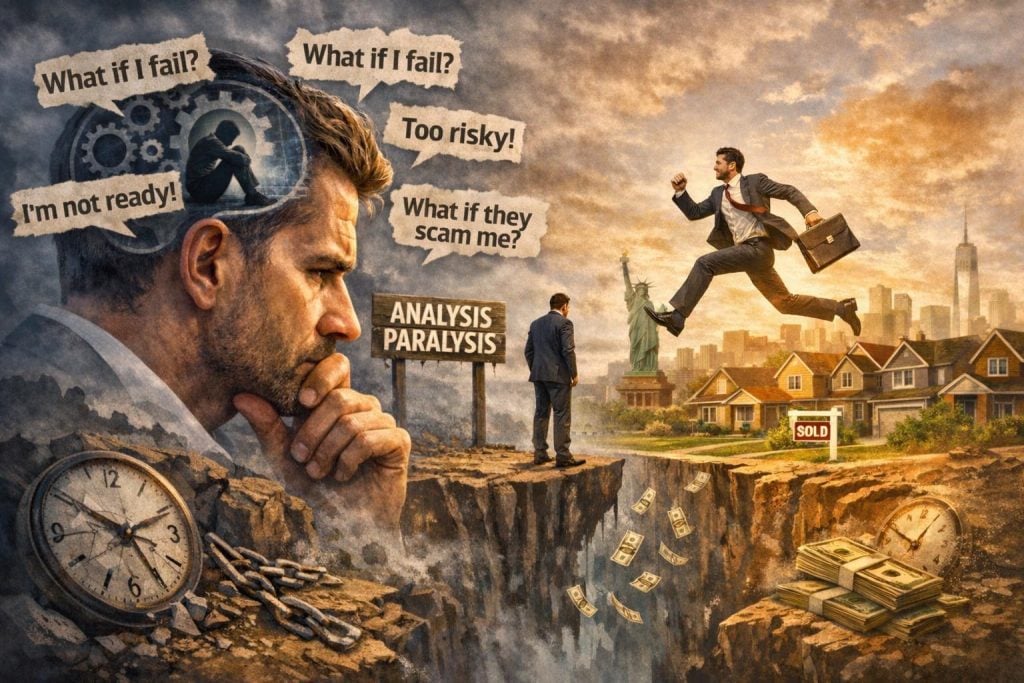
The deal doesn’t fail because of the numbers. It fails because of your psychology.
Most investors love talking about returns, leverage, NOI, Cap Rate. It sounds professional; it feels in control. But in reality, the best deals don’t fall apart because of Excel—they fall apart because of what happens between the investor’s ears.
The point where most people get stuck is even before their first deal. They convince themselves they’re “gathering information,” “learning the market,” “waiting for the right opportunity.” In reality, what’s happening is a combination of fear disguised as rationality.
It shows up in familiar phrases:
- “I want to understand everything first.”
- “I don’t want to make a mistake.”
- “I don’t trust people remotely.”
- “I’ll wait for a safer deal.”
On the surface, this sounds responsible.
In reality, it’s one of the most expensive traps there is. Because while you’re waiting for certainty, the market isn’t waiting for you.
Properties continue to close. Experienced players continue to act.
And those willing to make decisions in uncertain conditions gain an accumulated advantage.
This phenomenon is well-known outside of real estate, and it’s called Analysis Paralysis.
A situation where too much information doesn’t lead to a better decision—it leads to endless postponement of action. The mind creates a false sense of control, but in reality, it prevents you from moving forward.
Let’s put this clearly:
The problem, in most cases, isn’t lack of knowledge.
The problem is deeper fear mechanisms.
- Fear of looking unprofessional
- Fear of losing money
- Fear of trusting people
- Fear of making mistakes
The brain is wired to prefer avoiding loss over creating gain.
This is a well-known bias called Loss Aversion.
And so, many investors make one unconscious decision:
It’s better to not lose—even if it means not making anything at all.
But here comes the critical point most people miss:
In real estate, inaction is not a neutral state.
It’s a decision with a cost. It just happens to be less visible.
It can mean years of stagnation, erosion of purchasing power, or missing opportunities that, in hindsight, seem obvious.
In other words, loss doesn’t always look like a loss. Sometimes it looks like “I waited.”
There’s no such thing as a deal without risk.
Those who are looking for absolute certainty will never act.
The real difference between successful investors and others isn’t the absence of risk,
it’s the ability to understand it, price it, and act despite it.
And here comes the flip:
The same people who are afraid to enter a $150,000 deal because of risk, are unconsciously taking much larger risks.
They stay in place, avoid gaining experience, and don’t build momentum.
The real question isn’t whether there’s risk—because there always is.
The real question is:
Are you managing it professionally, or letting it manage you?
Because in the end, those who wait for complete certainty always remain on the sidelines analyzing.
And those who take action—even imperfectly—build an advantage that grows over time.
If you recognize yourself in this, it’s no coincidence.
This is the exact crossroads where you stop thinking like an observer and start acting like an investor.





















Responses