
U.S. Housing Market Update January 2026: Price Growth Continues to Slow


U.S. home prices continued to rise in January 2026, but the pace of growth slowed again. The latest data shows that the housing market is no longer moving at the strong speed seen in past years. Instead, it is entering a more balanced phase where both buyers and sellers are adjusting to new conditions.
U.S. Home Prices Increase at a Slower Pace
The national home price index reported a 0.9% year-over-year increase in January 2026. This includes all nine U.S. census regions and reflects a clear slowdown compared to previous months.
City-level data shows a similar trend:
- 10-city index: up 1.7% (previously 2.0%)
- 20-city index: up 1.2% (previously 1.4%)
This confirms that price growth is still positive, but it is losing momentum.
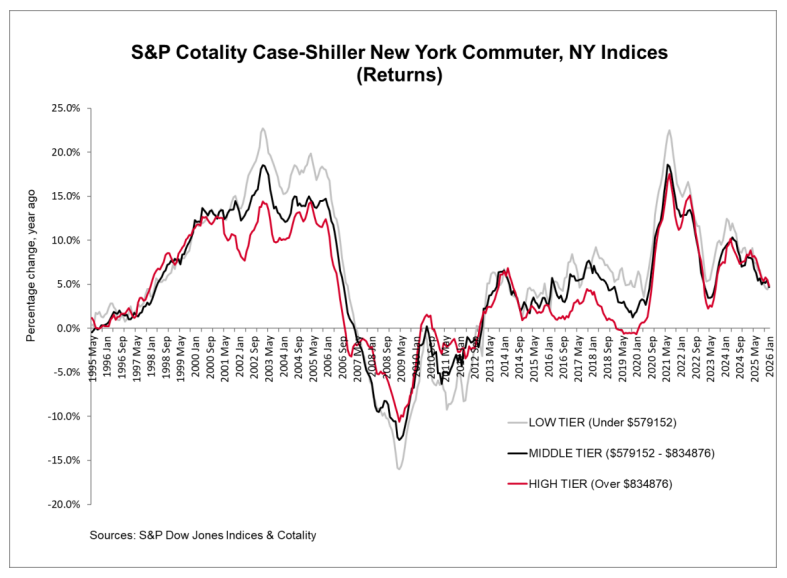
Price Growth Is Cooling Across the Market
The housing market is no longer seeing strong gains. Instead, price increases are becoming smaller month by month.
Over the past year, the market has shifted:
- First half of the year: prices rose 2.2%
- Second half of the year: prices fell 1.3%
Because of this change, overall yearly growth has dropped below 1%.
When inflation is considered, the situation becomes clearer. With consumer prices rising 2.4%, real home values have slightly declined.
Regional Differences Are Getting Bigger
The U.S. housing market is not moving in one direction. Some cities are still growing, while others are declining.
Top Performing Cities
- New York: +4.9%
- Chicago: +4.6%
- Cleveland: +3.6%
These areas continue to see strong demand and limited housing supply.
Weakest Markets
- Tampa: -2.5%
- Denver: -2.1%
- Phoenix: -1.6%
In these cities, higher inventory and lower demand are pushing prices down.
Monthly Trends Show a Stable Market
Monthly changes suggest that the market is stable but not strong:
- Before seasonal adjustment: slight declines
- After adjustment: small gains of around 0.2%
This indicates that the market is not crashing, but it is also not growing quickly.
Mortgage Rates and Affordability Remain Key Issues
Affordability is still the biggest challenge in the housing market.
At the start of 2026, mortgage rates briefly dropped to their lowest levels in nearly three years. However, this did not last long, and rates have increased again.
With 30-year mortgage rates near 6%, many buyers are waiting:
- Some are hoping for lower interest rates
- Others are waiting for prices to slow further
As a result, buyers now have more power in negotiations and are asking sellers for concessions.
Slow Start to 2026 Housing Market
The beginning of 2026 has been one of the weakest starts for home price growth in more than a decade.
Even though prices are still high overall, the growth rate is much lower than before. This shows that the market is adjusting rather than expanding.
Housing Market Outlook for 2026
The outlook remains uncertain.
What could support prices:
- Limited housing supply in some regions
- Continued demand in the Northeast and Midwest
What could slow the market:
- High mortgage rates
- Economic uncertainty
- Increasing inventory in some areas
Spring activity may bring stability, but differences between regions will likely continue.
Important Data Note
There were delays in housing transaction data from Wayne County, Michigan. Because of this, no updated data for Detroit was included in the January 2026 report. For direct financing consultations or mortgage options for you visit 👉 Nadlan Capital Group.
FAQ :
Why are U.S. home prices slowing in 2026?
Home prices are slowing due to high mortgage rates, affordability issues, and reduced buyer demand.
Are home prices falling in the U.S.?
Not everywhere. Some cities are seeing declines, while others are still experiencing growth.
Which cities have the highest home price growth?
New York, Chicago, and Cleveland are currently leading in annual price increases.
Will home prices drop in 2026?
Prices may decline in some regions, especially where inventory is rising, but other areas may still see growth.
Is it a good time to buy a house in 2026?
It depends on location and financial situation. Buyers may benefit from better negotiation conditions, but mortgage rates remain high.




















Responses