
Share of Newly Built Homes for Sale Drops to Four-Year Low as Builders Pull Back


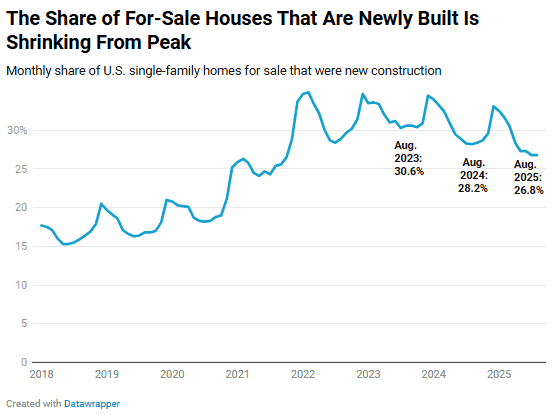
The share of newly built homes for sale across the U.S. has dropped to its lowest level in four years, marking a significant cooling in the once red-hot new construction market. According to a recent Redfin analysis, just 26.8% of single-family homes listed for sale in August were newly built down from 28.2% a year earlier and 30.6% two years ago.
While this decline signals a shift in housing dynamics, the share of new homes remains notably higher than pre-pandemic levels, when new builds typically made up between 15% and 20% of the single-family inventory. During the pandemic housing boom, that figure surged to over 35% in 2022, fueled by skyrocketing demand and limited supply of existing homes.
Now, the balance is shifting again. The supply of existing homes is increasing as more homeowners list their properties, while homebuilders grappling with elevated borrowing costs, softening demand, and rising construction expenses are easing back on new projects.
Why the Share of New Homes Is Shrinking
The drop in new home listings isn’t just about slowing construction. It’s also being driven by a rise in existing home supply, as sellers who were previously “locked in” by low mortgage rates are finally returning to the market.
Between 2022 and 2023, few existing homeowners listed their properties because they didn’t want to give up mortgages with rates in the 3% range. But now, with life events pushing some to move and mortgage rates showing signs of moderation, more Americans are deciding to sell.
Homes are spending longer on the market, too averaging about 50 days in September, the slowest pace for that month since 2016. Meanwhile, some homes under contract are being relisted after buyers back out, further boosting active inventory.
“We’re seeing a rebalancing between old and new inventory,” said a senior housing analyst at Redfin. “Builders are pulling back, but at the same time, more existing homes are hitting the market. It’s creating a dynamic where buyers suddenly have more options but also more hesitation.”
Builders Retrench as Inventory Sits
Homebuilders, once rushing to meet pandemic-era demand, are now showing restraint. U.S. Census data shows that housing completions fell 8.4% year over year in August, while housing starts dropped 6%.
This slowdown reflects both cautious sentiment and an effort to offload existing inventory before committing to new developments. Builders who overextended during the boom are now prioritizing balance sheets over expansion.
“Builders are hesitant to break ground on new projects because the math simply doesn’t work in today’s buyer’s market,” said Jesse Landin, a Redfin Premier agent in San Antonio. “We’ve even seen some local builders lay off workers something almost unheard of just a few years ago.”
In markets like Texas, Utah, and Florida, where new homes account for a large portion of available inventory, builders are fighting harder to attract buyers. Incentives such as mortgage-rate buydowns, closing cost coverage, and free upgrades have become increasingly common.
Builder Incentives Create Buyer Opportunities
While newly constructed homes often come with a higher price tag, today’s incentives can make them surprisingly competitive. Builders eager to move inventory are offering mortgage-rate reductions to 4–5%, along with cash credits worth $10,000 or more toward closing costs or upgrades.
“Builders are desperate to sell,” said Roze Swartz, a Redfin Premier agent in Houston. “Prices are lower than usual, insurance premiums are more affordable compared to older homes, and buyers have leverage. They’re getting rate buydowns, thousands in closing cost credits, and the peace of mind that comes with everything being brand new.”
For buyers who can afford it, this moment may present a unique opportunity to purchase a new home before the supply tightens further. Even as builders pull back, the current pool of new homes remains relatively deep, offering plenty of options with modern amenities and energy-efficient features.
However, with fewer new projects breaking ground, that availability is expected to shrink in the coming quarters especially if mortgage rates stabilize or fall further, reigniting buyer demand.
The Bigger Picture: Market in Transition
The broader housing market remains in transition, shaped by affordability challenges, fluctuating mortgage rates, and shifting consumer sentiment. Even as the share of new homes declines, the segment continues to play a crucial role in balancing national housing supply.
Builders are adapting to new market realities cutting back on speculative projects, focusing on smaller footprints, and prioritizing affordability-driven communities. Meanwhile, homebuyers are becoming more selective, weighing incentives and location value more heavily than ever.
“This is a cooling, not a collapse,” noted one housing economist. “The industry is simply correcting after several years of overextension. Once rates settle and consumer confidence returns, we’ll likely see a rebound in both starts and sales.”
Bottom Line
The share of newly built homes for sale may have fallen to a four-year low, but opportunities still exist for buyers who act strategically. Builders’ willingness to negotiate and offer generous incentives makes new construction more accessible than it’s been in years especially for those looking to secure modern amenities without the renovation headaches of older homes. For direct financing consultations or mortgage options for you visit 👉 Nadlan Capital Group.















Responses