
July Home Sales Climb as Prices Near a Turning Point

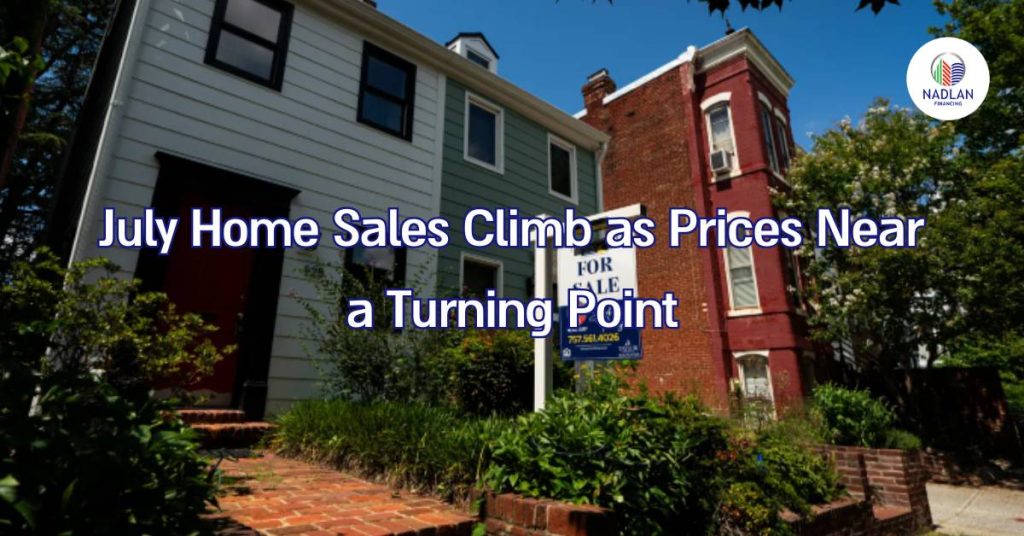
Sales of previously owned homes showed surprising resilience in July, rising 2% from June to reach a seasonally adjusted, annualized pace of 4.01 million units, according to the National Association of Realtors (NAR). Economists had anticipated a small decline, making this gain notable, especially in a market still navigating historically high mortgage rates. Compared with July 2024, sales were up 0.8%.
Because these sales are measured by closings, many homes counted in the July statistics were likely under contract in May or June, when the average 30-year fixed mortgage rate, after briefly exceeding 7% in May, ended June at 6.67%, according to Mortgage News Daily.
Inventory Rises, Easing Price Pressure
At the end of July, there were 1.55 million homes on the market, up 15.7% from the same month last year. This represents roughly a 4.6-month supply at the current sales pace. Traditionally, a six-month supply indicates a balanced market between buyers and sellers.
Inventory is now at its highest level since May 2020, though it remains below pre-pandemic norms. More homes on the market are gradually relieving upward pressure on prices. The median price for an existing home in July reached $422,400, a slight 0.2% increase from a year earlier and a record high for the month of July. Home prices have risen annually for 25 consecutive months, but indicators suggest the market may be approaching an inflection point.
The small improvement in housing affordability is slowly boosting home sales, said Lawrence Yun, NAR’s chief economist. Wage growth is comfortably outpacing home price increases, and buyers now have more options to choose from.
Regional and Price-Level Trends
Condominium sales in the South rose, reversing a year-long trend of falling prices. Overall, activity remains strongest at the upper end of the market:
- Homes priced above $1 million saw sales jump 7.1% year-over-year.
- Homes priced between $100,000 and $250,000 experienced a slight decline of 0.1%.
- Properties under $100,000 saw sales drop 8%.
Market Dynamics: Slower Sales and Shifting Buyer Profiles
Homes are taking slightly longer to sell. The average property spent 28 days on the market in July, compared with 24 days last year. First-time buyers accounted for 28% of transactions, down from 30% in June and 29% in July 2024.
Investors are also playing a larger role, representing 20% of all purchases, up from 13% a year earlier. This uptick may be linked to the increase in available inventory. With mortgage rates remaining high, the share of all-cash buyers climbed to 31% of transactions, compared with 27% the previous year.
This is unusually high, Yun observed. Stock market gains or accumulated housing wealth may be encouraging buyers to pay cash, particularly in a more competitive and uncertain environment.
Looking Ahead
While sales have risen modestly, the housing market is clearly in a transitional phase. Affordability is gradually improving as wage growth outpaces home prices, but the pace of transactions is slowing, particularly for entry-level homes. High-end properties continue to attract buyers, while first-time purchasers and lower-priced homes face more challenges.
For sellers, the market signals a need for strategic pricing and flexibility, especially as inventory grows. Buyers, on the other hand, may find more negotiating leverage and less competition than in the past two years.
As the housing landscape continues to adjust to elevated mortgage rates, fluctuating inventory, and regional price disparities, both buyers and sellers will need to remain agile. Analysts suggest that monitoring these trends over the coming months will be key to understanding whether the market has truly reached a turning point. For direct financing consultations or mortgage options for you visit 👉 Nadlan Capital Group.




























Responses