
Foreclosures Rise in 2025: Market Stress or Return to Normal?

Foreclosure activity moved higher in 2025, raising questions about whether homeowners are under growing pressure or if the housing market is simply settling into a more normal rhythm. New data suggests the answer leans more toward recalibration than crisis.
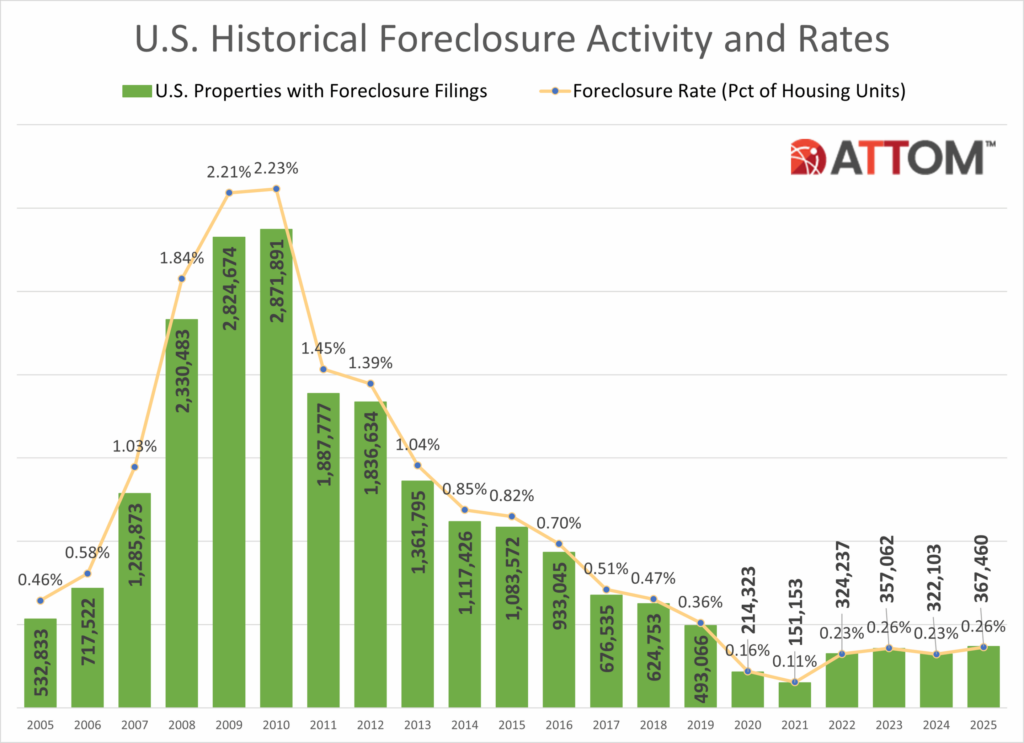
According to the ATTOM Year-End 2025 U.S. Foreclosure Market Report, about 367,460 properties nationwide had foreclosure filings last year. That includes default notices, scheduled auctions, and bank repossessions. The total marks a 14% increase from 2024 and a 3% rise from 2023, but it remains 25% lower than 2019, before the pandemic reshaped the housing market.
Even more telling, foreclosure filings in 2025 were roughly 87% lower than the peak of nearly 2.9 million homes in 2010 during the housing crash.
Foreclosure Share Still Historically Low
The 367,460 homes with foreclosure filings represented about 0.26% of all U.S. housing units in 2025. That figure is slightly higher than 0.23% in 2024 but well below 0.36% in 2019 and far from the 2.23% peak seen in 2010.
“Foreclosure activity increased in 2025, reflecting a continued normalization of the housing market after years of unusually low levels,” said Rob Barber, CEO of ATTOM. He added that strong homeowner equity and tighter lending standards are helping prevent a broader wave of distress.
Q4 2025 Shows Noticeable Uptick
Foreclosure filings picked up toward the end of the year. In the fourth quarter of 2025, there were 111,692 properties with foreclosure filings, up 10% from the prior quarter and 32% higher than a year earlier. Nationwide, one in every 1,274 properties had a foreclosure filing during the quarter.
States with the highest foreclosure rates in Q4 included South Carolina, Florida, Delaware, Illinois, and Nevada, with South Carolina seeing the most pressure at one filing for every 689 housing units.
Foreclosure Starts Increase, Still Below Past Norms
Lenders began foreclosure proceedings on 289,441 properties in 2025. That was 14% higher than 2024 and more than double the pandemic low reached in 2021. Still, starts were down 14% compared with 2019 and 86% lower than the 2009 peak.
Texas, Florida, California, Illinois, and New York recorded the highest number of foreclosure starts. Among large metro areas, New York City, Chicago, Houston, Miami, and Los Angeles led the list.
Bank Repossessions Rise but Remain Muted
Bank repossessions, also known as REOs, totaled 46,439 homes in 2025. That number rose 27% from 2024 but was still 68% lower than in 2019 and down 96% from the 2010 high.
Texas and California topped the list for REOs, followed by Pennsylvania, Florida, and Illinois.
When measured by rate, South Carolina, Florida, Delaware, Illinois, and Nevada posted the highest foreclosure activity for the year. New Jersey, Indiana, Ohio, Texas, and Maryland rounded out the top 10.
Foreclosure Timelines Are Shortening
The average time to complete a foreclosure also moved lower. In Q4 2025, properties spent an average of 592 days in the foreclosure process, down 22% from a year earlier and 3% from the prior quarter.
Some states still face lengthy timelines. Louisiana led the nation with an average foreclosure process lasting more than nine years, followed by New York, Hawaii, Connecticut, and Kansas.
A Market Adjusting, Not Breaking
Overall, the data shows foreclosure activity rising from historically low levels but remaining far below both pre-pandemic norms and the depths of the last housing crisis. While some households are clearly under strain, strong equity positions and more careful lending practices continue to limit broader risk.
For now, the increase in foreclosures appears to reflect a housing market adjusting to higher rates and tighter conditions, not a return to widespread homeowner distress. For direct financing consultations or mortgage options for you visit 👉 Nadlan Capital Group.





















Responses