
Fake It Until You Make It

#EntrepreneurOfTheWeek – Post #2
Fake it until you make it.
That’s how I felt for more than six months.
In October 2024, we relocated to New Jersey, USA — a decision that did not come easily.
Family, friends, the career I had built, the comfort — everything was replaced with “being alone” (at least at the beginning), economic uncertainty, rebuilding our lives, and no less important, rebuilding myself.
I’m still the same Niv, but here no one cares what I did in the past or what I achieved.
We relocated because of Shani’s job. It was a great professional opportunity for her, and for us it was an incredible opportunity for a family experience — just the two of us and our small family unit.
Alongside the concerns, months before the move I sat with Eliana for long conversations to discuss “how we can take maximum advantage of my move to the U.S.”
Of course, the geographical proximity to our properties is an advantage. Working on the U.S. time zone makes life much easier. And most importantly — the time that would free up for me to focus only on real estate.
After the move and settling in, with the extra time that suddenly appeared, came the emptiness.
The kind that made me ask myself again and again:
Did I make the right decision leaving the career I built?
Will I achieve what I planned?
You could write one or two full posts just about that feeling of emptiness.
One time, when my parents flew back to Israel after visiting us, I felt a heaviness I couldn’t explain. I’m not someone who connects easily to emotions.
At some point I realized what it was — the distance from family. We are losing precious time with them, and they are losing precious time with us and with their grandson.
That day I gained a new “why.”
At first it was for my immediate family. Now I have to do everything to achieve the goals I set for myself — and even more than that. Otherwise, the distance simply isn’t worth it.
And then I started spending hours and hours in front of the computer.
Most of the time I analyzed deals, joined virtual meetings, built connections in the real estate world, and kept learning.
But sometimes I sat in front of the computer for a long time doing nothing. Simply because I didn’t know what to do — or at least that’s how it felt.
And once again two important women in my life came to the rescue — Shani and Eliana.
In conversations with them, I realized that I knew exactly what and how I needed to do things. I just hadn’t done them yet.
The move to the U.S. didn’t reveal my potential.
It revealed my weaknesses.
And only when I faced them did I decide to use my strengths and start building a system.
I started activating the skills I had accumulated throughout my life — the ones that brought me to places I had dreamed about for years.
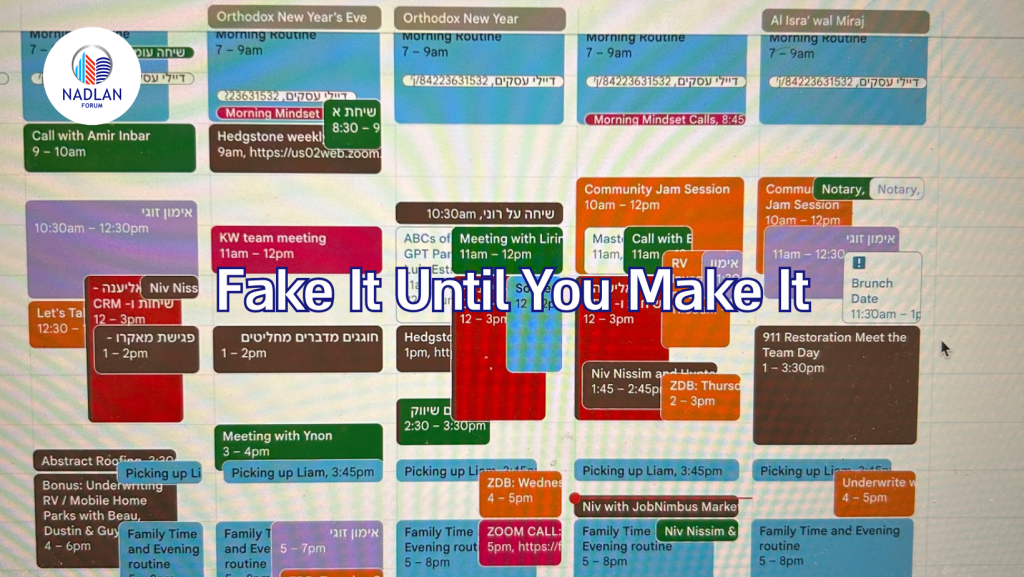
1. I went back to working with a structured schedule.
Because if it’s not in the schedule, it won’t happen. And if it’s in the schedule, it must be done (even if not exactly at the planned time, adjustments are made).
Over time, this schedule became an inseparable part of my routine, and luckily it’s what keeps me focused today and helps me use my time in the best way possible.
Another thing I learned in this context is to make sure my cup is always full.
I try to give 200% to my business, my child/children, my wife, and my relationships with family and friends. Giving to others means filling their cup. If my cup becomes empty — I won’t be able to fill theirs.
So I listened to one of my mentors, Jesse Stanton, and added the 5 Non-Negotiables to my schedule. I chose the things that fill me up, scheduled them — and they simply don’t get canceled, no matter what.
2. I started building connections.
I’m a very social person (as proven by the number of times people have asked me: “How do you maintain so many groups of friends?”)
So there’s no reason not to leverage that.
I reached out to people I already knew, people with whom we had something in common. I started having meetings — and more meetings — which led to even more meetings.
These connections created momentum, even if small.
And here two cliché slogans come together in one sentence:
“Who, not How” and
“Progress through small steps leads to meaningful change and the achievement of big goals.”
But in reality, these connections brought real results — work, successes, and new experiences.
That’s how we achieved amazing deals (!), became board members, acquired an operating business, and learned how to create goals and systems worthy of them.
3. Following “Who, not How” — it’s not just about knowing who to learn from and saving time and mistakes.
It’s also about letting go of control.
I’m the kind of person who needs to know everything, control everything, understand everything. It’s a positive trait — until it becomes a limitation when you want to grow to larger scales.
Either the growth won’t happen, or it will happen poorly.
Delegation comes in different forms: employees we hired, and the realization that there’s no chance we could continue trying to do wholesaling alone — so we created connections with wholesalers who bring us deals, and we gladly pay them the commission.
4. Being there for others.
From the beginning of my partnership with Eliana, we defined two clear principles:
Always operate with honesty and integrity (no matter the cost), and give to others.
That help comes in different forms:
Weekly hours dedicated to entrepreneurs at the beginning of their journey for guidance, brainstorming, and deal analysis
A WhatsApp group for passive investors to help them invest more safely and wisely
And sometimes through real estate itself — such as providing proper housing for people who cannot afford more
But above all, helping others also helps us.
It fills us.
And it returns to us in a big way (yes, even through a Seller Finance deal worth hundreds of thousands of dollars at 0% interest).
As part of our community, SubTo, we learn to be Go-Givers — people who are there for others. And that leads to good things happening to us as well.
5. Writing procedures and processes.
At the beginning we learned, executed, made mistakes, corrected them — but we didn’t document anything.
One of my favorite managers used to write on the board:
“What isn’t documented didn’t happen.”
He meant something else, but I understood that if things aren’t written down — did we really learn? Did we really progress? Can we truly grow?
So we started documenting everything:
How to approach wholesalers and maintain good relationships
How to analyze markets and deals
How to connect with lenders
What to check before closing and what happens immediately after
Sales processes, building co-living operations, and more
This documentation created order, prevented repeated mistakes, and most importantly — allows someone else to step into our shoes more easily.
It became a core document in our businesses — a living, breathing document that is constantly updated and improved.
These are only some of the things I’ve learned along the way that must exist for a large operation to work — with order, without things falling through the cracks, and without wasting time on repeated mistakes.
And most importantly —
I realized that I’m not faking confidence.
I’m building it through action.
















Responses