
The Comeback of Vacant REO Auctions: A Boost for Housing and Neighborhoods

The market for bank-owned properties has seen a significant shift in 2025, with the number of vacant REO homes heading to auction reaching the highest level in over four years. According to new figures from Auction.com, this surge could be a win not only for bargain-hunting buyers but also for struggling communities looking for a fresh start.
These auctions are drawing increased attention from buyers who may be newer to real estate investing or more cautious in their approach including a growing share of owner-occupants who want to live in the homes they purchase.
At the same time, local housing markets and neighborhoods stand to benefit. Vacant properties, if left idle, often fall into disrepair, attract vandalism, and can become magnets for crime. But once purchased, renovated, and reintroduced into the housing supply, they can become affordable, quality homes helping to revitalize entire communities.
Landon Cunningham, VP of Client Relations at Tenet Capital in Spokane, Washington, has seen firsthand the transformation that can happen when vacant foreclosures are put back to productive use.
“If a house sits empty for a year or two, it’s only going to get worse,” Cunningham said. “You get more damage, more crime, more squatters. But when those homes are sold and fixed up, it’s a win for everyone the neighborhood looks better, contractors get work, and a family gets a home.”
Numbers Point to a Market Shift
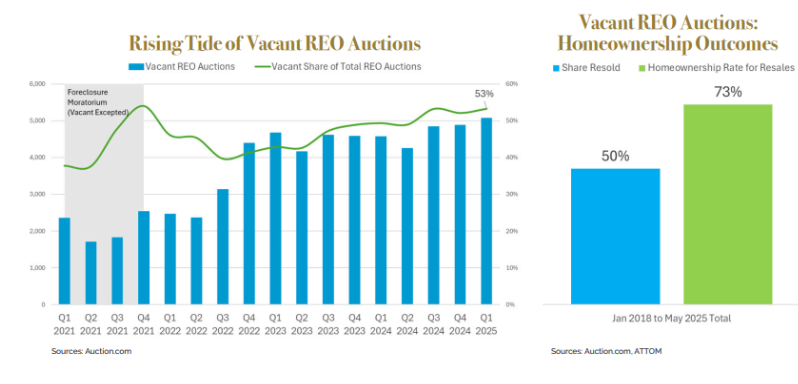
In the first quarter of 2025, more than 5,000 vacant REO properties were listed for auction on Auction.com. That’s a 4% jump from the previous quarter and 11% higher than a year earlier marking the biggest inventory since Q3 2020, in the early months of the COVID-19 pandemic.
Vacant homes accounted for 53% of all REO auctions during the quarter the largest share since the end of 2021. Back in 2020 and 2021, vacant properties made up a disproportionate portion of the REO market because they were exempt from the nationwide foreclosure moratorium on government-backed loans.
From Empty Shell to Lively Home
Before they sell, vacant REOs can drag down surrounding property values, create safety concerns, and weigh on the local housing market. But these same homes can become high-potential opportunities once acquired by local investors or developers who see the value in renovation.
One such example comes from Houston, where Auction.com buyer Francois Delille purchased a home in 2022 that had been sitting empty for roughly a year.
“It was just sitting there, not being cared for,” Delille recalled. “If it had gone to auction six months earlier, it could have been rented out six months earlier. It’s such a waste to let them sit.”
After making the necessary repairs, Delille listed the home as a rental helping meet local housing demand while breathing life back into the property.
Over the past seven years, buyers on Auction.com have purchased more than 45,000 vacant REOs. Over half of those 23,456 homes are now owner-occupied. Among properties that were resold, 73% went to homeowners rather than investors, demonstrating the role these auctions can play in increasing homeownership rates.
Affordability Gains
Vacant REO properties often sell for prices that are far more attainable than typical market listings. According to Auction.com’s analysis of public data, the average resale price for renovated vacant REOs was $301,156, requiring about 31% of the local median family income to afford when factoring in mortgage payments, property taxes, and insurance.
Not all of these properties are resold some remain as rentals. On average, vacant REO rentals fetched about $1,591 per month, representing 24% of the local median family income. That means many tenants gain access to well-maintained, affordable rental housing in a market where prices have climbed sharply in recent years.
Dana Morgan, a tenant in one of Delille’s renovated rentals, said finding the right home wasn’t easy.
“We looked at hundreds of properties 300 to 400 but none fit what we needed,” Morgan said. “This one was perfect for my family.”
More Everyday Buyers Enter the Scene
While experienced investors still make up a large share of REO buyers, Auction.com data shows that 20% of REO auction purchases in 2025 have been made by owner-occupants up from 19% in 2024 and the highest percentage since the platform began tracking this figure in 2017.
Vacant REOs tend to attract more of these buyers because they often come with interior inspections and appraisals, reducing the uncertainty and risk of surprise repairs. Without occupants, buyers also avoid the potential costs and delays of eviction.
Competitive Pricing Advantage
Vacant REOs frequently sell at deeper discounts than their occupied counterparts. In Q1 2025, the average winning bid equaled 54% of the property’s after-repair value, compared to 60% for occupied REOs a consistent 6-point spread that has held for years.
They also tend to have more accurate valuations. The average winning bid was 83% of the appraised value for vacant REOs, versus 76% for occupied ones. This is because appraisals can include interior inspections for vacant properties, giving buyers and sellers a clearer picture of the home’s true condition.
Clearing Out Long-Vacant Inventory
The recent uptick in vacant REO auctions has helped clear out properties that have been sitting idle for years. In Q1 2025, the average vacant REO had been bank-owned for 345 days down from 744 days in 2024 and a massive drop from 1,323 days in early 2022, just after the foreclosure moratorium ended.
That said, vacant REOs still remain in bank hands longer than occupied ones, which averaged 268 days in Q1 2025.
Where These Properties Are Concentrated
Vacant REO auctions are most common in rural parts of the country, with 72% of Q1 2025’s volume in areas classified as rural by the Census Bureau. Still, the majority aren’t isolated only 8% were in remote rural areas more than 25 miles from an urbanized zone, while 30% were within five miles of one.
Some metro areas are seeing sharper increases than others. Seattle; Wichita Falls, TX; Phoenix; Colorado Springs; and Los Angeles posted the biggest year-over-year jumps in vacant REO auctions. Cities with an above-average share include Houston, Phoenix, Los Angeles, Riverside (CA), and Baltimore.
Looking Ahead
The return of vacant REO auctions signals more than just increased activity in a niche corner of the housing market. It’s an opportunity to transform underused properties into homes, inject affordability into tight markets, and spur neighborhood revitalization.
If current trends continue, communities across the U.S. could see thousands of these once-forgotten homes restored, rented, or sold to new owners turning blight into opportunity and giving more families a place to call their own. For direct financing consultations or mortgage options for you visit 👉 Nadlan Capital Group.














Responses