
Government Shutdown Shows How Federal Lease Cuts Ripple Through Real Estate Markets

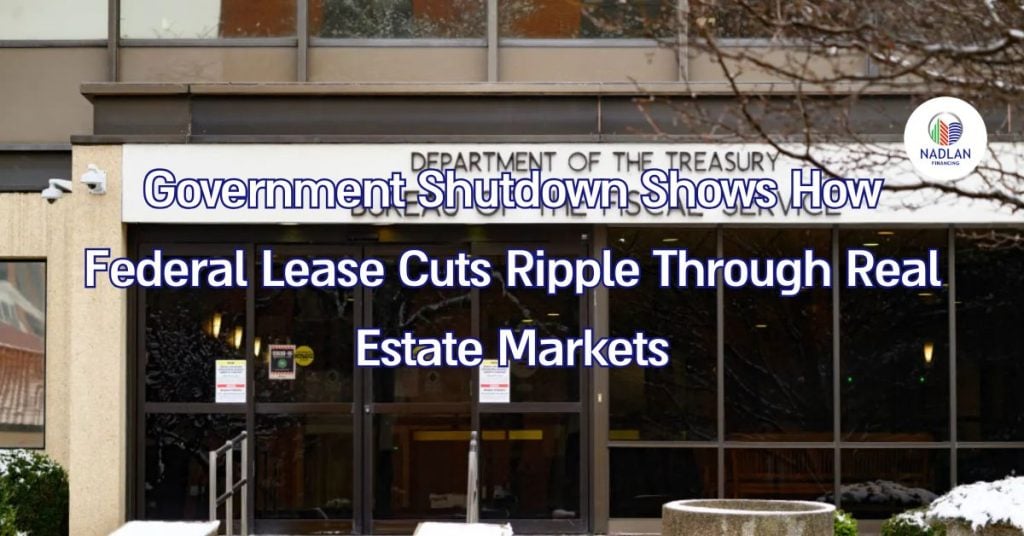
As the United States enters its first federal government shutdown since 2018, commercial real estate markets are already feeling the effects. Among the most visible indicators is the Department of Government Efficiency (DOGE) lease reduction program, which has canceled hundreds of office leases nationwide. While the agency reports estimated savings of $140 million from 384 terminated leases, experts warn that the broader economic consequences extend far beyond the balance sheet.
Federal Lease Cuts: More Than Dollar Savings
DOGE’s lease cancellations span federal agencies of all sizes, including the Social Security Administration, the Small Business Administration, and the U.S. Geological Survey. The leases affected range from sprawling 845,000-square-foot offices in Washington, D.C., to compact 250-square-foot spaces in New York City.
Cameron LaPoint, assistant professor of finance at Yale School of Management, explains that these cancellations create uncertainty for landlords who have historically relied on the government as a stable tenant. “The government has long been viewed as a low-risk tenant with predictable lease income,” LaPoint said. “Now landlords must scramble to find replacements, and this can destabilize not only individual properties but also the broader commercial lending ecosystem.”
The Ripple Effect on Lending and Investment
Government leases are considered anchor tenants in commercial mortgage-backed securities (CMBS) and other pooled loan structures. When these tenants vacate, it can trigger reduced valuations across multiple properties bundled in a single investment, potentially increasing interest rates on loans tied to those assets.
Mark Besharaty, senior VP of commercial lending at Arbor Financial Group in California, notes, “Vacancies from federal offices create a chain reaction. Lenders see higher risk, borrowing costs may rise, and landlords need to reconfigure their properties to attract new tenants. In many cases, this means subdividing large office spaces or converting them to mixed-use developments.”
Creative Solutions for Vacant Properties
Landlords across the country are exploring strategies to offset the loss of federal tenants. Options include converting office buildings into residential units, co-working spaces, or mixed-use properties that combine retail and office. Alexi Morgado, CEO of Lexawise in Florida, says, “Vacancies don’t automatically translate to lost value, but they do require strategic planning. Property owners need to be creative to maintain cash flow and preserve asset value.”
In Florida, for example, landlords in areas with reduced federal occupancy are pivoting toward residential leasing or flexible office configurations to attract smaller businesses. In rural markets, where properties often lack diversified tenant bases, the impact can be more acute. Michelle Hanley, mayor of Marquette, Michigan, notes that IRS office closures will have limited local impact, but cuts to tribal health centers and Bureau of Indian Affairs offices could create broader economic strain.
Economic Multipliers and Local Impact
The loss of federal tenants has secondary effects on local economies. When offices close, fewer workers visit surrounding businesses, from cafes to retail shops, reducing local economic activity. According to Tom Whalen, professor and chair of business administration at Massachusetts College of Liberal Arts, “When government spending is pulled out of local economies, the multiplier effect hits. Lower rental income for landlords, combined with reduced employment, translates into weaker local consumer spending.”
With the Trump administration signaling potential layoffs for federal employees, these effects could accelerate. Office of Management and Budget Director Russell Vought indicated that reductions in force could begin within days of the shutdown, intensifying economic uncertainty.
Rural America and Small Markets at Risk
Rural properties face heightened risk as they often rely on a single or a small number of federal tenants. LaPoint notes that of all leases eligible for early termination under DOGE, 57% are located outside the ten most populated states, and 63% are outside the 100 largest counties. These regions may have fewer alternative tenants, making financial adjustments more difficult and slowing potential recovery.
A Broader Lesson on Government Spending
Economists highlight that government leasing behavior is a microcosm of broader fiscal impacts. Reductions in federal property use decrease economic activity, reduce rental income streams, and create stress in the commercial debt market. Whalen summarizes, “This illustrates Keynesian principles: when the government reduces spending, economic activity contracts. Federal lease cuts don’t just save taxpayer dollars—they remove predictable cash flows from the economy, impacting landlords, tenants, and local markets alike.”
Looking Ahead
With prediction markets currently estimating a two-week shutdown, the full economic implications are yet to be realized. However, commercial real estate professionals, lenders, and policymakers are already adapting strategies to mitigate risk, from reconfiguring vacant offices to monitoring debt markets closely.
“Every lease canceled by the federal government sends ripples far beyond the office walls,” Morgado said. “The challenge for the real estate market will be turning these disruptions into opportunities while maintaining financial stability in both urban and rural communities.” For direct financing consultations or mortgage options for you visit 👉 Nadlan Capital Group.























Responses