
Supreme Court Tariff Ruling 2026: Trump Says Trade Deals Intact but Allies Reassess

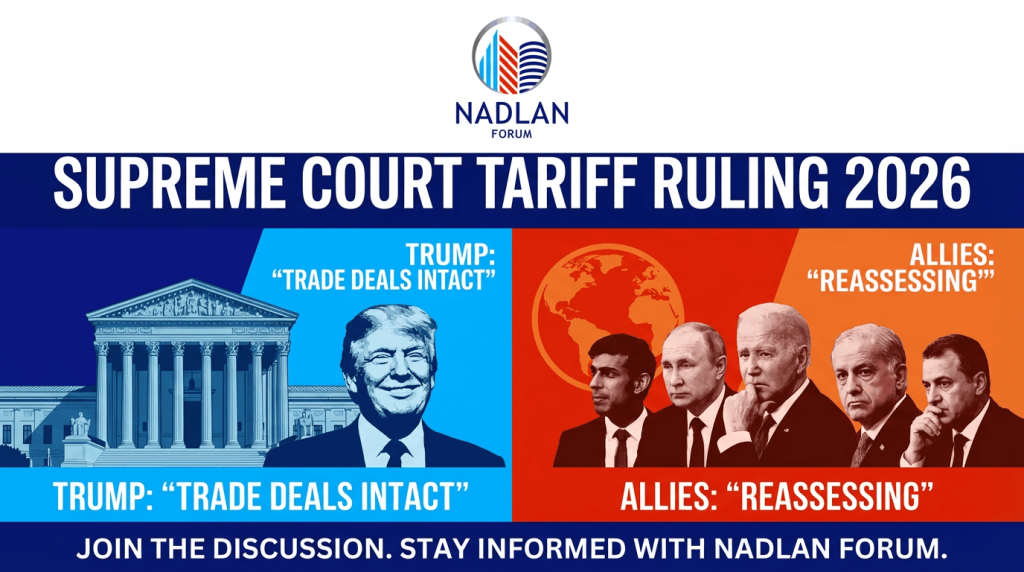
The Supreme Court tariff ruling 2026 has reshaped the legal foundation of President Donald Trump’s trade strategy, raising new questions about agreements negotiated over the past year.
Although Trump insists existing deals remain valid, several trading partners are taking a cautious approach as they review how the decision affects previously agreed tariff terms.
What the Court Decided
The Supreme Court of the United States ruled that the president exceeded his authority by using the International Emergency Economic Powers Act (IEEPA) to impose broad tariffs on imports from nearly every country.
The decision removed the legal basis for many of the emergency tariffs that were central to Trump’s trade negotiations.
Within days of the ruling, the administration imposed a new 10% tariff under Section 122 of the Trade Act of 1974. Trump has also signaled the possibility of raising that rate to 15%, though no firm timeline has been announced.
Trade Deals Now in Question
Many bilateral agreements reached over the past year were built around tariff rates established under IEEPA. With that authority struck down, governments are reviewing whether concessions they made still apply.
Johannes Fritz, CEO of the St. Gallen Endowment for Prosperity through Trade, noted that several countries agreed to specific trade terms in exchange for IEEPA-based tariff treatment. Without that legal structure, the agreements may need to be revised.
Future actions could rely on Section 301 of the Trade Act of 1974, which requires a formal investigation by the U.S. Trade Representative before tariffs are imposed. That process takes time and could delay further changes.
Mixed Global Reaction
Several countries appear to be reassessing their positions.
India paused plans to finalize an interim agreement ahead of high-level talks in Washington. Officials said they are waiting for more clarity before proceeding.
The European Parliament postponed a vote on a trade arrangement that would have set a 15% U.S. tariff rate on most European goods. European lawmakers have expressed concern that the latest 10% tariff could conflict with earlier understandings.
Canada responded more positively, with leaders in provinces such as Ontario and British Columbia calling the ruling a constructive development.
Meanwhile, Japan, which previously secured a deal lowering reciprocal tariffs to 15% in exchange for a large investment pledge, may now question whether those concessions were necessary if the universal tariff rate applies more broadly.
China signaled it would evaluate the court’s decision before adjusting its own countermeasures. Officials indicated they remain open to negotiation during upcoming talks.
Trump Stands Firm
During his recent address to Congress, Trump defended his trade agenda and warned countries not to withdraw from agreements.
He said that any country attempting to renegotiate could face higher duties under other trade laws. In public remarks and social media posts, he suggested that new investigations under Section 301 and Section 232 of the Trade Expansion Act of 1962 are possible.
Section 232 allows tariffs on imports deemed a national security threat, providing another potential pathway for the administration.
U.S. Trade Representative Jamieson Greer has also indicated that additional investigations may begin soon.
Legal and Economic Uncertainty
Jennifer Hillman, senior fellow for trade and international political economy at the Council on Foreign Relations, said the current tariff environment remains fluid.
She noted that many trade frameworks negotiated in recent months are not fully binding and have not been approved by Congress. As a result, adjustments could occur gradually.
The broader concern is that uncertainty may persist. Businesses and investors are watching closely, as shifting tariff rules can affect supply chains, pricing, and long-term planning.
What Happens Next?
The administration appears to be developing a “Plan B” that relies on other sections of trade law. However, replacing the scope and speed of IEEPA-based tariffs will require formal procedures and new investigations.
Foreign governments are largely in a wait-and-see mode, balancing the risk of retaliation against the desire to maintain stable trade ties.
Markets have responded cautiously, reflecting uncertainty about how durable existing agreements are under the new legal framework.
Bottom Line
The Supreme Court tariff ruling 2026 has altered the legal basis for key parts of U.S. trade policy. While President Trump says trade deals remain secure, many global partners are reassessing their positions.
Future tariffs may still be imposed under different laws, but the process could take time. Until a clear path emerges, trade negotiations and global markets are likely to remain in a period of adjustment. For direct financing consultations or mortgage options for you visit 👉 Nadlan Capital Group.
























Responses