
US Employment Data February 2026: Payroll Growth, Hiring Trends and Risks

The February 2026 jobs report will be released Friday morning, and economists expect it to show that the U.S. labor market remains steady but far from strong. The monthly employment report from the U.S. Bureau of Labor Statistics is scheduled for release at 8:30 a.m. Eastern Time, offering a fresh look at hiring activity, unemployment trends, and the overall health of the labor market.
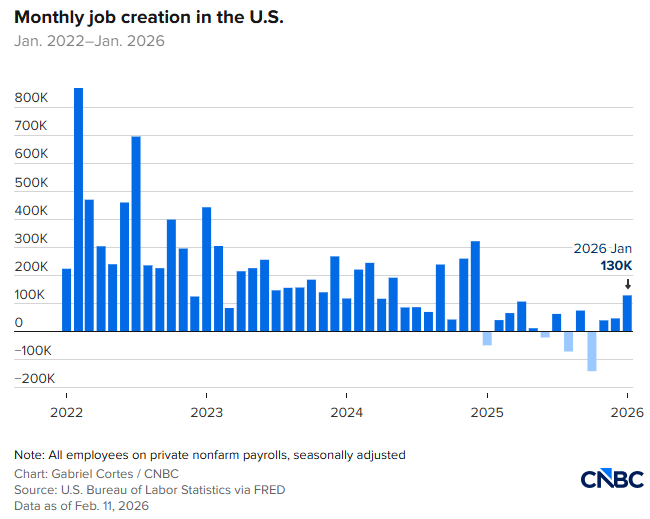
Current forecasts suggest the economy added around 50,000 jobs in February, a noticeable slowdown compared with the 130,000 jobs added in January. Economists also expect the unemployment rate to remain at 4.3%, indicating that the labor market is holding steady despite weak hiring momentum.
While the numbers may point to stability on the surface, a deeper look suggests the job market still faces several structural challenges.
A Labor Market With Low Hiring and Low Layoffs
One of the defining trends of the current labor market is what analysts call a “low-hire, low-fire” environment. Companies appear reluctant to make major staffing changes. On one hand, businesses are not cutting large numbers of workers. On the other hand, many employers are also hesitant to expand their workforce.
This cautious approach is largely driven by economic uncertainty. Businesses continue to watch several factors closely, including inflation pressures, trade policies, geopolitical risks, and interest rates. Until there is clearer direction in these areas, many firms prefer to hold onto existing employees rather than aggressively hiring new ones.
As a result, the labor market remains active but slow, with modest job gains rather than strong expansion.
Why Expectations Have Shifted in 2026
Even though hiring has been weak for some time, economists say the outlook for the labor market has improved slightly compared with last year. The key reason is that expectations have changed.
In 2025, concerns about slowing job growth raised fears of a possible recession. However, in 2026, many economists believe slower hiring may simply reflect limited labor supply rather than falling demand.
Stricter immigration policies and slower population growth have reduced the expansion of the workforce. Because fewer workers are entering the labor pool, even modest job growth can keep the unemployment rate stable.
Some economists view this shift as a sign that the labor market is adjusting rather than weakening.
However, others remain cautious.
Several analysts point out that the hiring rate remains unusually low, which could become a problem if economic conditions change. If companies suddenly begin reducing staff, the labor market may have limited capacity to absorb displaced workers.
Job Growth Concentrated in One Sector
Another concern about the labor market is that job growth has become heavily concentrated in specific industries, particularly health care.
Throughout 2025, most employment gains came from health care and social assistance sectors. Without these industries, overall job growth would have been nearly flat.
The trend continued in January. Health care added about 82,000 jobs, while social assistance contributed around 42,000 jobs. Together, these sectors accounted for nearly all the job gains reported that month.
Meanwhile, other parts of the economy showed little improvement. Some industries even experienced declines.
For example, construction employment fell by about 88,000 jobs during 2025, despite government efforts aimed at boosting the sector through tariff policies designed to support domestic production.
This uneven distribution of job growth has raised questions about the long-term strength of the labor market. Economists say a healthy job market usually shows expansion across many industries, not just one or two.
Technology Sector Facing New Pressure
The technology sector is another area facing change, particularly due to the rapid development of artificial intelligence.
Many companies are exploring ways to automate tasks and improve productivity through AI tools. While this may increase efficiency, it could also reduce demand for certain types of jobs.
Recently, a major technology company announced plans to cut about 40% of its workforce, citing artificial intelligence and automation as key reasons behind the restructuring. The decision sparked renewed debate about how AI may reshape the labor market in the coming years.
Some economists believe AI will eventually create new roles, while others warn that the transition could lead to job losses in the short term.
February Payroll Data May Be Distorted
The February employment report may also be affected by a temporary factor: a strike involving health care workers at Kaiser Permanente.
The labor dispute involved around 31,000 employees in California and Hawaii and occurred during the period used by the Bureau of Labor Statistics to collect employment data.
Although the strike ended on February 23, the timing means it could reduce the number of jobs reported in the health care sector for the month.
Because of this, some analysts expect the payroll figure to come in slightly lower than the consensus estimate. One major bank forecasts that February payroll growth could be closer to 35,000 jobs, rather than the expected 50,000.
Importantly, economists believe the strike will likely have little effect on the unemployment rate, since most of the affected workers remained employed but temporarily off the job.
What the February Jobs Report Means for the Economy
The February jobs report will provide an important signal about the direction of the U.S. economy in 2026.
If payroll growth comes in near expectations and unemployment remains stable, it would reinforce the view that the labor market is steady but slow. That scenario could support the idea that the economy is expanding gradually without overheating.
However, if job growth drops sharply below expectations, it may raise concerns about weakening demand for workers.
Investors, policymakers, and business leaders will watch the data closely, especially as the Federal Reserve continues evaluating interest rate decisions and broader economic conditions.
For now, the central theme of the labor market remains clear: employment is stable, but strong job growth has yet to return. For direct financing consultations or mortgage options for you visit 👉 Nadlan Capital Group.

















Responses