
Mortgage Rates Drop to Recent Lows: Housing Market Shows Signs of Growth

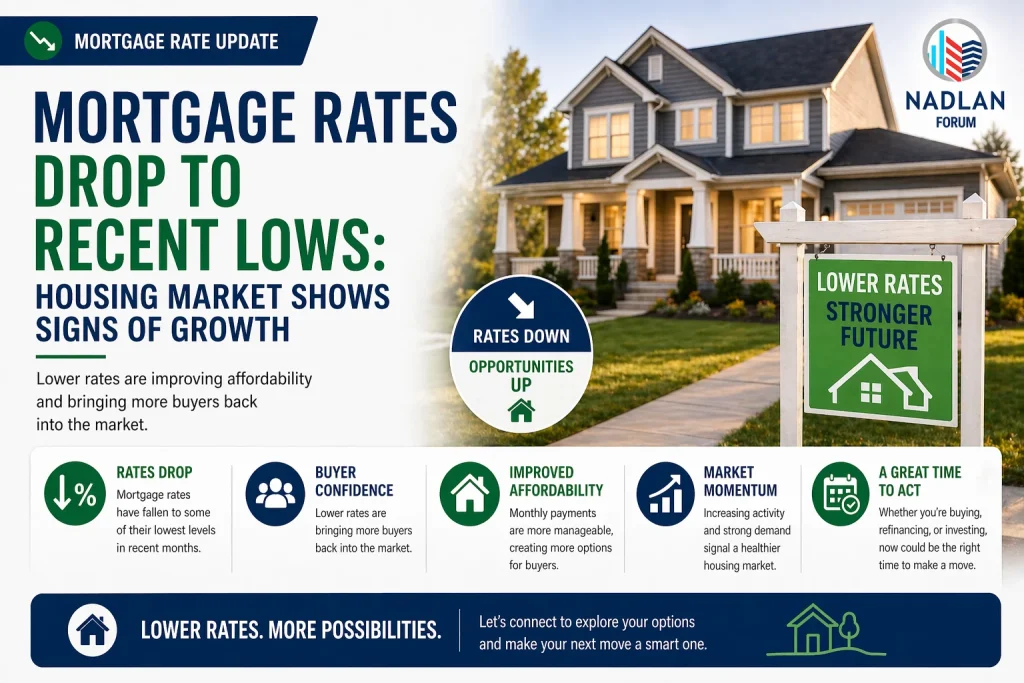
Mortgage rates in the United States have moved lower again, reaching their lowest level seen during the last three spring homebuying seasons. This decline is giving both buyers and homeowners more opportunities as the housing market begins to show signs of renewed activity.
Recent data shows that the average 30-year fixed mortgage rate is now around 6.23%, down from 6.3% just one week earlier. This drop comes as financial markets respond positively to global developments and improving economic outlook.
Lower Rates Bring More Activity in Housing Market
With borrowing costs easing, more people are entering the housing market. Recent reports highlight a clear increase in buyer and refinancing activity:
- Mortgage applications for home purchases increased by 10% last week
- Refinancing applications rose by 6%
- New home listings went up by 3% over the past four weeks
These changes suggest that buyers are starting to respond to slightly better conditions, leading to what some analysts describe as a small seasonal rebound.
Current Mortgage Rates (April 2026)
Based on the latest national averages, mortgage rates are as follows:
- 30-year fixed: 6.10%
- 20-year fixed: 6.05%
- 15-year fixed: 5.56%
- 5/1 adjustable-rate mortgage (ARM): 6.20%
- 7/1 ARM: 5.99%
- 30-year VA loan: 5.60%
- 15-year VA loan: 5.23%
- 5/1 VA loan: 5.16%
These rates are averages and may vary depending on lender, borrower profile, and loan details.
Current Refinance Rates
For homeowners considering refinancing, current rates are:
- 30-year fixed refinance: 6.13%
- 20-year fixed refinance: 6.16%
- 15-year fixed refinance: 5.60%
- 5/1 ARM refinance: 5.97%
- 7/1 ARM refinance: 6.02%
- 30-year VA refinance: 5.51%
- 15-year VA refinance: 5.06%
- 5/1 VA refinance: 5.42%
Refinance rates are often slightly higher than purchase rates, but this can vary depending on market conditions.
How Mortgage Rates Affect Monthly Payments
Even small changes in mortgage rates can significantly impact monthly payments. A lower rate reduces the total interest paid over time and can make homeownership more affordable.
When estimating your monthly payment, it is important to include:
- Loan amount
- Interest rate
- Property taxes
- Insurance
- Additional costs like HOA fees
Understanding the full cost helps buyers make better decisions and avoid surprises later.
Fixed vs Adjustable Mortgage Rates
There are two main types of mortgage rates:
Fixed-rate mortgage
A fixed rate stays the same for the entire loan term. This option provides stability and predictable monthly payments.
Adjustable-rate mortgage (ARM)
An ARM starts with a fixed rate for a set period, then adjusts periodically. For example, a 5/1 ARM keeps the same rate for five years before changing annually.
Borrowers who plan to stay in a home for a shorter period may consider an ARM, while long-term buyers often prefer fixed rates for consistency.
What Determines Mortgage Rates?
Mortgage rates depend on both personal and economic factors.
Factors you can control:
- Credit score
- Debt-to-income ratio
- Down payment size
- Choice of lender
Borrowers with stronger financial profiles usually receive better rates.
Factors you cannot control:
- Inflation
- Employment trends
- Federal Reserve policy
- Overall economic conditions
When the economy slows, rates often decrease to encourage borrowing. When growth is strong, rates may rise to control inflation.
30-Year vs 15-Year Mortgage: Key Differences
The two most common mortgage terms offer different benefits:
30-year mortgage
- Lower monthly payments
- Higher total interest over time
15-year mortgage
- Higher monthly payments
- Lower interest costs overall
- Faster loan payoff
Choosing between the two depends on budget and long-term financial goals.
Common Questions About Mortgage Rates
Which lenders offer the lowest rates?
Large banks like Chase and Citibank often provide competitive rates, but it is important to compare multiple lenders, including credit unions and online providers.
Is 2.75% a good mortgage rate?
Yes, but rates that low were mostly available in 2020–2021. It is unlikely to see those levels again soon under current market conditions.
What is the lowest mortgage rate ever recorded?
The lowest average for a 30-year mortgage was about 2.65% in early 2021.
When should you refinance?
Many experts suggest refinancing when you can lower your rate by at least 1% to 2%, but the decision also depends on closing costs and how long you plan to stay in your home.
Final Outlook
The recent drop in mortgage rates is helping bring more balance to the housing market. Increased buyer activity, rising listings, and stronger refinance demand all point to improving conditions.
While rates are still higher than the record lows seen in previous years, the current trend offers a better opportunity for buyers and homeowners compared to recent months.
Going forward, economic conditions and global events will continue to influence where mortgage rates move next. For direct financing consultations or mortgage options for you visit 👉 Nadlan Capital Group.























Responses